How to Tell a Story
A free B2-level English story for language learners, readable online in 7 languages, with an option to listen via the free Storyteller app.
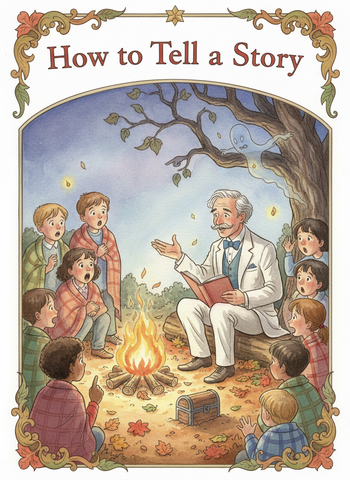
Mark Twain breaks down the secret art of the American humorous story — deadpan delivery, a buried punchline, and a perfectly timed pause — then proves his point with his own spine-tingling campfire tale.
The Humorous Story an American Development.—Its Difference from Comic and Witty Stories.
A História Humorística, uma Criação Americana. Sua Diferença em Relação às Histórias Cômicas e Espirituosas.
I do not claim that I can tell a story as it ought to be told. I only claim to know how a story ought to be told, for I have been almost daily in the company of the most expert story-tellers for many years.
Não afirmo que sei contar uma história como ela deveria ser contada. Afirmo apenas saber como uma história deveria ser contada, pois convivi quase diariamente, por muitos anos, com os mais hábeis contadores de histórias.
There are several kinds of stories, but only one difficult kind—the humorous. I will talk mainly about that one. The humorous story is American, the comic story is English, the witty story is French. The humorous story depends for its effect upon the manner of the telling; the comic story and the witty story upon the matter.
Há várias espécies de histórias, mas apenas uma é difícil: a humorística. Falarei principalmente sobre essa. A história humorística é americana, a história cômica é inglesa, a história espirituosa é francesa. A história humorística depende, para seu efeito, do modo de contar; a história cômica e a espirituosa dependem do conteúdo.
The humorous story may be spun out to great length, and may wander around as much as it pleases, and arrive nowhere in particular; but the comic and witty stories must be brief and end with a point. The humorous story bubbles gently along, the others burst.
A história humorística pode se alongar bastante, e pode divagar quanto quiser, sem chegar a lugar nenhum em particular; mas as histórias cômica e espirituosa devem ser breves e terminar com uma piada certeira. A história humorística borbulha suavemente ao longo do caminho; as outras explodem.
The humorous story is strictly a work of art—high and delicate art—and only an artist can tell it; but no art is necessary in telling the comic and the witty story; anybody can do it. The art of telling a humorous story—understand, I mean by word of mouth, not print—was created in America, and has remained at home.
A história humorística é estritamente uma obra de arte, uma arte elevada e delicada, e só um artista sabe contá-la; mas nenhuma arte é necessária para contar a história cômica ou a espirituosa; qualquer um consegue fazê-lo. A arte de contar uma história humorística, entenda-se, de viva voz, não impressa, foi criada na América, e nela permaneceu.
The humorous story is told gravely; the teller does his best to conceal the fact that he even dimly suspects that there is anything funny about it; but the teller of the comic story tells you beforehand that it is one of the funniest things he has ever heard, then tells it with eager delight, and is the first person to laugh when he gets through. And sometimes, if he has had good success, he is so glad and happy that he will repeat the “nub” of it and glance around from face to face, collecting applause, and then repeat it again. It is a pathetic thing to see.
A história humorística é contada com gravidade; o narrador faz o possível para esconder o fato de que sequer suspeita vagamente que haja algo de engraçado nela; mas o contador da história cômica avisa antecipadamente que é uma das coisas mais engraçadas que já ouviu, depois a conta com ávido entusiasmo, e é o primeiro a rir quando termina. E, às vezes, se teve bom êxito, fica tão contente e feliz que repete o "âmago" da piada, olhando de rosto em rosto para colher aplausos, e então a repete de novo. É uma coisa patética de se ver.
Very often, of course, the rambling and disjointed humorous story finishes with a nub, point, snapper, or whatever you like to call it. Then the listener must be alert, for in many cases the teller will divert attention from that nub by dropping it in a carefully casual and indifferent way, with the pretence that he does not know it is a nub.
Muitas vezes, é claro, a história humorística, divagante e desconexa, termina com um âmago, um golpe final, um estalo, ou seja lá como você queira chamá-lo. Então o ouvinte precisa estar atento, pois em muitos casos o narrador desviará a atenção desse ponto final, deixando-o cair de um jeito cuidadosamente casual e indiferente, fingindo não saber que aquilo é o ponto alto.
Artemus Ward used that trick a good deal; then when the belated audience presently caught the joke he would look up with innocent surprise, as if wondering what they had found to laugh at. Dan Setchell used it before him, Nye and Riley and others use it to-day.
Artemus Ward usava bastante esse truque; então, quando a plateia atrasada finalmente captava a piada, ele erguia os olhos com inocente surpresa, como se se perguntasse do que estavam rindo. Dan Setchell o usou antes dele, e Nye, Riley e outros o usam hoje.
But the teller of the comic story does not slur the nub; he shouts it at you—every time. And when he prints it, in England, France, Germany, and Italy, he italicizes it, puts some whooping exclamation-points after it, and sometimes explains it in a parenthesis. All of which is very depressing, and makes one want to renounce joking and lead a better life.
Mas o contador da história cômica não disfarça o ponto alto; ele o grita para você, toda vez. E quando o imprime, na Inglaterra, na França, na Alemanha e na Itália, coloca-o em itálico, acrescenta alguns pontos de exclamação bem escandalosos depois dele, e às vezes ainda o explica entre parênteses. Tudo isso é bastante deprimente, e dá vontade de renunciar às piadas e levar uma vida melhor.
Let me set down an instance of the comic method, using an anecdote which has been popular all over the world for twelve or fifteen hundred years. The teller tells it in this way:
Deixe-me registrar um exemplo do método cômico, usando uma anedota que tem sido popular pelo mundo todo há doze ou quinze séculos. O narrador a conta desta forma:
THE WOUNDED SOLDIER.
O SOLDADO FERIDO.
In the course of a certain battle a soldier whose leg had been shot off appealed to another soldier who was hurrying by to carry him to the rear, informing him at the same time of the loss which he had sustained; whereupon the generous son of Mars, shouldering the unfortunate, proceeded to carry out his desire. The bullets and cannon-balls were flying in all directions, and presently one of the latter took the wounded man's head off—without, however, his deliverer being aware of it. In no long time he was hailed by an officer, who said:
No decorrer de certa batalha, um soldado que tivera a perna decepada por um tiro pediu a outro soldado, que passava apressado, que o carregasse para a retaguarda, informando-o ao mesmo tempo da perda que havia sofrido; ao que o generoso filho de Marte, carregando o infortunado nos ombros, pôs-se a atender seu pedido. As balas e as bolas de canhão voavam em todas as direções, e logo uma destas últimas arrancou a cabeça do ferido, sem que, no entanto, seu socorrista percebesse. Não muito depois, foi interpelado por um oficial, que disse:
“Where are you going with that carcass?”
"Para onde você está levando essa carcaça?"
“To the rear, sir—he's lost his leg!”
"Para a retaguarda, senhor, ele perdeu a perna!"
“His leg, forsooth?” responded the astonished officer; “you mean his head, you booby.”
"A perna, francamente?", respondeu o oficial, espantado; "você quer dizer a cabeça, seu tolo."
Whereupon the soldier dispossessed himself of his burden, and stood looking down upon it in great perplexity. At length he said:
Ao que o soldado se desfez de seu fardo, e ficou olhando para ele com grande perplexidade. Por fim, disse:
“It is true, sir, just as you have said.” Then after a pause he added, “But he TOLD me IT WAS HIS LEG—”
"É verdade, senhor, exatamente como o senhor disse." Depois, após uma pausa, acrescentou: "Mas ele me DISSE que ERA A PERNA—"
Here the narrator bursts into explosion after explosion of thunderous horse-laughter, repeating that nub from time to time through his gaspings and shriekings and suffocatings.
Aqui o narrador estoura em explosão após explosão de estrondosas gargalhadas, repetindo esse ponto alto de tempos em tempos, entre suas ofegações, seus guinchos e seus sufocos.
It takes only a minute and a half to tell that in its comic-story form; and isn't worth the telling, after all. Put into the humorous-story form it takes ten minutes, and is about the funniest thing I have ever listened to—as James Whitcomb Riley tells it.
Leva apenas um minuto e meio para contar isso em sua forma de história cômica; e, no fim das contas, não vale a pena ser contada. Colocada na forma de história humorística, leva dez minutos, e é praticamente a coisa mais engraçada que já ouvi, do jeito que James Whitcomb Riley a conta.
He tells it in the character of a dull-witted old farmer who has just heard it for the first time, thinks it is unspeakably funny, and is trying to repeat it to a neighbor. But he can't remember it; so he gets all mixed up and wanders helplessly round and round, putting in tedious details that don't belong in the tale and only retard it; taking them out conscientiously and putting in others that are just as useless; making minor mistakes now and then and stopping to correct them and explain how he came to make them.
Ele a conta no papel de um velho fazendeiro de raciocínio lento, que acabou de ouvi-la pela primeira vez, acha-a inefavelmente engraçada, e está tentando repeti-la a um vizinho. Mas não consegue se lembrar dela; então se enrola todo e vagueia sem rumo, de um lado para outro, inserindo detalhes enfadonhos que não pertencem ao conto e só o atrasam; tirando-os conscienciosamente e colocando outros igualmente inúteis; cometendo pequenos erros de vez em quando e parando para corrigi-los e explicar como veio a cometê-los.
Remembering things which he forgot to put in in their proper place and going back to put them in there; stopping his narrative a good while in order to try to recall the name of the soldier that was hurt, and finally remembering that the soldier's name was not mentioned, and remarking placidly that the name is of no real importance, anyway—better, of course, if one knew it, but not essential, after all—and so on, and so on, and so on.
Lembrando-se de coisas que esqueceu de inserir no lugar próprio e voltando atrás para inseri-las ali; interrompendo sua narrativa por um bom tempo para tentar se lembrar do nome do soldado que se feriu, e finalmente se lembrando de que o nome do soldado nunca foi mencionado, e observando placidamente que o nome não tem nenhuma importância real, de qualquer forma, melhor, claro, se alguém o soubesse, mas não essencial, afinal, e assim por diante, e assim por diante.
The teller is innocent and happy and pleased with himself, and has to stop every little while to hold himself in and keep from laughing outright; and does hold in, but his body quakes in a jelly-like way with interior chuckles; and at the end of the ten minutes the audience have laughed until they are exhausted, and the tears are running down their faces.
O narrador está inocente e feliz e satisfeito consigo mesmo, e precisa parar a cada instante para se conter e evitar dar uma gargalhada franca; e consegue se conter, mas seu corpo treme como gelatina com risadinhas internas; e, ao fim dos dez minutos, a plateia riu até se exaurir, e as lágrimas escorrem por seus rostos.
The simplicity and innocence and sincerity and unconsciousness of the old farmer are perfectly simulated, and the result is a performance which is thoroughly charming and delicious. This is art and fine and beautiful, and only a master can compass it; but a machine could tell the other story.
A simplicidade, a inocência, a sinceridade e a inconsciência do velho fazendeiro são perfeitamente simuladas, e o resultado é uma performance absolutamente encantadora e deliciosa. Isto é arte, fina e bela, e só um mestre consegue realizá-la; mas uma máquina poderia contar a outra história.
To string incongruities and absurdities together in a wandering and sometimes purposeless way, and seem innocently unaware that they are absurdities, is the basis of the American art, if my position is correct. Another feature is the slurring of the point. A third is the dropping of a studied remark apparently without knowing it, as if one were thinking aloud. The fourth and last is the pause.
Encadear incongruências e absurdos, de forma divagante e às vezes sem propósito, e parecer inocentemente inconsciente de que são absurdos, é a base da arte americana, se minha tese estiver correta. Outra característica é a disfarçada do ponto alto. Uma terceira é deixar cair um comentário estudado como que sem perceber, como se alguém estivesse pensando em voz alta. A quarta e última é a pausa.
Artemus Ward dealt in numbers three and four a good deal. He would begin to tell with great animation something which he seemed to think was wonderful; then lose confidence, and after an apparently absent-minded pause add an incongruous remark in a soliloquizing way; and that was the remark intended to explode the mine—and it did.
Artemus Ward lidava bastante com o terceiro e o quarto recursos. Ele começava a contar, com grande animação, algo que parecia achar maravilhoso; depois perdia a confiança, e, após uma pausa aparentemente distraída, acrescentava um comentário incongruente, como quem solilóquia; e esse era o comentário destinado a detonar a mina, e detonava.
For instance, he would say eagerly, excitedly, “I once knew a man in New Zealand who hadn't a tooth in his head”—here his animation would die out; a silent, reflective pause would follow, then he would say dreamily, and as if to himself, “and yet that man could beat a drum better than any man I ever saw.”
Por exemplo, ele dizia, ansioso, empolgado: "Certa vez conheci um homem na Nova Zelândia que não tinha um único dente na boca", aqui sua animação se esvaía; seguia-se uma pausa silenciosa e reflexiva, e então ele dizia, sonhador, como que para si mesmo, "e, no entanto, aquele homem sabia tocar tambor melhor do que qualquer outro que eu já vi."
The pause is an exceedingly important feature in any kind of story, and a frequently recurring feature, too. It is a dainty thing, and delicate, and also uncertain and treacherous; for it must be exactly the right length—no more and no less—or it fails of its purpose and makes trouble. If the pause is too short the impressive point is passed, and [and if too long] the audience have had time to divine that a surprise is intended—and then you can't surprise them, of course.
A pausa é um elemento extremamente importante em qualquer tipo de história, e também um elemento frequente. É uma coisa delicada e sutil, e também incerta e traiçoeira; pois precisa ter exatamente a duração certa, nem mais, nem menos, ou falha em seu propósito e causa problemas. Se a pausa é curta demais, o ponto impressionante passa despercebido, e se longa demais, a plateia já teve tempo de adivinhar que uma surpresa está por vir, e então, é claro, você não consegue mais surpreendê-la.
On the platform I used to tell a negro ghost story that had a pause in front of the snapper on the end, and that pause was the most important thing in the whole story. If I got it the right length precisely, I could spring the finishing ejaculation with effect enough to make some impressible girl deliver a startled little yelp and jump out of her seat—and that was what I was after. This story was called “The Golden Arm,” and was told in this fashion. You can practise with it yourself—and mind you look out for the pause and get it right.
No palco, eu costumava contar uma história de fantasma que tinha uma pausa logo antes do golpe final, e essa pausa era a coisa mais importante de toda a história. Se eu acertasse a duração exata, conseguia soltar a exclamação final com efeito suficiente para fazer alguma moça impressionável soltar um gritinho assustado e pular da cadeira, e era exatamente isso que eu buscava. Essa história se chamava "O Braço de Ouro", e era contada da seguinte forma. Você pode praticá-la você mesmo, mas cuidado com a pausa, e acerte-a bem.
THE GOLDEN ARM.
O BRAÇO DE OURO.
Once 'pon a time dey wuz a monsus mean man, en he live 'way out in de prairie all 'lone by hisself, 'cep'n he had a wife. En bimeby she died, en he tuck en toted her way out dah in de prairie en buried her. Well, she had a golden arm—all solid gold, fum de shoulder down. He wuz pow'ful mean—pow'ful; en dat night he couldn't sleep, Gaze he want dat golden arm so bad.
Era uma vez um homem terrivelmente mau, que morava lá longe na pradaria, sozinho, só ele, exceto que tinha uma esposa. E, com o tempo, ela morreu, e ele a carregou lá para a pradaria e a enterrou. Pois bem, ela tinha um braço de ouro, todo de ouro maciço, do ombro para baixo. Ele era terrivelmente mau, terrivelmente; e naquela noite não conseguia dormir, de tanto que queria aquele braço de ouro.
When it come midnight he couldn't stan' it no mo'; so he git up, he did, en tuck his lantern en shoved out thoo de storm en dug her up en got de golden arm; en he bent his head down 'gin de win', en plowed en plowed en plowed thoo de snow. Den all on a sudden he stop (make a considerable pause here, and look startled, and take a listening attitude) en say: “My LAN', what's dat!”
Quando bateu meia-noite, ele não aguentou mais; então se levantou, pegou sua lanterna e se lançou para fora, através da tempestade, desenterrou-a e apanhou o braço de ouro; e, curvando a cabeça contra o vento, foi abrindo caminho, e abrindo, e abrindo, através da neve. Então, de repente, ele parou (faça uma pausa considerável aqui, e mostre-se assustado, com uma postura de quem está escutando) e disse: "Minha nossa, o que é isso!"
En he listen—en listen—en de win' say (set your teeth together and imitate the wailing and wheezing singsong of the wind), “Bzzz-z-zzz”—en den, way back yonder whah de grave is, he hear a voice! he hear a voice all mix' up in de win' can't hardly tell 'em 'part—“Bzzz-zzz—W-h-o—g-o-t—m-y—g-o-l-d-e-n arm?—zzz—zzz—W-h-o g-o-t m-y g-o-l-d-e-n arm!” (You must begin to shiver violently now.)
E ele escutou, e escutou, e o vento dizia (aperte os dentes e imite o gemido cantante do vento) "Bzzz-z-zzz", e então, lá longe, de onde estava a sepultura, ele ouviu uma voz! Ouviu uma voz toda misturada com o vento, mal se conseguia distinguir uma coisa da outra, "Bzzz-zzz—Q-u-e-m—l-e-v-o-u—m-e-u—b-r-a-ç-o—d-e—o-u-r-o?—zzz—zzz—Q-u-e-m l-e-v-o-u m-e-u b-r-a-ç-o d-e o-u-r-o!" (Você deve começar a tremer violentamente agora.)
En he begin to shiver en shake, en say, “Oh, my! OH, my lan'!” en de win' blow de lantern out, en de snow en sleet blow in his face en mos' choke him, en he start a-plowin' knee-deep towards home mos' dead, he so sk'yerd—en pooty soon he hear de voice agin, en (pause) it 'us comin' after him! “Bzzz—zzz—zzz—W-h-o—g-o-t m-y—g-o-l-d-e-n—arm?”
E ele começou a tremer e a estremecer, e disse: "Ai, meu Deus! Ai, minha nossa!", e o vento apagou a lanterna, e a neve e o gelo bateram em seu rosto e quase o sufocaram, e ele partiu a caminho de casa, abrindo caminho na neve até os joelhos, quase morto de tanto medo, e logo depois ouviu a voz de novo, e (pausa) ela vinha atrás dele! "Bzzz—zzz—zzz—Q-u-e-m—l-e-v-o-u m-e-u—b-r-a-ç-o—d-e—o-u-r-o?"
When he git to de pasture he hear it agin closter now, en a-comin'!—a-comin' back dah in de dark en de storm—(repeat the wind and the voice). When he git to de house he rush up-stairs en jump in de bed en kiver up, head and years, en lay dah shiverin' en shakin'—en den way out dah he hear it agin!—en a-comin'! En bimeby he hear (pause—awed, listening attitude)—pat—pat—pat—hit's acomin' up-stairs! Den he hear de latch, en he know it's in de room!
Quando ele chegou ao pasto, ouviu-a de novo, mais perto agora, e vindo!, vindo de volta ali na escuridão e na tempestade (repita o vento e a voz). Quando chegou em casa, subiu correndo as escadas, pulou na cama e se cobriu, cabeça e orelhas, e ficou ali tremendo e estremecendo, e então, lá longe, ele a ouviu de novo!, e vindo! E logo depois ouviu (pausa, atitude de assombro, escutando) — pat — pat — pat — estava subindo as escadas! Então ele ouviu a tranca, e soube que estava no quarto!
Den pooty soon he know it's a-stannin' by de bed! (Pause.) Den—he know it's a-bendin' down over him—en he cain't skasely git his breath! Den—den—he seem to feel someth' n c-o-l-d, right down 'most agin his head! (Pause.)
Então, logo depois, soube que estava parada ao lado da cama! (Pausa.) Então, soube que estava se inclinando sobre ele, e ele mal conseguia respirar! Então, então, pareceu sentir algo f-r-i-o, bem perto de sua cabeça! (Pausa.)
Den de voice say, right at his year—“W-h-o g-o-t—m-y—g-o-l-d-e-n arm?” (You must wail it out very plaintively and accusingly; then you stare steadily and impressively into the face of the farthest-gone auditor—a girl, preferably—and let that awe-inspiring pause begin to build itself in the deep hush. When it has reached exactly the right length, jump suddenly at that girl and yell, “You've got it!”)
Então a voz disse, bem junto ao seu ouvido: "Q-u-e-m—l-e-v-o-u—m-e-u—b-r-a-ç-o—d-e—o-u-r-o?" (Você deve gemer isso de forma bem plangente e acusadora; então encare fixamente e com intensidade o rosto do ouvinte mais absorto, de preferência uma moça, e deixe que essa pausa de assombro se construa naquele profundo silêncio. Quando tiver alcançado exatamente a duração certa, salte de repente na direção da moça e grite: "VOCÊ está com ele!")
If you've got the pause right, she'll fetch a dear little yelp and spring right out of her shoes. But you must get the pause right; and you will find it the most troublesome and aggravating and uncertain thing you ever undertook.
Se você acertar a pausa, ela soltará um adorável gritinho e pulará para fora dos sapatos. Mas você precisa acertar a pausa; e vai achar isso a coisa mais incômoda, irritante e incerta que já tentou fazer.
