The Allocation Queue
A free C1-level English story for language learners, readable online in English, with an option to listen via the free Storyteller app.
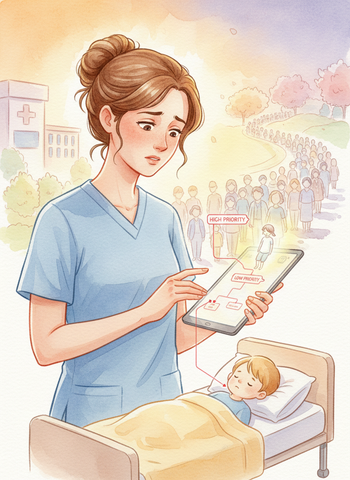
A transplant coordinator finds a childhood friend ranked low on an organ allocation algorithm and must decide how to correct a possible error without letting personal loyalty compromise the process.
Ingrid had reviewed thousands of names on the transplant allocation system without once feeling the ground shift under her, which was precisely the job. The algorithm ranked candidates by projected outcome, distance to the donor hospital, and time already waited. Her role was to confirm the ranking, not to feel anything about it. Then, on a Tuesday like any other, the name three lines from the top was Petra Lindqvist, and Ingrid sat very still for a moment before scrolling back up to check she hadn't misread it.
She had not. Petra had taught her to ride a bike on a gravel road neither of their mothers ever found out about. She had sent a single dry text the day Ingrid's marriage ended and nothing else, because Petra had always known when silence was the more useful gift. Now she was seventh on a list where the kidney would go to the first eligible match. Seventh, Ingrid saw at a glance, because of a compatibility score that looked lower than it should have, given what she remembered of Petra's blood type from a hospital visit years before this system existed.
She could have said nothing. Had she simply approved the ranking as it stood, no one would ever have known she'd hesitated, and the day would have proceeded exactly as every other day proceeded. What stopped her was not loyalty so much as the specific, ordinary possibility that the number was wrong. It was not falsified, just wrong — the way a lab value gets mistyped at three in the morning by someone at the end of a double shift.
Cross-checking the source record took forty minutes she didn't officially have. There it was: a transposed digit in an antibody panel, entered eleven days earlier, sitting quietly beneath a ranking that had already been generated and re-run twice without anyone catching it. Correcting it would move Petra up to second. It would also, Ingrid understood immediately, look — to anyone reviewing the log later — exactly like a coordinator adjusting a score for someone she knew.
What she did next was the part she was proudest of, and also the part that cost her the most. Rather than fixing the figure herself, quietly, the way she could have and no one would likely have checked, she flagged the discrepancy through the formal data-correction channel. She recused herself from Petra's case entirely and let a colleague in another building verify and re-enter the value. It added six hours to a process where hours occasionally mattered more than anything else did.
Petra received the kidney two days later, from a different, better-matched donor than the one Ingrid had first seen her ranked against. It was proof, if she'd needed any, that the system had simply been waiting on a correct number all along. Ingrid did not tell her, that week or for months afterward, how close the whole thing had come to depending on who she happened to know.
