The Fantasy League Tiebreaker
A free C1-level English story for language learners, readable online in English, with an option to listen via the free Storyteller app.
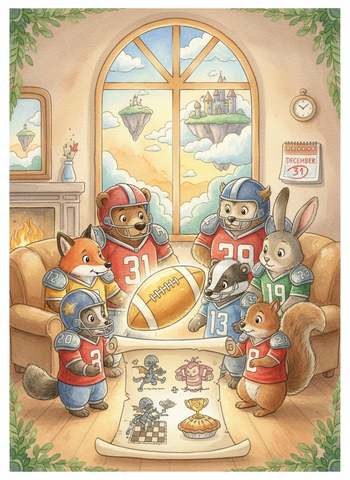
An exact tie in a friend group's fantasy football league forces them to use an absurd nine-year-old tiebreaker rule nobody ever expected to need.
Cormac had written the fantasy football league's constitution nine years ago, half as a joke, and had spent every year since defending clauses nobody else remembered agreeing to.
This year, for the first time in league history, the season ended in an exact tie between Ansel and Solveig, both finishing with identical records and, improbably, identical total points down to the decimal. The group chat, usually dormant between seasons, exploded with theories about what should happen next.
"There's a tiebreaker rule," Cormac announced, with the quiet satisfaction of a man who had been waiting nine years for this exact moment. "Section 4, Subsection C. Nobody's ever needed it before."
He read it aloud. In the event of an exact tie, the champion would be decided by whichever finalist's team, at any point that season, had benched the most total points by accident.
Nobody could quite believe this was a real rule, and yet there it was, in a document four of them had technically signed. Clem, who had opted out of the league entirely this year, was nonetheless pulled back in as the self-appointed auditor. Her task was combing through nine months of lineup history to determine who had made more costly mistakes.
Had Cormac written a simpler rule back then, none of what followed would have taken three full days. Instead, Clem produced a spreadsheet so detailed that Ansel accused her, only half joking, of enjoying his failures a little too much.
"You benched your best receiver for six straight weeks," Clem told him, sharing her screen at their emergency video call. "That's four hundred and twelve wasted points. Solveig only wasted three hundred and ninety."
"So I lose," Ansel said, "because I was worse at my hobby than she was."
"You lose," Cormac confirmed, "because the rule I wrote nine years ago for a completely different, now-forgotten dispute has decided, entirely by accident, that incompetence is somehow the deciding factor in who gets the trophy."
What none of them could deny, once the numbers were in front of them, was how seriously all four had taken the game. There was no actual prize beyond a plastic trophy Cormac had bought secondhand years earlier. Solveig, newly crowned champion by a margin of twenty-two wasted points, accepted her win with a solemnity the moment did not remotely deserve.
"I'd like to thank," she said, holding an imaginary microphone, "my own laziness, for costing me slightly less than Ansel's."
Ansel demanded a rule change for next season. Cormac refused, on the grounds that a rule nobody had ever needed for nine years had finally proven itself, and precedent, he insisted, was precedent.
The trophy shipped to Solveig's apartment the following week, and she texted a photo of it sitting, absurdly, next to her actual diploma, with the caption: not sure which one I worked harder for.
