The Frosty Footprints
A free B1-level English story for language learners, readable online in English, with an option to listen via the free Storyteller app.
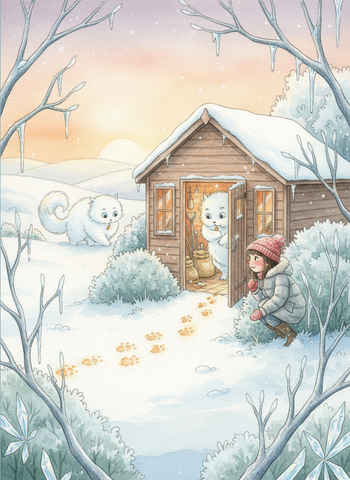
Strange footprints keep leading to Tessa's garden shed each frosty morning, and she stays up early to discover who has been using it.
Every morning this week, Tessa has noticed a strange set of footprints crossing her backyard. They are small and evenly spaced. They lead from the fence straight to the old garden shed and back again. The grass has been frosty since Monday, so the tracks show up clearly in the pale morning light.
At first, she assumes it's an animal, maybe a fox or a large cat. The footprints look too regular, though, almost like they belong to someone walking the same path on purpose. She mentions it to her mother, who laughs and suggests it's probably just the neighbor's dog.
Tessa isn't convinced. On Thursday, she wakes up earlier than usual and pulls a coat over her pajamas. She watches the shed from her bedroom window instead of going straight downstairs. At exactly 6:40, a boy climbs quietly over the fence from the house next door. He lets himself into the shed.
She recognizes him immediately: Kerem, from her math class. He moved in three weeks ago and has barely spoken to anyone at school. Curious rather than annoyed, Tessa pulls on her boots and walks out to the shed herself. She knocks gently on the wooden door.
Kerem opens it looking startled, a trumpet held awkwardly against his chest. "I practice here before school," he admits, clearly embarrassed. "My dad works night shifts and sleeps during the day, so I can't play without waking him."
Tessa realizes he has been using her family's old, mostly forgotten shed as a quiet practice space. He assumed nobody would notice this early. Rather than telling him to stop, she offers something better: a spare key. That way, he doesn't have to keep climbing the fence in the frost.
"Just don't tell my mom it was you," she says, smiling. "She's convinced it's the neighbor's dog, and honestly, that theory is more fun."
