The Skylight Room
A free C1-level English story for language learners, readable online in 7 languages, with an option to listen via the free Storyteller app.
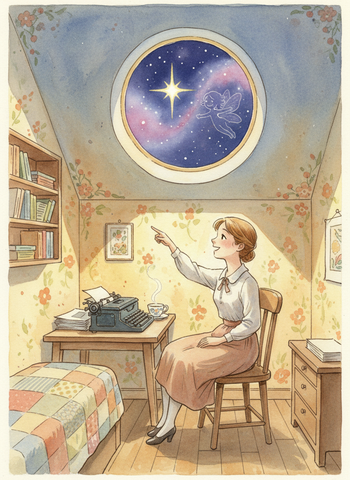
A cheerful young typist takes the cheapest, tiniest room in a boarding house and names a distant star after an imaginary friend to keep herself company.
First Mrs. Parker would show you the double parlours. You would not dare to interrupt her description of their advantages and of the merits of the gentleman who had occupied them for eight years. Then you would manage to stammer forth the confession that you were neither a doctor nor a dentist. Mrs. Parker’s manner of receiving the admission was such that you could never afterward entertain the same feeling toward your parents, who had neglected to train you up in one of the professions that fitted Mrs. Parker’s parlours.
Primeiro, a senhora Parker lhe mostraria os dois salões duplos. Você não ousaria interromper sua descrição das vantagens deles e dos méritos do cavalheiro que os ocupara por oito anos. Então você conseguiria gaguejar a confissão de que não era médico nem dentista. O jeito da senhora Parker de receber essa admissão era tal que você nunca mais conseguiria sentir o mesmo pelos seus pais, que haviam negligenciado educá-lo em uma das profissões que se ajustavam aos salões da senhora Parker.
Next you ascended one flight of stairs and looked at the second-floor-back at $8. Convinced by her second-floor manner that it was worth the $12 that Mr. Toosenberry always paid for it until he left to take charge of his brother’s orange plantation in Florida near Palm Beach, where Mrs. McIntyre always spent the winters that had the double front room with private bath, you managed to babble that you wanted something still cheaper.
Em seguida, você subia um lance de escadas e olhava o quarto dos fundos do segundo andar, por 8 dólares. Convencido pelo jeito do segundo andar de que valia os 12 dólares que o senhor Toosenberry sempre pagava por ele até partir para cuidar da plantação de laranjas de seu irmão na Flórida, perto de Palm Beach, onde a senhora McIntyre sempre passava os invernos, na sala dupla da frente com banheiro privativo, você conseguia balbuciar que queria algo ainda mais barato.
If you survived Mrs. Parker’s scorn, you were taken to look at Mr. Skidder’s large hall room on the third floor. Mr. Skidder’s room was not vacant. He wrote plays and smoked cigarettes in it all day long. But every room-hunter was made to visit his room to admire the lambrequins. After each visit, Mr. Skidder, from the fright caused by possible eviction, would pay something on his rent.
Se sobrevivesse ao desdém da senhora Parker, você era levado a ver o grande quarto de hóspedes do senhor Skidder no terceiro andar. O quarto do senhor Skidder não estava vago. Ele escrevia peças de teatro e fumava cigarros ali o dia todo. Mas todo caçador de quartos era obrigado a visitar seu quarto para admirar as sanefas. Depois de cada visita, o senhor Skidder, com o susto de uma possível expulsão, pagava alguma coisa do aluguel.
Then—oh, then—if you still stood on one foot, with your hot hand clutching the three moist dollars in your pocket, and hoarsely proclaimed your hideous and culpable poverty, nevermore would Mrs. Parker be cicerone of yours. She would honk loudly the word “Clara,” she would show you her back, and march downstairs. Then Clara, the coloured maid, would escort you up the carpeted ladder that served for the fourth flight, and show you the Skylight Room. It occupied 7×8 feet of floor space at the middle of the hall. On each side of it was a dark lumber closet or storeroom.
Então — ah, então — se você ainda estivesse parado sobre um pé só, com a mão suada apertando os três dólares úmidos no bolso, e proclamasse com voz rouca sua hedionda e culpável pobreza, nunca mais a senhora Parker seria sua guia. Ela gritaria bem alto o nome "Clara", viraria as costas para você, e desceria a escada. Então Clara, a criada negra, o escoltaria pela escada carpetada que servia de quarto lance, e lhe mostraria o Quarto da Clarabóia. Ele ocupava dois metros por dois e meio de piso, bem no meio do corredor. De cada lado havia um depósito ou despensa escuros.
In it was an iron cot, a washstand and a chair. A shelf was the dresser. Its four bare walls seemed to close in upon you like the sides of a coffin. Your hand crept to your throat, you gasped, you looked up as from a well—and breathed once more. Through the glass of the little skylight you saw a square of blue infinity.
Dentro havia uma cama de ferro, uma pia e uma cadeira. Uma prateleira fazia as vezes de cômoda. Suas quatro paredes nuas pareciam se fechar sobre você como as laterais de um caixão. Sua mão se erguia até a garganta, você ofegava, olhava para cima como do fundo de um poço — e respirava outra vez. Através do vidro da pequena clarabóia, você via um quadrado de infinito azul.
“Two dollars, suh,” Clara would say in her half-contemptuous, half-Tuskegeenial tones.
"Dois dólares, senhor," dizia Clara, num tom meio de desdém, meio de escola de boas maneiras.
One day Miss Leeson came hunting for a room. She carried a typewriter made to be lugged around by a much larger lady. She was a very little girl, with eyes and hair that had kept on growing after she had stopped and that always looked as if they were saying: “Goodness me! Why didn’t you keep up with us?”
Certo dia, a senhorita Leeson veio procurar um quarto. Ela carregava uma máquina de escrever feita para ser transportada por uma senhora bem maior. Era uma moça muito pequena, com olhos e cabelos que continuavam crescendo depois que ela parara, e que sempre pareciam dizer: "Nossa! Por que vocês não me acompanharam?"
Mrs. Parker showed her the double parlours. “In this closet,” she said, “one could keep a skeleton or anaesthetic or coal—”
A senhora Parker lhe mostrou os salões duplos. "Neste armário," disse ela, "dá para guardar um esqueleto, ou anestésico, ou carvão—"
“But I am neither a doctor nor a dentist,” said Miss Leeson, with a shiver.
"Mas eu não sou médica nem dentista," disse a senhorita Leeson, com um arrepio.
Mrs. Parker gave her the incredulous, pitying, sneering, icy stare that she kept for those who failed to qualify as doctors or dentists, and led the way to the second floor back.
A senhora Parker lhe lançou o olhar incrédulo, compassivo, zombeteiro e gélido que reservava para os que não se qualificavam como médicos ou dentistas, e a conduziu ao quarto dos fundos do segundo andar.
“Eight dollars?” said Miss Leeson. “Dear me! I’m not Hetty if I do look green. I’m just a poor little working girl. Show me something higher and lower.”
"Oito dólares?" disse a senhorita Leeson. "Meu Deus! Não sou nenhuma herdeira, mesmo que pareça inocente. Sou só uma pobre moça trabalhadora. Mostre-me algo mais alto e mais barato."
Mr. Skidder jumped and strewed the floor with cigarette stubs at the rap on his door.
O senhor Skidder deu um pulo e espalhou o chão de pontas de cigarro à batida na porta.
“Excuse me, Mr. Skidder,” said Mrs. Parker, with her demon’s smile at his pale looks. “I didn’t know you were in. I asked the lady to have a look at your lambrequins.”
"Desculpe, senhor Skidder," disse a senhora Parker, com seu sorriso demoníaco diante da palidez dele. "Não sabia que estava aí. Pedi à moça para dar uma olhada nas suas sanefas."
“They’re too lovely for anything,” said Miss Leeson, smiling in exactly the way the angels do.
"São lindas demais," disse a senhorita Leeson, sorrindo exatamente como sorriem os anjos.
After they had gone Mr. Skidder got very busy erasing the tall, black-haired heroine from his latest (unproduced) play and inserting a small, roguish one with heavy, bright hair and vivacious features.
Depois que se foram, o senhor Skidder ficou muito ocupado apagando a heroína alta e de cabelos escuros de sua peça mais recente (não encenada) e inserindo uma pequena e travessa, de cabelos claros e fartos e feições vivazes.
“Anna Held’ll jump at it,” said Mr. Skidder to himself, putting his feet up against the lambrequins and disappearing in a cloud of smoke like an aerial cuttlefish.
"A Anna Held vai adorar," disse o senhor Skidder para si mesmo, apoiando os pés nas sanefas e desaparecendo numa nuvem de fumaça como uma lula aérea.
Presently the tocsin call of “Clara!” sounded to the world the state of Miss Leeson’s purse. A dark goblin seized her, mounted a Stygian stairway, thrust her into a vault with a glimmer of light in its top and muttered the menacing and cabalistic words “Two dollars!”
Logo o toque de rebate de "Clara!" anunciou ao mundo o estado da bolsa da senhorita Leeson. Um duende sombrio a agarrou, subiu uma escada estígia, empurrou-a para dentro de uma câmara com um lampejo de luz no topo e murmurou as palavras ameaçadoras e cabalísticas "Dois dólares!"
“I’ll take it!” sighed Miss Leeson, sinking down upon the squeaky iron bed.
"Eu fico com ele!" suspirou a senhorita Leeson, afundando-se na cama de ferro que rangia.
Every day Miss Leeson went out to work. At night she brought home papers with handwriting on them and made copies with her typewriter. Sometimes she had no work at night, and then she would sit on the steps of the high stoop with the other roomers. Miss Leeson was not intended for a sky-light room when the plans were drawn for her creation. She was gay-hearted and full of tender, whimsical fancies. Once she let Mr. Skidder read to her three acts of his great (unpublished) comedy, “It’s No Kid; or, The Heir of the Subway.”
Todo dia a senhorita Leeson saía para trabalhar. À noite trazia papéis com anotações e fazia cópias na máquina de escrever. Às vezes não tinha trabalho à noite, e então se sentava nos degraus da escadaria alta com os outros hóspedes. A senhorita Leeson não fora feita para um quarto de clarabóia, quando os planos de sua criação foram traçados. Ela era alegre de coração e cheia de fantasias ternas e caprichosas. Uma vez deixou que o senhor Skidder lhe lesse três atos de sua grande comédia (inédita), "Não Sou Nenhum Bobo; ou, O Herdeiro do Metrô".
There was rejoicing among the gentlemen roomers whenever Miss Leeson had time to sit on the steps for an hour or two. But Miss Longnecker, the tall blonde who taught in a public school and said, “Well, really!” to everything you said, sat on the top step and sniffed. And Miss Dorn, who shot at the moving ducks at Coney every Sunday and worked in a department store, sat on the bottom step and sniffed. Miss Leeson sat on the middle step and the men would quickly group around her.
Havia regozijo entre os cavalheiros hóspedes sempre que a senhorita Leeson tinha tempo de se sentar nos degraus por uma hora ou duas. Mas a senhorita Longnecker, a loira alta que lecionava numa escola pública e dizia "Ora, francamente!" a tudo o que se falava, sentava-se no degrau mais alto e fungava. E a senhorita Dorn, que atirava nos patos móveis em Coney todo domingo e trabalhava numa loja de departamentos, sentava-se no degrau mais baixo e fungava. A senhorita Leeson sentava-se no degrau do meio, e os homens rapidamente se agrupavam ao redor dela.
Especially Mr. Skidder, who had cast her in his mind for the star part in a private, romantic (unspoken) drama in real life. And especially Mr. Hoover, who was forty-five, fat, flush and foolish. And especially very young Mr. Evans, who set up a hollow cough to induce her to ask him to leave off cigarettes. The men voted her “the funniest and jolliest ever,” but the sniffs on the top step and the lower step were implacable.
Especialmente o senhor Skidder, que já a escalara mentalmente para o papel principal de um drama particular, romântico (não declarado) na vida real. E especialmente o senhor Hoover, que tinha quarenta e cinco anos, era gordo, endinheirado e tolo. E especialmente o bem jovem senhor Evans, que forçava uma tosse oca para induzi-la a lhe pedir que largasse os cigarros. Os homens votaram nela como "a mais engraçada e alegre de todas", mas os fungos do degrau de cima e do degrau de baixo eram implacáveis.
I pray you let the drama halt while Chorus stalks to the footlights and drops an epicedian tear upon the fatness of Mr. Hoover. Tune the pipes to the tragedy of tallow, the bane of bulk, the calamity of corpulence. Tried out, Falstaff might have rendered more romance to the ton than would have Romeo’s rickety ribs to the ounce. A lover may sigh, but he must not puff. To the train of Momus are the fat men remanded. In vain beats the faithfullest heart above a 52-inch belt. Avaunt, Hoover! Hoover, forty-five, flush and foolish, might carry off Helen herself; Hoover, forty-five, flush, foolish and fat is meat for perdition. There was never a chance for you, Hoover.
Peço-lhes que deixem o drama pausar enquanto o Coro avança até a ribalta e deixa cair uma lágrima elegíaca sobre a gordura do senhor Hoover. Afinem as flautas para a tragédia do sebo, a maldição do volume, a calamidade da corpulência. Testado, Falstaff talvez tivesse rendido mais romance por tonelada do que as costelas frágeis de Romeu por onça. Um apaixonado pode suspirar, mas não deve ofegar. Ao séquito de Momo são relegados os homens gordos. Em vão bate o coração mais fiel acima de um cinto de 130 centímetros. Afasta-te, Hoover! Hoover, quarenta e cinco anos, endinheirado e tolo, poderia levar consigo a própria Helena; Hoover, quarenta e cinco anos, endinheirado, tolo e gordo é carne para a perdição. Nunca houve chance para você, Hoover.
As Mrs. Parker’s roomers sat thus one summer’s evening, Miss Leeson looked up into the firmament and cried with her little gay laugh:
Enquanto os hóspedes da senhora Parker assim se sentavam certa noite de verão, a senhorita Leeson ergueu os olhos para o firmamento e exclamou com sua risada leve e alegre:
“Why, there’s Billy Jackson! I can see him from down here, too.”
"Ora, lá está o Billy Jackson! Consigo vê-lo daqui de baixo, também."
All looked up—some at the windows of skyscrapers, some casting about for an airship, Jackson-guided.
Todos ergueram os olhos — alguns para as janelas dos arranha-céus, outros procurando uma aeronave, pilotada por algum Jackson.
“It’s that star,” explained Miss Leeson, pointing with a tiny finger. “Not the big one that twinkles—the steady blue one near it. I can see it every night through my skylight. I named it Billy Jackson.”
"É aquela estrela," explicou a senhorita Leeson, apontando com um dedinho. "Não a grande que pisca — a azul e firme perto dela. Consigo vê-la toda noite pela minha clarabóia. Eu a chamei de Billy Jackson."
“Well, really!” said Miss Longnecker. “I didn’t know you were an astronomer, Miss Leeson.”
"Ora, francamente!" disse a senhorita Longnecker. "Eu não sabia que a senhorita era astrônoma, senhorita Leeson."
“Oh, yes,” said the small star gazer, “I know as much as any of them about the style of sleeves they’re going to wear next fall in Mars.”
"Ah, sim," disse a pequena observadora de estrelas, "sei tanto quanto qualquer um deles sobre o estilo de mangas que vão usar no próximo outono, em Marte."
“Well, really!” said Miss Longnecker. “The star you refer to is Gamma, of the constellation Cassiopeia. It is nearly of the second magnitude, and its meridian passage is—”
"Ora, francamente!" disse a senhorita Longnecker. "A estrela a que você se refere é a Gama, da constelação de Cassiopeia. É de quase segunda magnitude, e sua passagem meridiana é—"
“Oh,” said the very young Mr. Evans, “I think Billy Jackson is a much better name for it.”
"Ah," disse o bem jovem senhor Evans, "acho que Billy Jackson é um nome muito melhor para ela."
“Same here,” said Mr. Hoover, loudly breathing defiance to Miss Longnecker. “I think Miss Leeson has just as much right to name stars as any of those old astrologers had.”
"Concordo," disse o senhor Hoover, respirando alto seu desafio à senhorita Longnecker. "Acho que a senhorita Leeson tem tanto direito de nomear estrelas quanto qualquer um daqueles velhos astrólogos tinha."
“Well, really!” said Miss Longnecker.
"Ora, francamente!" disse a senhorita Longnecker.
“I wonder whether it’s a shooting star,” remarked Miss Dorn. “I hit nine ducks and a rabbit out of ten in the gallery at Coney Sunday.”
"Será que é uma estrela cadente," observou a senhorita Dorn. "Acertei nove patos e um coelho em dez, na galeria de tiro em Coney no domingo."
“He doesn’t show up very well from down here,” said Miss Leeson. “You ought to see him from my room. You know you can see stars even in the daytime from the bottom of a well. At night my room is like the shaft of a coal mine, and it makes Billy Jackson look like the big diamond pin that Night fastens her kimono with.”
"Ele não aparece muito bem daqui de baixo," disse a senhorita Leeson. "Vocês deviam vê-lo do meu quarto. Sabem que dá para ver estrelas até de dia, do fundo de um poço. À noite, meu quarto é como o poço de uma mina de carvão, e isso faz o Billy Jackson parecer o grande broche de diamante com que a Noite prende seu quimono."
There came a time after that when Miss Leeson brought no formidable papers home to copy. And when she went out in the morning, instead of working, she went from office to office and let her heart melt away in the drip of cold refusals transmitted through insolent office boys. This went on.
Depois disso veio um tempo em que a senhorita Leeson não trazia mais papéis formidáveis para casa, para copiar. E quando saía de manhã, em vez de trabalhar, ia de escritório em escritório e deixava o coração se derreter no gotejar das recusas frias, transmitidas por rapazes de escritório insolentes. Isso continuou.
There came an evening when she wearily climbed Mrs. Parker’s stoop at the hour when she always returned from her dinner at the restaurant. But she had had no dinner.
Veio uma noite em que ela subiu com cansaço a escadaria da senhora Parker, na hora em que sempre voltava do jantar no restaurante. Mas ela não tinha jantado.
As she stepped into the hall Mr. Hoover met her and seized his chance. He asked her to marry him, and his fatness hovered above her like an avalanche. She dodged, and caught the balustrade. He tried for her hand, and she raised it and smote him weakly in the face. Step by step she went up, dragging herself by the railing. She passed Mr. Skidder’s door as he was red-inking a stage direction for Myrtle Delorme (Miss Leeson) in his (unaccepted) comedy, to “pirouette across stage from L to the side of the Count.” Up the carpeted ladder she crawled at last and opened the door of the skylight room.
Ao entrar no corredor, o senhor Hoover a encontrou e aproveitou sua chance. Pediu-a em casamento, e sua gordura pairou sobre ela como uma avalanche. Ela se esquivou, e se agarrou ao corrimão. Ele tentou pegar sua mão, e ela a ergueu e o esbofeteou fracamente no rosto. Degrau por degrau ela subiu, arrastando-se pelo corrimão. Passou pela porta do senhor Skidder enquanto ele escrevia em tinta vermelha uma rubrica de cena para Myrtle Delorme (a senhorita Leeson) em sua comédia (não aceita), para "piruetar pelo palco da esquerda até o lado do Conde". Pela escada carpetada, enfim, ela se arrastou e abriu a porta do quarto da clarabóia.
She was too weak to light the lamp or to undress. She fell upon the iron cot, her fragile body scarcely hollowing the worn springs. And in that Erebus of the skylight room, she slowly raised her heavy eyelids, and smiled.
Ela estava fraca demais para acender o lampião ou se despir. Caiu na cama de ferro, seu corpo frágil mal afundando as molas gastas. E naquele Érebo do quarto da clarabóia, ela lentamente ergueu as pálpebras pesadas, e sorriu.
For Billy Jackson was shining down on her, calm and bright and constant through the skylight. There was no world about her. She was sunk in a pit of blackness, with but that small square of pallid light framing the star that she had so whimsically and oh, so ineffectually named. Miss Longnecker must be right; it was Gamma, of the constellation Cassiopeia, and not Billy Jackson. And yet she could not let it be Gamma.
Pois Billy Jackson brilhava sobre ela, calmo, luminoso e constante através da clarabóia. Não havia mundo ao redor dela. Estava afundada num poço de escuridão, com apenas aquele pequeno quadrado de luz pálida emoldurando a estrela que ela havia nomeado de forma tão caprichosa e, ah, tão inutilmente. A senhorita Longnecker devia estar certa; era a Gama, da constelação de Cassiopeia, e não Billy Jackson. E, no entanto, ela não conseguia deixar que fosse a Gama.
As she lay on her back she tried twice to raise her arm. The third time she got two thin fingers to her lips and blew a kiss out of the black pit to Billy Jackson. Her arm fell back limply.
Deitada de costas, ela tentou duas vezes erguer o braço. Na terceira vez conseguiu levar dois dedos finos até os lábios e soprou um beijo do poço negro para Billy Jackson. O braço caiu de novo, sem forças.
“Good-bye, Billy,” she murmured faintly. “You’re millions of miles away and you won’t even twinkle once. But you kept where I could see you most of the time up there when there wasn’t anything else but darkness to look at, didn’t you? … Millions of miles … Good-bye, Billy Jackson.”
"Adeus, Billy," ela murmurou fracamente. "Você está a milhões de quilômetros de distância e nem vai piscar uma vez sequer. Mas você ficou onde eu podia te ver na maior parte do tempo, lá em cima, quando não havia mais nada além da escuridão para se olhar, não foi? … Milhões de quilômetros … Adeus, Billy Jackson."
Clara, the coloured maid, found the door locked at 10 the next day, and they forced it open. Vinegar, and the slapping of wrists and burnt feathers proving of no avail, some one ran to ‘phone for an ambulance.
Clara, a criada negra, encontrou a porta trancada às dez da manhã seguinte, e a forçaram a abrir. Vinagre, e tapinhas nos pulsos, e penas queimadas não adiantando de nada, alguém correu para telefonar pedindo uma ambulância.
In due time it backed up to the door with much gong-clanging, and the capable young medico, in his white linen coat, ready, active, confident, with his smooth face half debonair, half grim, danced up the steps.
No devido tempo, ela chegou marcha à ré até a porta, com muito badalar de sino, e o capaz jovem médico, em seu casaco de linho branco, pronto, ativo, confiante, com o rosto suave meio galante, meio grave, subiu os degraus saltitando.
“Ambulance call to 49,” he said briefly. “What’s the trouble?”
"Chamado de ambulância para o número 49," disse ele, brevemente. "Qual é o problema?"
“Oh, yes, doctor,” sniffed Mrs. Parker, as though her trouble that there should be trouble in the house was the greater. “I can’t think what can be the matter with her. Nothing we could do would bring her to. It’s a young woman, a Miss Elsie—yes, a Miss Elsie Leeson. Never before in my house—”
"Ah, sim, doutor," fungou a senhora Parker, como se seu incômodo por haver problema em sua casa fosse o maior de todos. "Não consigo pensar no que possa ser com ela. Nada que fizéssemos conseguia fazê-la voltar a si. É uma moça jovem, uma senhorita Elsie — sim, uma senhorita Elsie Leeson. Nunca antes, na minha casa—"
“What room?” cried the doctor in a terrible voice, to which Mrs. Parker was a stranger.
"Que quarto?" gritou o médico, com uma voz terrível, que era estranha para a senhora Parker.
“The skylight room. It—”
"O quarto da clarabóia. Ele—"
Evidently the ambulance doctor was familiar with the location of skylight rooms. He was gone up the stairs, four at a time. Mrs. Parker followed slowly, as her dignity demanded.
Evidentemente o médico da ambulância conhecia bem a localização dos quartos de clarabóia. Ele subiu as escadas, quatro de cada vez. A senhora Parker o seguiu devagar, como exigia sua dignidade.
On the first landing she met him coming back bearing the astronomer in his arms. He stopped and let loose the practised scalpel of his tongue, not loudly. Gradually Mrs. Parker crumpled as a stiff garment that slips down from a nail. Ever afterward there remained crumples in her mind and body. Sometimes her curious roomers would ask her what the doctor said to her.
No primeiro patamar, ela o encontrou voltando, carregando a astrônoma nos braços. Ele parou e soltou o bisturi afiado de sua língua, não muito alto. Aos poucos a senhora Parker desmoronou como uma roupa rígida que escorrega de um gancho. Para sempre depois disso restaram amassados em sua mente e em seu corpo. Às vezes seus hóspedes curiosos lhe perguntavam o que o médico havia lhe dito.
“Let that be,” she would answer. “If I can get forgiveness for having heard it I will be satisfied.”
"Deixem isso quieto," ela respondia. "Se eu conseguir perdão por ter ouvido aquilo, ficarei satisfeita."
The ambulance physician strode with his burden through the pack of hounds that follow the curiosity chase, and even they fell back along the sidewalk abashed, for his face was that of one who bears his own dead.
O médico da ambulância caminhou a passos largos com seu fardo através da matilha que segue a caça pela curiosidade, e mesmo eles recuaram ao longo da calçada, envergonhados, pois seu rosto era o de alguém que carrega seu próprio morto.
They noticed that he did not lay down upon the bed prepared for it in the ambulance the form that he carried, and all that he said was: “Drive like h––––l, Wilson,” to the driver.
Notaram que ele não deitou sobre a maca preparada na ambulância a forma que carregava, e tudo o que disse foi: "Corra que nem o dem-nho, Wilson," ao motorista.
That is all. Is it a story? In the next morning’s paper I saw a little news item, and the last sentence of it may help you (as it helped me) to weld the incidents together.
Isso é tudo. Será que é uma história? No jornal da manhã seguinte vi uma pequena notícia, e a última frase dela pode ajudá-lo (como me ajudou) a costurar os acontecimentos.
It recounted the reception into Bellevue Hospital of a young woman who had been removed from No. 49 East –––– street, suffering from debility induced by starvation. It concluded with these words:
Relatava a admissão no Hospital Bellevue de uma jovem que fora removida do número 49 da rua leste ––––, sofrendo de debilidade causada por inanição. Concluía com estas palavras:
“Dr. William Jackson, the ambulance physician who attended the case, says the patient will recover.”
"O doutor William Jackson, o médico da ambulância que atendeu ao caso, diz que a paciente vai se recuperar."
