The Cobbler and the Financier
A free B2-level English story for language learners, readable online in 7 languages, with an option to listen via the free Storyteller app.
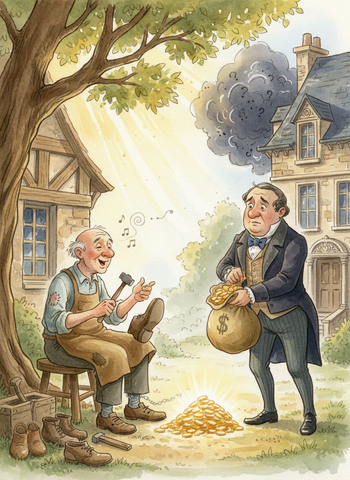
A cheerful cobbler loses his happiness when a wealthy neighbor gives him money, discovering that worry over wealth destroys the joy of simple living.
There was once a cobbler who was so light hearted that he sang from morning to night. It was wonderful to watch him at his work, and more wonderful still to hear his runs and trills. He was in fact happier than the Seven Sages.
Había una vez un zapatero remendón tan alegre que cantaba de la mañana a la noche. Era maravilloso verlo trabajar, y más maravilloso aún oír sus gorgoritos y trinos. Era, de hecho, más feliz que los Siete Sabios.
This merry soul had a neighbour who was exactly the reverse. He sang little and slept less; for he was a financier, and made of money, as they say. Whenever it happened that after a sleepless night he would doze off in the early morning, the cobbler, who was always up betimes, would wake him up again with his joyful songs. "Ha!" thought the man of wealth, "what a misfortune it is that one cannot buy sleep in the open market as one buys food and drink!" Then an idea came to him. He invited the cobbler to his house, where he asked him some questions.
Este alma alegre tenía un vecino que era exactamente lo contrario. Cantaba poco y dormía menos; pues era financiero, y estaba hecho de dinero, como se suele decir. Cada vez que, tras una noche en vela, lograba adormecerse a primera hora de la mañana, el zapatero, que siempre madrugaba, lo despertaba de nuevo con sus alegres canciones. «¡Ja!», pensaba el hombre rico, «¡qué desgracia es que uno no pueda comprar el sueño en el mercado abierto, como se compra comida y bebida!». Entonces se le ocurrió una idea. Invitó al zapatero a su casa, donde le hizo algunas preguntas.
"Tell me, Master Gregory, what do you suppose your earnings amount to in a year?"
«Dime, maese Gregorio, ¿a cuánto calculas que ascienden tus ganancias en un año?»
"In a year," laughed the cobbler, "that's more than I know. I never keep accounts that way, nor even keep one day from another. So long as I can make both ends meet, that's good enough for me!"
«En un año», rió el zapatero, «eso es más de lo que sé. Yo nunca llevo cuentas de esa manera, ni distingo un día de otro. ¡Mientras pueda llegar a fin de mes, con eso me basta!»
"Really!" replied the financier. "But what can you earn in one day?"
«¡De veras!», respondió el financiero. «Pero ¿cuánto puedes ganar en un día?»
"Oh, sometimes more and sometimes less. The mischief of it is that there are so many fête days and high-days and fast-days crowded into the year, on which, as the priest tells us, it is wicked to work at all; and worse still he keeps on finding some new saint or other to give weight to his sermons. If it were not for that, cobbling would be a fine paying game."
«Ah, a veces más y a veces menos. El problema es que hay tantos días de fiesta, festividades y días de ayuno amontonados en el año, en los que, como nos dice el cura, es pecado trabajar; y peor aún, no deja de encontrar algún nuevo santo para dar más peso a sus sermones. Si no fuera por eso, remendar zapatos sería un negocio muy rentable.»
At this the wealthy man laughed. "Look here, my friend, to-day I'll lift you to the seats of the mighty! Here is a hundred pounds. Guard them and use them with care."
Ante esto, el hombre rico se echó a reír. «Mira, amigo mío, hoy voy a elevarte a los asientos de los poderosos. Aquí tienes cien libras. Guárdalas y úsalas con cuidado.»
When the cobbler held the bag of money in his hand he imagined that it must be as much as would be coined in a hundred years.
Cuando el zapatero tuvo la bolsa de dinero en la mano, se imaginó que debía de ser tanto como lo que se acuñaría en cien años.
Returning home he buried the cash in his cellar. Alas! he buried his joy with it, for there were no more songs. From the moment he came into possession of this wealth, the love of which is the root of all evil, his voice left him, and not only his voice, but his sleep also. And in place of these came anxiety, suspicion, and alarms; guests which abode with him constantly. All day he kept his eye on the cellar door. Did a cat make a noise in the night, then for a certainty that cat was after his money.
Al volver a casa, enterró el dinero en su bodega. ¡Ay! Enterró también su alegría junto con él, pues ya no hubo más canciones. Desde el momento en que entró en posesión de aquella riqueza, cuyo amor es la raíz de todo mal, su voz lo abandonó, y no solo su voz, sino también su sueño. Y en su lugar llegaron la ansiedad, la sospecha y las alarmas; huéspedes que se quedaron con él constantemente. Todo el día tenía la vista puesta en la puerta de la bodega. Si un gato hacía ruido por la noche, entonces con toda certeza aquel gato andaba tras su dinero.
At last, in despair, the wretched cobbler ran to the financier whom he now no longer kept awake. "Oh, give me back my joy in life, my songs, my sleep; and take your hundred pounds again."
Por fin, desesperado, el desdichado zapatero corrió hacia el financiero, a quien ya no mantenía despierto. «Oh, devuélveme mi alegría de vivir, mis canciones, mi sueño; y toma de vuelta tus cien libras.»
