The Count and the Wedding Guest
A free B2-level English story for language learners, readable online in 7 languages, with an option to listen via the free Storyteller app.
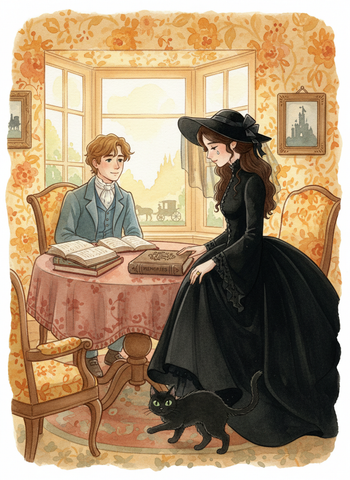
A lonely young man falls for a boarder mourning a dashing count she claims to have lost — but her all-black wardrobe is hiding a much closer secret.
One evening when Andy Donovan went to dinner at his Second Avenue boarding-house, Mrs. Scott introduced him to a new boarder, a young lady, Miss Conway. Miss Conway was small and unobtrusive. She wore a plain, snuffy-brown dress, and bestowed her interest, which seemed languid, upon her plate. She lifted her diffident eyelids and shot one perspicuous, judicial glance at Mr. Donovan, politely murmured his name, and returned to her mutton. Mr. Donovan bowed with the grace and beaming smile that were rapidly winning for him social, business and political advancement, and erased the snuffy-brown one from the tablets of his consideration.
Una noche, cuando Andy Donovan fue a cenar a su pensión de la Segunda Avenida, la señora Scott se lo presentó a una nueva huésped, una joven señorita, la señorita Conway. La señorita Conway era menuda y discreta. Llevaba un vestido sencillo, de un pardo apagado, y dedicaba su interés, que parecía lánguido, a su plato. Levantó sus párpados tímidos y lanzó una mirada perspicaz y calculadora al señor Donovan, murmuró cortésmente su nombre y volvió a su cordero. El señor Donovan hizo una reverencia con la gracia y la sonrisa radiante que rápidamente le estaban ganando ascensos sociales, comerciales y políticos, y borró a la del vestido pardo apagado de las tablas de su consideración.
Two weeks later Andy was sitting on the front steps enjoying his cigar. There was a soft rustle behind and above him, and Andy turned his head—and had his head turned.
Dos semanas después, Andy estaba sentado en los escalones de la entrada disfrutando de su cigarro. Hubo un suave frufrú detrás y por encima de él, y Andy volvió la cabeza—y quedó con la cabeza vuelta.
Just coming out the door was Miss Conway. She wore a night-black dress of crêpe de—crêpe de—oh, this thin black goods. Her hat was black, and from it drooped and fluttered an ebon veil, filmy as a spider’s web. She stood on the top step and drew on black silk gloves. Not a speck of white or a spot of color about her dress anywhere.
Justo en ese momento salía por la puerta la señorita Conway. Llevaba un vestido negro como la noche, de crepé de—crepé de—ay, esa tela negra y fina. Su sombrero era negro, y de él colgaba y ondeaba un velo de ébano, tenue como una telaraña. Se detuvo en el escalón más alto y se puso los guantes de seda negra. No había ni una mota de blanco ni una mancha de color en todo su vestido.
Her rich golden hair was drawn, with scarcely a ripple, into a shining, smooth knot low on her neck. Her face was plain rather than pretty, but it was now illuminated and made almost beautiful by her large gray eyes that gazed above the houses across the street into the sky with an expression of the most appealing sadness and melancholy.
Su cabello, de un rico rubio dorado, estaba recogido, sin apenas una onda, en un moño liso y brillante bajo la nuca. Su rostro era más sencillo que bonito, pero ahora estaba iluminado y casi embellecido por sus grandes ojos grises, que miraban por encima de las casas de la calle hacia el cielo con una expresión de la más conmovedora tristeza y melancolía.
Gather the idea, girls—all black, you know, with the preference for crêpe de—oh, crêpe de Chine—that’s it. All black, and that sad, faraway look, and the hair shining under the black veil (you have to be a blonde, of course), and try to look as if, although your young life had been blighted just as it was about to give a hop-skip-and-a-jump over the threshold of life, a walk in the park might do you good, and be sure to happen out the door at the right moment, and—oh, it’ll fetch ’em every time. But it’s fierce, now, how cynical I am, ain’t it?—to talk about mourning costumes this way.
Fíjense bien, muchachas—todo de negro, ya saben, con preferencia por el crepé de—ay, crepé de China—eso es. Todo de negro, y esa mirada triste y perdida, y el pelo brillando bajo el velo negro (hay que ser rubia, claro), y hay que procurar parecer que, aunque su joven vida se hubiera visto truncada justo cuando estaba a punto de dar el salto hacia el umbral de la existencia, un paseo por el parque le sentaría bien, y hay que asegurarse de salir por la puerta en el momento justo, y—ay, siempre funciona. Pero qué cínica soy, ¿verdad?, al hablar así de los trajes de luto.
Mr. Donovan suddenly reinscribed Miss Conway upon the tablets of his consideration. He threw away the remaining inch-and-a-quarter of his cigar, that would have been good for eight minutes yet, and quickly shifted his center of gravity to his low cut patent leathers.
El señor Donovan reinscribió de inmediato a la señorita Conway en las tablas de su consideración. Tiró la pulgada y cuarto de cigarro que le quedaba, que aún le habría durado ocho minutos, y rápidamente trasladó su centro de gravedad hacia sus zapatos de charol de tacón bajo.
“It’s a fine, clear evening, Miss Conway,” he said; and if the Weather Bureau could have heard the confident emphasis of his tones it would have hoisted the square white signal, and nailed it to the mast.
—Hace una noche estupenda y despejada, señorita Conway—dijo él; y si la Oficina Meteorológica hubiera escuchado el énfasis confiado de su tono, habría izado la señal blanca cuadrada y la habría clavado al mástil.
“To them that has the heart to enjoy it, it is, Mr. Donovan,” said Miss Conway, with a sigh.
—Para quien tenga el corazón para disfrutarla, sí lo es, señor Donovan—dijo la señorita Conway, con un suspiro.
Mr. Donovan, in his heart, cursed fair weather. Heartless weather! It should hail and blow and snow to be consonant with the mood of Miss Conway.
El señor Donovan, en su fuero interno, maldijo el buen tiempo. ¡Tiempo desalmado! Debería granizar y soplar viento y nevar, para estar en consonancia con el estado de ánimo de la señorita Conway.
“I hope none of your relatives—I hope you haven’t sustained a loss?” ventured Mr. Donovan.
—Espero que ninguno de sus parientes… espero que no haya sufrido una pérdida—se atrevió a preguntar el señor Donovan.
“Death has claimed,” said Miss Conway, hesitating—“not a relative, but one who—but I will not intrude my grief upon you, Mr. Donovan.”
—La muerte ha reclamado—dijo la señorita Conway, titubeando—no a un pariente, sino a alguien que… pero no quiero imponerle mi dolor, señor Donovan.
“Intrude?” protested Mr. Donovan. “Why, say, Miss Conway, I’d be delighted, that is, I’d be sorry—I mean I’m sure nobody could sympathize with you truer than I would.”
—¿Imponer?—protestó el señor Donovan—. Vaya, señorita Conway, me sentiría honrado, es decir, lo lamentaría… quiero decir que estoy seguro de que nadie podría compadecerse de usted más sinceramente que yo.
Miss Conway smiled a little smile. And oh, it was sadder than her expression in repose.
La señorita Conway esbozó una pequeña sonrisa. Y, ay, era más triste que su expresión en reposo.
“‘Laugh, and the world laughs with you; weep, and they give you the laugh,’” she quoted. “I have learned that, Mr. Donovan. I have no friends or acquaintances in this city. But you have been kind to me. I appreciate it highly.”
—«Ríe, y el mundo ríe contigo; llora, y se ríen de ti»—citó ella—. Eso lo he aprendido, señor Donovan. No tengo amigos ni conocidos en esta ciudad. Pero usted ha sido amable conmigo. Se lo agradezco mucho.
He had passed her the pepper twice at the table.
Él le había pasado la pimienta dos veces en la mesa.
“It’s tough to be alone in New York—that’s a cinch,” said Mr. Donovan. “But, say—whenever this little old town does loosen up and get friendly it goes the limit. Say you took a little stroll in the park, Miss Conway—don’t you think it might chase away some of your mullygrubs? And if you’d allow me—”
—Es duro estar sola en Nueva York, eso es verdad—dijo el señor Donovan—. Pero, mire, cuando esta viejecita ciudad se decide a relajarse y a ser amable, no se queda corta. Dígame, ¿qué tal si diera un pequeño paseo por el parque, señorita Conway? ¿No cree que eso le ahuyentaría un poco la murria? Y si usted me lo permitiera…
“Thanks, Mr. Donovan. I’d be pleased to accept of your escort if you think the company of one whose heart is filled with gloom could be anyways agreeable to you.”
—Gracias, señor Donovan. Estaría encantada de aceptar su compañía, si cree que la de alguien cuyo corazón está lleno de pesar puede resultarle de alguna manera agradable.
Through the open gates of the iron-railed, old, downtown park, where the elect once took the air, they strolled, and found a quiet bench.
A través de las verjas abiertas del viejo parque del centro, cercado de hierro, donde antaño la gente distinguida tomaba el aire, pasearon, y encontraron un banco tranquilo.
There is this difference between the grief of youth and that of old age: youth’s burden is lightened by as much of it as another shares; old age may give and give, but the sorrow remains the same.
Hay esta diferencia entre el dolor de la juventud y el de la vejez: la carga de la juventud se aligera en la misma medida en que otro la comparte; la vejez puede dar y dar, pero la pena sigue siendo la misma.
“He was my fiance,” confided Miss Conway, at the end of an hour. “We were going to be married next spring. I don’t want you to think that I am stringing you, Mr. Donovan, but he was a real Count. He had an estate and a castle in Italy. Count Fernando Mazzini was his name. I never saw the beat of him for elegance. Papa objected, of course, and once we eloped, but papa overtook us, and took us back. I thought sure papa and Fernando would fight a duel. Papa has a livery business—in P’kipsee, you know.”
—Era mi prometido—confió la señorita Conway, al cabo de una hora—. Íbamos a casarnos la próxima primavera. No quiero que piense que le estoy tomando el pelo, señor Donovan, pero era un verdadero conde. Tenía una hacienda y un castillo en Italia. Se llamaba el conde Fernando Mazzini. Nunca vi a nadie que lo superara en elegancia. Papá se opuso, claro está, y una vez nos fugamos, pero papá nos alcanzó y nos hizo volver. Estaba segura de que papá y Fernando se batirían en duelo. Papá tiene un negocio de alquiler de coches de caballos… en P'kipsee, ya sabe.
“Finally, papa came ’round, all right, and said we might be married next spring. Fernando showed him proofs of his title and wealth, and then went over to Italy to get the castle fixed up for us. Papa’s very proud, and when Fernando wanted to give me several thousand dollars for my trousseau he called him down something awful. He wouldn’t even let me take a ring or any presents from him. And when Fernando sailed I came to the city and got a position as cashier in a candy store.”
—Al final, papá cedió, y dijo que podríamos casarnos la próxima primavera. Fernando le mostró pruebas de su título y su fortuna, y luego se fue a Italia a arreglar el castillo para nosotros. Papá es muy orgulloso, y cuando Fernando quiso darme varios miles de dólares para mi ajuar, lo regañó de una manera terrible. Ni siquiera me dejó aceptar un anillo ni ningún regalo de él. Y cuando Fernando zarpó, yo vine a la ciudad y conseguí un puesto de cajera en una tienda de dulces.
“Three days ago I got a letter from Italy, forwarded from P’kipsee, saying that Fernando had been killed in a gondola accident.”
—Hace tres días recibí una carta de Italia, reenviada desde P'kipsee, que decía que Fernando había muerto en un accidente de góndola.
“That is why I am in mourning. My heart, Mr. Donovan, will remain forever in his grave. I guess I am poor company, Mr. Donovan, but I cannot take any interest in no one. I should not care to keep you from gayety and your friends who can smile and entertain you. Perhaps you would prefer to walk back to the house?”
—Por eso estoy de luto. Mi corazón, señor Donovan, permanecerá para siempre en su tumba. Supongo que soy mala compañía, señor Donovan, pero no puedo interesarme por nadie. No querría apartarlo de la alegría y de sus amigos, que pueden sonreír y entretenerlo. Quizá prefiera que volvamos caminando a la casa.
Now, girls, if you want to observe a young man hustle out after a pick and shovel, just tell him that your heart is in some other fellow’s grave. Young men are grave-robbers by nature. Ask any widow. Something must be done to restore that missing organ to weeping angels in _crêpe de Chine_. Dead men certainly get the worst of it from all sides.
Ahora bien, muchachas, si quieren ver a un joven salir corriendo a buscar pico y pala, basta con decirle que su corazón está en la tumba de otro hombre. Los jóvenes son, por naturaleza, profanadores de tumbas. Pregúntenle a cualquier viuda. Algo hay que hacer para devolver ese órgano perdido a los ángeles llorosos vestidos de _crepé de China_. Los muertos, sin duda, salen perdiendo por todos los lados.
“I’m awfully sorry,” said Mr. Donovan, gently. “No, we won’t walk back to the house just yet. And don’t say you haven’t no friends in this city, Miss Conway. I’m awful sorry, and I want you to believe I’m your friend, and that I’m awful sorry.”
—Lo siento muchísimo—dijo el señor Donovan, con suavidad—. No, no volvamos todavía a la casa. Y no diga que no tiene amigos en esta ciudad, señorita Conway. Lo siento de veras, y quiero que crea que soy su amigo, y que lo siento de veras.
“I’ve got his picture here in my locket,” said Miss Conway, after wiping her eyes with her handkerchief. “I never showed it to anybody; but I will to you, Mr. Donovan, because I believe you to be a true friend.”
—Tengo su retrato aquí, en mi medallón—dijo la señorita Conway, después de secarse los ojos con el pañuelo—. Nunca se lo he enseñado a nadie; pero se lo enseñaré a usted, señor Donovan, porque creo que es un verdadero amigo.
Mr. Donovan gazed long and with much interest at the photograph in the locket that Miss Conway opened for him. The face of Count Mazzini was one to command interest. It was a smooth, intelligent, bright, almost a handsome face—the face of a strong, cheerful man who might well be a leader among his fellows.
El señor Donovan contempló largo rato y con mucho interés la fotografía del medallón que la señorita Conway abrió para él. El rostro del conde Mazzini era de los que atraían el interés. Era un rostro suave, inteligente, luminoso, casi apuesto—el rostro de un hombre fuerte y alegre que bien podría ser un líder entre sus semejantes.
“I have a larger one, framed, in my room,” said Miss Conway. “When we return I will show you that. They are all I have to remind me of Fernando. But he ever will be present in my heart, that’s a sure thing.”
—Tengo una más grande, enmarcada, en mi habitación—dijo la señorita Conway—. Cuando volvamos se la mostraré. Son todo lo que me queda para recordar a Fernando. Pero él siempre estará presente en mi corazón, de eso puede estar seguro.
A subtle task confronted Mr. Donovan,—that of supplanting the unfortunate Count in the heart of Miss Conway. This his admiration for her determined him to do. But the magnitude of the undertaking did not seem to weigh upon his spirits. The sympathetic but cheerful friend was the rôle he essayed; and he played it so successfully that the next half-hour found them conversing pensively across two plates of ice-cream, though yet there was no diminution of the sadness in Miss Conway’s large gray eyes.
Una tarea delicada se le presentaba al señor Donovan: la de suplantar al desdichado conde en el corazón de la señorita Conway. Su admiración por ella lo decidió a intentarlo. Pero la magnitud de la empresa no parecía pesarle en el ánimo. El papel que asumió fue el del amigo compasivo pero animoso, y lo interpretó con tanto éxito que, media hora después, los encontramos conversando pensativamente frente a dos platos de helado, aunque todavía no había disminuido la tristeza en los grandes ojos grises de la señorita Conway.
Before they parted in the hall that evening she ran upstairs and brought down the framed photograph wrapped lovingly in a white silk scarf. Mr. Donovan surveyed it with inscrutable eyes.
Antes de despedirse en el vestíbulo aquella noche, ella subió corriendo y bajó con la fotografía enmarcada, envuelta con cariño en un pañuelo de seda blanca. El señor Donovan la examinó con ojos inescrutables.
“He gave me this the night he left for Italy,” said Miss Conway. “I had the one for the locket made from this.”
—Me la dio la noche que se marchó a Italia—dijo la señorita Conway—. De esta hice hacer la del medallón.
“A fine-looking man,” said Mr. Donovan, heartily. “How would it suit you, Miss Conway, to give me the pleasure of your company to Coney next Sunday afternoon?”
—Un hombre de muy buen ver—dijo el señor Donovan, con calidez—. ¿Qué le parecería, señorita Conway, darme el placer de su compañía en Coney el próximo domingo por la tarde?
A month later they announced their engagement to Mrs. Scott and the other boarders. Miss Conway continued to wear black.
Un mes después anunciaron su compromiso a la señora Scott y a los demás huéspedes. La señorita Conway siguió vistiendo de negro.
A week after the announcement the two sat on the same bench in the downtown park, while the fluttering leaves of the trees made a dim kinetoscopic picture of them in the moonlight. But Donovan had worn a look of abstracted gloom all day. He was so silent to-night that love’s lips could not keep back any longer the questions that love’s heart propounded.
Una semana después del anuncio, los dos estaban sentados en el mismo banco del parque del centro, mientras las hojas agitadas de los árboles formaban un tenue cuadro cinético de ellos bajo la luz de la luna. Pero Donovan había mostrado un aire de sombría distracción todo el día. Estaba tan callado esa noche que los labios del amor ya no pudieron contener las preguntas que el corazón del amor formulaba.
“What’s the matter, Andy, you are so solemn and grouchy to-night?”
—¿Qué te pasa, Andy, que estás tan solemne y de mal humor esta noche?
“Nothing, Maggie.”
—Nada, Maggie.
“I know better. Can’t I tell? You never acted this way before. What is it?”
—Sé que no es nada. ¿Acaso no puedo notarlo? Nunca te habías comportado así. ¿Qué es?
“It’s nothing much, Maggie.”
—No es nada, Maggie.
“Yes it is; and I want to know. I’ll bet it’s some other girl you are thinking about. All right. Why don’t you go get her if you want her? Take your arm away, if you please.”
—Sí que lo es; y quiero saberlo. Apuesto a que es alguna otra chica en la que estás pensando. Está bien. ¿Por qué no vas a buscarla, si es a ella a quien quieres? Quita tu brazo, por favor.
“I’ll tell you then,” said Andy, wisely, “but I guess you won’t understand it exactly. You’ve heard of Mike Sullivan, haven’t you? ‘Big Mike’ Sullivan, everybody calls him.”
—Te lo diré entonces—dijo Andy, con sensatez—, aunque supongo que no lo entenderás del todo. Has oído hablar de Mike Sullivan, ¿no? «Big Mike» Sullivan, así lo llama todo el mundo.
“No, I haven’t,” said Maggie. “And I don’t want to, if he makes you act like this. Who is he?”
—No, no he oído hablar de él—dijo Maggie—. Y no quiero oír hablar de él, si te hace comportarte así. ¿Quién es?
“He’s the biggest man in New York,” said Andy, almost reverently. “He can about do anything he wants to with Tammany or any other old thing in the political line. He’s a mile high and as broad as East River. You say anything against Big Mike, and you’ll have a million men on your collarbone in about two seconds. Why, he made a visit over to the old country awhile back, and the kings took to their holes like rabbits.
—Es el hombre más importante de Nueva York—dijo Andy, casi con reverencia—. Puede hacer casi lo que quiera con Tammany o con cualquier otra cosa del ámbito político. Es tan alto como una milla y tan ancho como el East River. Como digas algo en contra de Big Mike, tendrás a un millón de hombres encima de tu clavícula en unos dos segundos. Fíjate que hizo una visita hace poco al viejo continente, y los reyes se metieron en sus madrigueras como conejos.
“Well, Big Mike’s a friend of mine. I ain’t more than deuce-high in the district as far as influence goes, but Mike’s as good a friend to a little man, or a poor man as he is to a big one. I met him to-day on the Bowery, and what do you think he does? Comes up and shakes hands.
—Bueno, Big Mike es amigo mío. Yo no valgo más que un dos de bastos en el distrito en cuanto a influencia, pero Mike es tan buen amigo de un hombre pequeño, o de un pobre, como lo es de uno grande. Lo encontré hoy en el Bowery, y ¿sabes qué hizo? Se acercó y me dio la mano.
“‘Andy,’ says he, ‘I’ve been keeping cases on you. You’ve been putting in some good licks over on your side of the street, and I’m proud of you. What’ll you take to drink?” He takes a cigar, and I take a highball. I told him I was going to get married in two weeks. ‘Andy,’ says he, ‘send me an invitation, so I’ll keep in mind of it, and I’ll come to the wedding.’ That’s what Big Mike says to me; and he always does what he says.
—«Andy», me dijo, «te he estado siguiendo el rastro. Has estado dando buenos golpes por tu lado de la calle, y estoy orgulloso de ti. ¿Qué vas a tomar?». Él pidió un puro, y yo un whisky con soda. Le conté que me iba a casar en dos semanas. «Andy», me dijo, «mándame una invitación, para que no se me olvide, e iré a la boda». Eso es lo que me dijo Big Mike; y él siempre cumple lo que dice.
“You don’t understand it, Maggie, but I’d have one of my hands cut off to have Big Mike Sullivan at our wedding. It would be the proudest day of my life. When he goes to a man’s wedding, there’s a guy being married that’s made for life. Now, that’s why I’m maybe looking sore to-night.”
—No lo entiendes, Maggie, pero me cortaría una mano con tal de tener a Big Mike Sullivan en nuestra boda. Sería el día más orgulloso de mi vida. Cuando él va a la boda de un hombre, ese hombre queda hecho para toda la vida. Así que por eso ando quizá con cara de pocos amigos esta noche.
“Why don’t you invite him, then, if he’s so much to the mustard?” said Maggie, lightly.
—Entonces, ¿por qué no lo invitas, si es tan importante?—dijo Maggie, con ligereza.
“There’s a reason why I can’t,” said Andy, sadly. “There’s a reason why he mustn’t be there. Don’t ask me what it is, for I can’t tell you.”
—Hay una razón por la que no puedo—dijo Andy, con tristeza—. Hay una razón por la que él no debe estar allí. No me preguntes cuál es, porque no puedo decírtela.
“Oh, I don’t care,” said Maggie. “It’s something about politics, of course. But it’s no reason why you can’t smile at me.”
—Ah, no me importa—dijo Maggie—. Será algo de política, seguro. Pero eso no es motivo para que no me sonrías.
“Maggie,” said Andy, presently, “do you think as much of me as you did of your—as you did of the Count Mazzini?”
—Maggie—dijo Andy, al cabo de un rato—, ¿me quieres tanto como querías a… a tu conde Mazzini?
He waited a long time, but Maggie did not reply. And then, suddenly she leaned against his shoulder and began to cry—to cry and shake with sobs, holding his arm tightly, and wetting the crêpe de Chine with tears.
Esperó largo rato, pero Maggie no respondió. Y entonces, de repente, se recostó sobre su hombro y empezó a llorar—a llorar y a sacudirse con sollozos, aferrándose fuerte a su brazo, y mojando el crepé de China con lágrimas.
“There, there, there!” soothed Andy, putting aside his own trouble. “And what is it, now?”
—¡Vamos, vamos, vamos!—la consoló Andy, dejando de lado su propia preocupación—. ¿Y ahora qué es lo que pasa?
“Andy,” sobbed Maggie. “I’ve lied to you, and you’ll never marry me, or love me any more. But I feel that I’ve got to tell. Andy, there never was so much as the little finger of a count. I never had a beau in my life. But all the other girls had; and they talked about ’em; and that seemed to make the fellows like ’em more.
—Andy—sollozó Maggie—. Te he mentido, y nunca te casarás conmigo, ni me querrás más. Pero siento que tengo que decírtelo. Andy, nunca hubo ni la sombra de un conde. Nunca tuve un novio en mi vida. Pero todas las otras chicas sí los tenían; y hablaban de ellos; y eso parecía hacer que los muchachos las quisieran más.
“And, Andy, I look swell in black—you know I do. So I went out to a photograph store and bought that picture, and had a little one made for my locket, and made up all that story about the Count, and about his being killed, so I could wear black. And nobody can love a liar, and you’ll shake me, Andy, and I’ll die for shame. Oh, there never was anybody I liked but you—and that’s all.”
—Y, Andy, me veo elegante de negro—ya sabes que sí. Así que fui a una tienda de fotografía y compré ese retrato, e hice hacer uno pequeño para mi medallón, e inventé toda esa historia sobre el conde, y sobre que lo habían matado, para poder vestir de negro. Y nadie puede querer a una mentirosa, y me vas a dejar, Andy, y me voy a morir de vergüenza. Ay, nunca hubo nadie que me gustara sino tú… y eso es todo.
But instead of being pushed away, she found Andy’s arm folding her closer. She looked up and saw his face cleared and smiling.
Pero en lugar de apartarla, ella sintió que el brazo de Andy la envolvía aún más cerca. Levantó la mirada y vio su rostro despejado y sonriente.
“Could you—could you forgive me, Andy?”
—¿Podrías… podrías perdonarme, Andy?
“Sure,” said Andy. “It’s all right about that. Back to the cemetery for the Count. You’ve straightened everything out, Maggie. I was in hopes you would before the wedding-day. Bully girl!”
—Claro que sí—dijo Andy—. Todo está bien en cuanto a eso. Que el conde vuelva al cementerio. Has aclarado todo, Maggie. Tenía la esperanza de que lo hicieras antes del día de la boda. ¡Qué chica tan valiente!
“Andy,” said Maggie, with a somewhat shy smile, after she had been thoroughly assured of forgiveness, “did you believe all that story about the Count?”
—Andy—dijo Maggie, con una sonrisa algo tímida, después de haberse asegurado por completo del perdón—, ¿de verdad creíste toda esa historia del conde?
“Well, not to any large extent,” said Andy, reaching for his cigar case, “because it’s Big Mike Sullivan’s picture you’ve got in that locket of yours.”
—Bueno, no del todo—dijo Andy, buscando su petaca de cigarros—, porque la foto que tienes en ese medallón tuyo es la de Big Mike Sullivan.
