The Story of Icarus and Daedalus
A free C1-level English story for language learners, readable online in 7 languages, with an option to listen via the free Storyteller app.
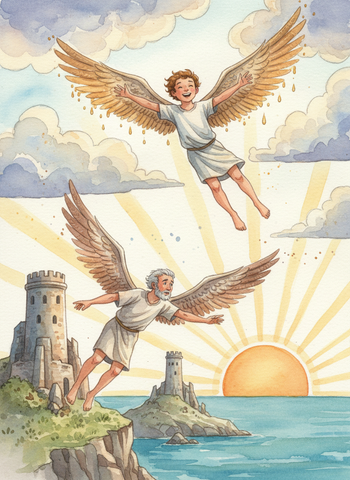
A brilliant inventor builds waxen wings to escape a tower prison with his son, warning the boy not to fly too high — but the thrill of soaring proves impossible to resist.
The labyrinth from which Theseus escaped by means of the clew of Ariadne was built by Daedalus, a most skilful artificer. It was an edifice with numberless winding passages and turnings opening into one another, and seeming to have neither beginning nor end, like the river Maeander, which returns on itself, and flows now onward, now backward, in its course to the sea. Daedalus built the labyrinth for King Minos, but afterwards lost the favor of the king, and was shut up in a tower.
El laberinto del cual escapó Teseo por medio del ovillo de Ariadna fue construido por Dédalo, un artífice sumamente hábil. Era un edificio con innumerables pasadizos y vueltas que se abrían unos en otros, y que parecía no tener principio ni fin, como el río Meandro, que vuelve sobre sí mismo y fluye ora hacia adelante, ora hacia atrás, en su curso hacia el mar. Dédalo construyó el laberinto para el rey Minos, pero después perdió el favor del rey y fue encerrado en una torre.
He contrived to make his escape from his prison, but could not leave the island by sea, as the king kept strict watch on all the vessels, and permitted none to sail without being carefully searched.
Logró escapar de su prisión, pero no pudo abandonar la isla por mar, pues el rey vigilaba estrechamente todas las naves y no permitía que ninguna zarpara sin ser minuciosamente registrada.
"Minos may control the land and sea," said Daedalus, "but not the regions of the air. I will try that way." So he set to work to fabricate wings for himself and his young son Icarus. He wrought feathers together, beginning with the smallest and adding larger, so as to form an increasing surface. The larger ones he secured with thread and the smaller with wax, and gave the whole a gentle curvature like the wings of a bird.
«Minos podrá dominar la tierra y el mar», dijo Dédalo, «pero no las regiones del aire. Probaré ese camino». Así que se puso a fabricar alas para sí mismo y para su joven hijo Ícaro. Entretejió plumas, comenzando por las más pequeñas y añadiendo las más grandes, de modo que formaran una superficie creciente. Las más grandes las sujetó con hilo y las más pequeñas con cera, y dio al conjunto una suave curvatura, como las alas de un ave.
Icarus, the boy, stood and looked on, sometimes running to gather up the feathers which the wind had blown away, and then handling the wax and working it over with his fingers, by his play impeding his father in his labors.
Ícaro, el muchacho, se quedaba mirando, corriendo a veces a recoger las plumas que el viento había arrastrado, y luego tomando la cera y trabajándola entre los dedos, estorbando con su juego la labor de su padre.
When at last the work was done, the artist, waving his wings, found himself buoyed upward, and hung suspended, poising himself on the beaten air. He next equipped his son in the same manner, and taught him how to fly, as a bird tempts her young ones from the lofty nest into the air. When all was prepared for flight he said, "Icarus, my son, I charge you to keep at a moderate height, for if you fly too low the damp will clog your wings, and if too high the heat will melt them. Keep near me and you will be safe."
Cuando al fin la obra estuvo terminada, el artesano, agitando sus alas, se encontró sostenido en el aire y quedó suspendido, equilibrándose sobre el aire batido. Enseguida equipó a su hijo de la misma manera y le enseñó a volar, como un ave que incita a sus crías desde el nido elevado hacia el aire. Cuando todo estuvo listo para el vuelo, dijo: «Ícaro, hijo mío, te encargo que mantengas una altura moderada, pues si vuelas demasiado bajo la humedad entorpecerá tus alas, y si vuelas demasiado alto el calor las derretirá. Mantente cerca de mí y estarás a salvo».
While he gave him these instructions and fitted the wings to his shoulders, the face of the father was wet with tears, and his hands trembled. He kissed the boy, not knowing that it was for the last time. Then rising on his wings, he flew off, encouraging him to follow, and looked back from his own flight to see how his son managed his wings. As they flew the ploughman stopped his work to gaze, and the shepherd leaned on his staff and watched them, astonished at the sight, and thinking they were gods who could thus cleave the air.
Mientras le daba estas instrucciones y le ajustaba las alas a los hombros, el rostro del padre estaba húmedo de lágrimas, y sus manos temblaban. Besó al muchacho, sin saber que era por última vez. Luego, remontándose con sus alas, echó a volar, animándolo a seguirlo, y miraba hacia atrás desde su propio vuelo para ver cómo su hijo manejaba sus alas. Mientras volaban, el labrador detuvo su labor para contemplarlos, y el pastor se apoyó en su bastón y los observó, asombrado ante la escena, y pensando que eran dioses que así hendían el aire.
They passed Samos and Delos on the left and Lebynthos on the right, when the boy, exulting in his career, began to leave the guidance of his companion and soar upward as if to reach heaven. The nearness of the blazing sun softened the wax which held the feathers together, and they came off. He fluttered with his arms, but no feathers remained to hold the air.
Pasaron Samos y Delos a la izquierda y Lebintos a la derecha, cuando el muchacho, exultante en su vuelo, comenzó a abandonar la guía de su compañero y a remontarse como si quisiera alcanzar el cielo. La cercanía del sol abrasador ablandó la cera que sostenía las plumas, y estas se desprendieron. Agitó los brazos, pero ya no le quedaban plumas para sostenerse en el aire.
While his mouth uttered cries to his father it was submerged in the blue waters of the sea, which thenceforth was called by his name. His father cried, "Icarus, Icarus, where are you?" At last he saw the feathers floating on the water, and bitterly lamenting his own arts, he buried the body and called the land Icaria in memory of his child. Daedalus arrived safe in Sicily, where he built a temple to Apollo, and hung up his wings, an offering to the god.
Mientras su boca lanzaba gritos a su padre, quedó sumergido en las aguas azules del mar, que desde entonces llevó su nombre. Su padre gritó: «¡Ícaro, Ícaro! ¿Dónde estás?». Por fin vio las plumas flotando sobre el agua, y lamentando amargamente su propio arte, enterró el cuerpo y llamó a aquella tierra Icaria en memoria de su hijo. Dédalo llegó sano y salvo a Sicilia, donde erigió un templo a Apolo y colgó allí sus alas, como ofrenda al dios.
Daedalus was so proud of his achievements that he could not bear the idea of a rival. His sister had placed her son Perdix under his charge to be taught the mechanical arts. He was an apt scholar and gave striking evidences of ingenuity. Walking on the seashore he picked up the spine of a fish. Imitating it, he took a piece of iron and notched it on the edge, and thus invented the SAW. He put two pieces of iron together, connecting them at one end with a rivet, and sharpening the other ends, and made a PAIR OF COMPASSES.
Dédalo estaba tan orgulloso de sus logros que no podía soportar la idea de tener un rival. Su hermana había puesto a su hijo Perdix bajo su tutela para que le enseñara las artes mecánicas. Este era un alumno aventajado y dio muestras notables de ingenio. Paseando por la orilla del mar recogió la espina de un pez. Imitándola, tomó un trozo de hierro y le hizo muescas en el borde, inventando así la SIERRA. Unió dos piezas de hierro, sujetándolas por un extremo con un remache y afilando los otros extremos, e hizo un PAR DE COMPÁS.
Daedalus was so envious of his nephew's performances that he took an opportunity, when they were together one day on the top of a high tower, to push him off. But Minerva, who favors ingenuity, saw him falling, and arrested his fate by changing him into a bird called after his name, the Partridge. This bird does not build his nest in the trees, nor take lofty flights, but nestles in the hedges, and mindful of his fall, avoids high places.
Dédalo sintió tanta envidia de los logros de su sobrino que aprovechó una ocasión en que estaban juntos, un día, en lo alto de una torre elevada, para empujarlo al vacío. Pero Minerva, que favorece el ingenio, lo vio caer y detuvo su destino convirtiéndolo en un ave llamada en su honor, la Perdiz. Esta ave no construye su nido en los árboles ni emprende vuelos elevados, sino que anida en los setos y, recordando su caída, evita los lugares altos.
The death of Icarus is told in the following lines by Darwin:
La muerte de Ícaro está narrada en los siguientes versos de Darwin:
"… with melting wax and loosened strings Sunk hapless Icarus on unfaithful wings; Headlong he rushed through the affrighted air, With limbs distorted and dishevelled hair; His scattered plumage danced upon the wave, And sorrowing Nereids decked his watery grave; O'er his pale corse their pearly sea-flowers shed, And strewed with crimson moss his marble bed; Struck in their coral towers the passing bell, And wide in ocean tolled his echoing knell."
«… con la cera derretida y los lazos sueltos cayó el infortunado Ícaro sobre alas infieles; precipitado se lanzó a través del aire aterrado, con los miembros retorcidos y el cabello desgreñado; su plumaje disperso danzó sobre la ola, y las afligidas Nereidas adornaron su tumba acuática; sobre su pálido cuerpo esparcieron sus nacaradas flores marinas, y cubrieron con musgo carmesí su lecho de mármol; tañó la campana en sus torres de coral, y ancho, sobre el océano, resonó su doble fúnebre». </content>
