The Swineherd
A free B1-level English story for language learners, readable online in 7 languages, with an option to listen via the free Storyteller app.
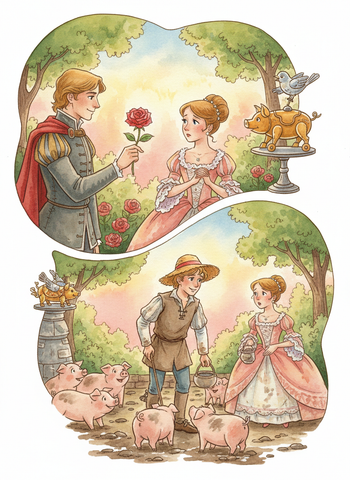
A poor prince offers a princess a beautiful rose and a nightingale, but she scorns real gifts for clever toys. Disguised as a swineherd, the prince teaches her a lesson about what truly matters.
There was once a poor Prince, who had a kingdom. His kingdom was very small, but still quite large enough to marry upon; and he wished to marry.
Era uma vez um Príncipe pobre, que tinha um reino. Seu reino era muito pequeno, mas ainda assim grande o bastante para se casar; e ele queria se casar.
It was certainly rather cool of him to say to the Emperor's daughter, “Will you have me?” But so he did; for his name was renowned far and wide; and there were a hundred princesses who would have answered, “Yes!” and “Thank you kindly.” We shall see what this princess said.
Foi certamente um tanto atrevido da sua parte perguntar à filha do Imperador: — Você me aceita? — Mas foi o que ele fez; pois seu nome era conhecido por toda parte; e havia uma centena de princesas que teriam respondido: — Sim! — e — Muito obrigada. — Vamos ver o que esta princesa disse.
Listen!
Escutem!
It happened that where the Prince's father lay buried, there grew a rose tree—a most beautiful rose tree, which blossomed only once in every five years, and even then bore only one flower, but that was a rose! It smelt so sweet that all cares and sorrows were forgotten by him who inhaled its fragrance.
Aconteceu que onde o pai do Príncipe estava enterrado, crescia uma roseira — uma roseira lindíssima, que florescia apenas uma vez a cada cinco anos, e mesmo assim dava só uma flor, mas que flor! Cheirava tão docemente que todas as preocupações e tristezas eram esquecidas por quem aspirasse seu perfume.
And furthermore, the Prince had a nightingale, who could sing in such a manner that it seemed as though all sweet melodies dwelt in her little throat. So the Princess was to have the rose, and the nightingale; and they were accordingly put into large silver caskets, and sent to her.
E além disso, o Príncipe tinha um rouxinol, que sabia cantar de tal forma que parecia que todas as melodias doces moravam em sua pequena garganta. Então a Princesa deveria receber a rosa, e o rouxinol; e eles foram colocados em grandes cofres de prata, e enviados a ela.
The Emperor had them brought into a large hall, where the Princess was playing at “Visiting,” with the ladies of the court; and when she saw the caskets with the presents, she clapped her hands for joy.
O Imperador mandou trazê-los para um grande salão, onde a Princesa brincava de "Visitinhas" com as damas da corte; e quando ela viu os cofres com os presentes, bateu palmas de alegria.
“Ah, if it were but a little pussy-cat!” said she; but the rose tree, with its beautiful rose came to view.
— Ah, quem me dera fosse um gatinho! — disse ela; mas a roseira, com sua bela rosa, apareceu diante dela.
“Oh, how prettily it is made!” said all the court ladies.
— Ah, como é feita com primor! — disseram todas as damas da corte.
“It is more than pretty,” said the Emperor, “it is charming!”
— É mais do que primorosa — disse o Imperador — é encantadora!
But the Princess touched it, and was almost ready to cry.
Mas a Princesa a tocou, e quase chorou.
“Fie, papa!” said she. “It is not made at all, it is natural!”
— Ora, papai! — disse ela. — Ela não é feita de jeito nenhum, é natural!
“Let us see what is in the other casket, before we get into a bad humor,” said the Emperor. So the nightingale came forth and sang so delightfully that at first no one could say anything ill-humored of her.
— Vejamos o que há no outro cofre, antes de ficarmos de mau humor — disse o Imperador. Então o rouxinol saiu e cantou tão deliciosamente que a princípio ninguém conseguiu dizer nada de ruim sobre ele.
“Superbe! Charmant!” exclaimed the ladies; for they all used to chatter French, each one worse than her neighbor.
— Superbe! Charmant! — exclamaram as damas; pois todas costumavam tagarelar em francês, cada uma pior que a vizinha.
“How much the bird reminds me of the musical box that belonged to our blessed Empress,” said an old knight. “Oh yes! These are the same tones, the same execution.”
— Como esse pássaro me lembra a caixinha de música que pertencia à nossa saudosa Imperatriz — disse um velho cavaleiro. — Ah, sim! São os mesmos tons, a mesma execução.
“Yes! yes!” said the Emperor, and he wept like a child at the remembrance.
— Sim! Sim! — disse o Imperador, e chorou como uma criança ao se lembrar.
“I will still hope that it is not a real bird,” said the Princess.
— Ainda vou ter esperança de que não seja um pássaro de verdade — disse a Princesa.
“Yes, it is a real bird,” said those who had brought it. “Well then let the bird fly,” said the Princess; and she positively refused to see the Prince.
— Sim, é um pássaro de verdade — disseram os que o trouxeram. — Bem, então deixem o pássaro voar — disse a Princesa; e se recusou terminantemente a receber o Príncipe.
However, he was not to be discouraged; he daubed his face over brown and black; pulled his cap over his ears, and knocked at the door.
Contudo, ele não se deixou desanimar; besuntou o rosto de marrom e preto; puxou o boné sobre as orelhas, e bateu à porta.
“Good day to my lord, the Emperor!” said he. “Can I have employment at the palace?”
— Bom dia a meu senhor, o Imperador! — disse ele. — Posso ter emprego no palácio?
“Why, yes,” said the Emperor. “I want some one to take care of the pigs, for we have a great many of them.”
— Ora, sim — disse o Imperador. — Preciso de alguém para cuidar dos porcos, pois temos muitos deles.
So the Prince was appointed “Imperial Swineherd.” He had a dirty little room close by the pigsty; and there he sat the whole day, and worked. By the evening he had made a pretty little kitchen-pot. Little bells were hung all round it; and when the pot was boiling, these bells tinkled in the most charming manner, and played the old melody,
Então o Príncipe foi nomeado "Porqueiro Imperial". Ele tinha um quartinho sujo perto do chiqueiro; e ali ficava sentado o dia todo, trabalhando. Ao entardecer, tinha feito uma bonita panelinha de cozinha. Sininhos foram pendurados ao redor dela; e quando a panela fervia, esses sininhos tilintavam da maneira mais encantadora, e tocavam a velha melodia,
“Ach! du lieber Augustin, Alles ist weg, weg, weg!”*
"Ach! du lieber Augustin, Alles ist weg, weg, weg!"*
* “Ah! dear Augustine! All is gone, gone, gone!”
* "Ah! querido Augustin! Tudo se foi, se foi, se foi!"
But what was still more curious, whoever held his finger in the smoke of the kitchen-pot, immediately smelt all the dishes that were cooking on every hearth in the city—this, you see, was something quite different from the rose.
Mas o que era ainda mais curioso, quem quer que colocasse o dedo na fumaça da panelinha, imediatamente sentia o cheiro de todos os pratos que estavam sendo cozidos em cada lareira da cidade — isso, veem vocês, era algo bem diferente da rosa.
Now the Princess happened to walk that way; and when she heard the tune, she stood quite still, and seemed pleased; for she could play “Lieber Augustine”; it was the only piece she knew; and she played it with one finger.
Ora, a Princesa por acaso passou por ali; e quando ouviu a melodia, ficou completamente parada, e parecia satisfeita; pois ela sabia tocar "Lieber Augustin"; era a única peça que sabia; e a tocava com um dedo só.
“Why there is my piece,” said the Princess. “That swineherd must certainly have been well educated! Go in and ask him the price of the instrument.”
— Ora, essa é a minha peça — disse a Princesa. — Esse porqueiro deve certamente ter sido bem-educado! Vá lá dentro e pergunte a ele o preço do instrumento.
So one of the court-ladies must run in; however, she drew on wooden slippers first.
Então uma das damas da corte teve que ir correndo; contudo, primeiro calçou tamancos de madeira.
“What will you take for the kitchen-pot?” said the lady.
— O que você quer pela panelinha de cozinha? — perguntou a dama.
“I will have ten kisses from the Princess,” said the swineherd.
— Quero dez beijos da Princesa — disse o porqueiro.
“Yes, indeed!” said the lady.
— Ora essa! — disse a dama.
“I cannot sell it for less,” rejoined the swineherd.
— Não posso vendê-la por menos — retrucou o porqueiro.
“He is an impudent fellow!” said the Princess, and she walked on; but when she had gone a little way, the bells tinkled so prettily
— Ele é um sujeito atrevido! — disse a Princesa, e seguiu andando; mas quando já tinha ido um pouco adiante, os sininhos tilintaram tão docemente
“Ach! du lieber Augustin, Alles ist weg, weg, weg!”
"Ach! du lieber Augustin, Alles ist weg, weg, weg!"
“Stay,” said the Princess. “Ask him if he will have ten kisses from the ladies of my court.”
— Espere — disse a Princesa. — Pergunte se ele aceita dez beijos das damas da minha corte.
“No, thank you!” said the swineherd. “Ten kisses from the Princess, or I keep the kitchen-pot myself.”
— Não, obrigado! — disse o porqueiro. — Dez beijos da Princesa, ou fico eu mesmo com a panelinha.
“That must not be, either!” said the Princess. “But do you all stand before me that no one may see us.”
— Isso também não pode ser! — disse a Princesa. — Mas fiquem todas na minha frente para que ninguém nos veja.
And the court-ladies placed themselves in front of her, and spread out their dresses—the swineherd got ten kisses, and the Princess—the kitchen-pot.
E as damas da corte se colocaram diante dela, e estenderam seus vestidos — o porqueiro ganhou dez beijos, e a Princesa — a panelinha de cozinha.
That was delightful! The pot was boiling the whole evening, and the whole of the following day. They knew perfectly well what was cooking at every fire throughout the city, from the chamberlain's to the cobbler's; the court-ladies danced and clapped their hands.
Isso foi delicioso! A panela ficou fervendo a noite toda, e todo o dia seguinte. Elas sabiam perfeitamente o que estava sendo cozido em cada fogo por toda a cidade, desde o do camareiro até o do sapateiro; as damas da corte dançavam e batiam palmas.
“We know who has soup, and who has pancakes for dinner to-day, who has cutlets, and who has eggs. How interesting!”
— Sabemos quem tem sopa, e quem tem panquecas no jantar hoje, quem tem costeletas, e quem tem ovos. Que interessante!
“Yes, but keep my secret, for I am an Emperor's daughter.”
— Sim, mas guardem meu segredo, pois sou filha de Imperador.
The swineherd—that is to say—the Prince, for no one knew that he was other than an ill-favored swineherd, let not a day pass without working at something; he at last constructed a rattle, which, when it was swung round, played all the waltzes and jig tunes, which have ever been heard since the creation of the world.
O porqueiro — isto é, o Príncipe, pois ninguém sabia que ele era outra coisa senão um porqueiro de aparência desagradável — não deixava passar um dia sem trabalhar em algo; por fim construiu uma matraca, que, quando girada, tocava todas as valsas e melodias de dança que já se ouviu desde a criação do mundo.
“Ah, that is superbe!” said the Princess when she passed by. “I have never heard prettier compositions! Go in and ask him the price of the instrument; but mind, he shall have no more kisses!”
— Ah, isso é superbe! — disse a Princesa quando passou por ali. — Nunca ouvi composições mais bonitas! Vá lá dentro e pergunte a ele o preço do instrumento; mas atenção, ele não terá mais nenhum beijo!
“He will have a hundred kisses from the Princess!” said the lady who had been to ask.
— Ele quer cem beijos da Princesa! — disse a dama que tinha ido perguntar.
“I think he is not in his right senses!” said the Princess, and walked on, but when she had gone a little way, she stopped again. “One must encourage art,” said she, “I am the Emperor's daughter. Tell him he shall, as on yesterday, have ten kisses from me, and may take the rest from the ladies of the court.”
— Acho que ele não está em seu juízo perfeito! — disse a Princesa, e seguiu andando, mas quando tinha ido um pouco adiante, parou de novo. — É preciso incentivar a arte — disse ela. — Sou filha do Imperador. Digam a ele que, como ontem, terá dez beijos meus, e pode pegar o resto das damas da corte.
“Oh—but we should not like that at all!” said they. “What are you muttering?” asked the Princess. “If I can kiss him, surely you can. Remember that you owe everything to me.” So the ladies were obliged to go to him again.
— Ah, mas não gostaríamos nada disso! — disseram elas. — O que estão resmungando? — perguntou a Princesa. — Se eu posso beijá-lo, certamente vocês também podem. Lembrem-se de que devem tudo a mim. — Então as damas foram obrigadas a ir até ele de novo.
“A hundred kisses from the Princess,” said he, “or else let everyone keep his own!”
— Cem beijos da Princesa — disse ele — ou então cada um fica com o que tem!
“Stand round!” said she; and all the ladies stood round her whilst the kissing was going on.
— Fiquem ao redor! — disse ela; e todas as damas ficaram ao redor dela enquanto os beijos aconteciam.
“What can be the reason for such a crowd close by the pigsty?” said the Emperor, who happened just then to step out on the balcony; he rubbed his eyes, and put on his spectacles. “They are the ladies of the court; I must go down and see what they are about!” So he pulled up his slippers at the heel, for he had trodden them down.
— Qual pode ser a razão de tanta gente perto do chiqueiro? — disse o Imperador, que por acaso saiu naquele momento à varanda; esfregou os olhos, e colocou os óculos. — São as damas da corte; preciso descer e ver o que estão fazendo! — Então puxou os chinelos pelo salto, pois os tinha amassado pisando neles.
As soon as he had got into the court-yard, he moved very softly, and the ladies were so much engrossed with counting the kisses, that all might go on fairly, that they did not perceive the Emperor. He rose on his tiptoes.
Assim que chegou ao pátio, moveu-se bem devagar, e as damas estavam tão absortas em contar os beijos, para que tudo corresse com justiça, que não perceberam o Imperador. Ele se ergueu na ponta dos pés.
“What is all this?” said he, when he saw what was going on, and he boxed the Princess's ears with his slipper, just as the swineherd was taking the eighty-sixth kiss.
— O que é isso tudo? — disse ele, ao ver o que estava acontecendo, e deu um tapa nas orelhas da Princesa com o chinelo, bem quando o porqueiro estava recebendo o octogésimo sexto beijo.
“March out!” said the Emperor, for he was very angry; and both Princess and swineherd were thrust out of the city.
— Fora daqui! — disse o Imperador, pois estava muito zangado; e tanto a Princesa quanto o porqueiro foram expulsos da cidade.
The Princess now stood and wept, the swineherd scolded, and the rain poured down.
A Princesa ficou parada, chorando, o porqueiro resmungava, e a chuva caía torrencial.
“Alas! Unhappy creature that I am!” said the Princess. “If I had but married the handsome young Prince! Ah! how unfortunate I am!”
— Ai! Criatura infeliz que sou! — disse a Princesa. — Se ao menos eu tivesse me casado com o belo jovem Príncipe! Ah! Como sou desafortunada!
And the swineherd went behind a tree, washed the black and brown color from his face, threw off his dirty clothes, and stepped forth in his princely robes; he looked so noble that the Princess could not help bowing before him.
E o porqueiro foi atrás de uma árvore, lavou o marrom e o preto do rosto, jogou fora suas roupas sujas, e surgiu com suas vestes principescas; parecia tão nobre que a Princesa não pôde deixar de se curvar diante dele.
“I am come to despise thee,” said he. “Thou would'st not have an honorable Prince! Thou could'st not prize the rose and the nightingale, but thou wast ready to kiss the swineherd for the sake of a trumpery plaything. Thou art rightly served.”
— Vim para te desprezar — disse ele. — Tu não quiseste um Príncipe honrado! Não conseguiste apreciar a rosa e o rouxinol, mas estavas disposta a beijar o porqueiro por causa de um brinquedinho qualquer. Bem feito para ti.
He then went back to his own little kingdom, and shut the door of his palace in her face. Now she might well sing,
Então ele voltou para seu pequeno reino, e fechou a porta do seu palácio na cara dela. Agora ela bem que podia cantar,
“Ach! du lieber Augustin, Alles ist weg, weg, weg!”
"Ach! du lieber Augustin, Alles ist weg, weg, weg!"
