Gudbrand on the Hill-Side
A free B1-level English story for language learners, readable online in 7 languages, with an option to listen via the free Storyteller app.
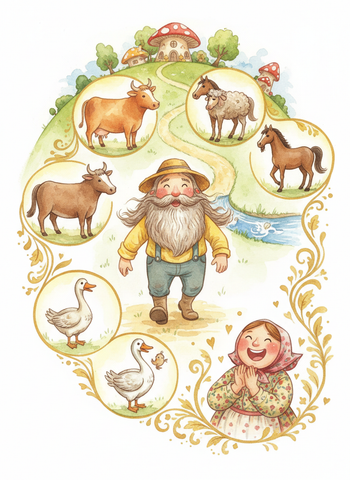
A farmer trades his way down from a cow to almost nothing on the way to market, and his wife is delighted with every single swap.
Once on a time there was a man whose name was Gudbrand; he had a farm which lay far, far away upon a hill-side, and so they called him Gudbrand on the Hill-side.
Había una vez un hombre que se llamaba Gudbrand; tenía una granja que quedaba muy, muy lejos, en la ladera de una colina, y por eso lo llamaban Gudbrand de la Ladera.
Now, you must know this man and his goodwife lived so happily together, and understood one another so well, that all the husband did the wife thought so well done there was nothing like it in the world, and she was always glad whatever he turned his hand to. The farm was their own land, and they had a hundred dollars lying at the bottom of their chest, and two cows tethered up in a stall in their farm-yard.
Pues bien, has de saber que este hombre y su buena esposa vivían tan felices juntos, y se entendían tan bien el uno al otro, que todo lo que el marido hacía le parecía a la esposa tan bien hecho que no había nada igual en el mundo, y ella siempre se alegraba de cualquier cosa a la que él pusiera mano. La granja era tierra propia de ambos, y tenían cien dólares guardados en el fondo de su cofre, y dos vacas atadas en un establo en el corral de la granja.
So one day his wife said to Gudbrand:
Así que un día su esposa le dijo a Gudbrand:
“Do you know, dear, I think we ought to take one of our cows into town, and sell it; that’s what I think; for then we shall have some money in hand, and such well-to-do people as we ought to have ready money like the rest of the world. As for the hundred dollars at the bottom of the chest yonder, we can’t make a hole in them, and I’m sure I don’t know what we want with more than one cow. Besides, we shall gain a little in another way, for then I shall get off with only looking after one cow, instead of having, as now, to feed and litter and water two.”
«¿Sabes, querido? Creo que deberíamos llevar una de nuestras vacas al pueblo y venderla; eso es lo que pienso; porque así tendríamos algo de dinero a mano, y una gente tan acomodada como nosotros debería tener dinero en efectivo como el resto del mundo. En cuanto a los cien dólares del fondo del cofre, no podemos tocarlos, y de veras no sé para qué queremos más de una vaca. Además, ganaremos algo de otra manera, pues entonces solo tendré que ocuparme de una vaca, en lugar de tener que alimentar, poner cama y dar de beber a dos, como ahora.»
Well, Gudbrand thought his wife talked right good sense, so he set off at once with the cow on his way to town to sell her; but when he got to the town, there was no one who would buy his cow.
Bueno, a Gudbrand le pareció que su esposa hablaba con mucho sentido, así que se puso en marcha enseguida con la vaca camino del pueblo para venderla; pero cuando llegó al pueblo, no había nadie que quisiera comprar su vaca.
“Well! well! never mind”, said Gudbrand, “at the worst, I can only go back home again with my cow. I’ve both stable and tether for her, I should think, and the road is no farther out than in”; and with that he began to toddle home with his cow.
«¡Bueno, bueno, no importa!», dijo Gudbrand, «en el peor de los casos, puedo volver a casa con mi vaca. Tengo establo y cuerda para atarla, me parece, y el camino no es más largo de vuelta que de ida»; y con eso se puso a caminar de vuelta a casa con su vaca.
But when he had gone a bit of the way, a man met him who had a horse to sell, so Gudbrand thought ’twas better to have a horse than a cow, so he swopped with the man. A little farther on he met a man walking along and driving a fat pig before him, and he thought it better to have a fat pig than a horse, so he swopped with the man.
Pero cuando había recorrido un trecho del camino, se encontró con un hombre que tenía un caballo para vender, así que Gudbrand pensó que era mejor tener un caballo que una vaca, y cambió con el hombre. Un poco más adelante se encontró con un hombre que iba caminando arreando un cerdo gordo, y pensó que era mejor tener un cerdo gordo que un caballo, así que cambió con aquel hombre.
After that he went a little farther, and a man met him with a goat; so he thought it better to have a goat than a pig, and he swopped with the man that owned the goat. Then he went on a good bit till he met a man who had a sheep, and he swopped with him too, for he thought it always better to have a sheep than a goat.
Después de eso caminó un poco más, y se encontró con un hombre que tenía una cabra; así que pensó que era mejor tener una cabra que un cerdo, y cambió con el hombre dueño de la cabra. Luego siguió un buen trecho hasta que encontró a un hombre que tenía una oveja, y también cambió con él, pues pensó que siempre era mejor tener una oveja que una cabra.
After a while he met a man with a goose, and he swopped away the sheep for the goose; and when he had walked a long, long time, he met a man with a cock, and he swopped with him, for he thought in this wise, “’Tis surely better to have a cock than a goose.” Then he went on till the day was far spent, and he began to get very hungry, so he sold the cock for a shilling, and bought food with the money, for, thought Gudbrand on the Hill-side, “’Tis always better to save one’s life than to have a cock.”
Al cabo de un rato se encontró con un hombre que tenía un ganso, y cambió la oveja por el ganso; y cuando llevaba ya un buen rato, largo rato caminando, se encontró con un hombre que tenía un gallo, y cambió con él, pues pensó así: «Seguramente es mejor tener un gallo que un ganso.» Luego siguió caminando hasta que el día estaba muy avanzado, y empezó a sentir mucha hambre, así que vendió el gallo por un chelín, y compró comida con el dinero, pues pensó Gudbrand de la Ladera: «Siempre es mejor salvar la propia vida que tener un gallo.»
After that he went on home till he reached his nearest neighbour’s house, where he turned in.
Después de eso siguió camino a casa hasta que llegó a la casa de su vecino más cercano, donde entró a descansar.
“Well”, said the owner of the house, “how did things go with you in town?”
«Bueno», dijo el dueño de la casa, «¿cómo te fue en el pueblo?»
“Rather so so”, said Gudbrand, “I can’t praise my luck, nor do I blame it either”, and with that he told the whole story from first to last.
«Así así», dijo Gudbrand, «no puedo alabar mi suerte, pero tampoco puedo quejarme de ella»; y con eso le contó toda la historia de principio a fin.
“Ah!” said his friend, “you’ll get nicely called over the coals, that one can see, when you get home to your wife. Heaven help you, I wouldn’t stand in your shoes for something.”
«¡Ah!», dijo su amigo, «te van a echar una buena reprimenda, eso se ve venir, cuando llegues a casa con tu esposa. Que el cielo te ayude, no me gustaría estar en tu lugar por nada del mundo.»
“Well!” said Gudbrand on the Hill-side, “I think things might have gone much worse with me; but now, whether I have done wrong or not, I have so kind a goodwife, she never has a word to say against anything that I do.”
«¡Bueno!», dijo Gudbrand de la Ladera, «creo que las cosas podrían haberme ido mucho peor; pero ahora, haya hecho mal o no, tengo una esposa tan buena que jamás tiene una palabra en contra de nada de lo que hago.»
“Oh!” answered his neighbour, “I hear what you say, but I don’t believe it for all that.”
«¡Ah!», respondió su vecino, «oigo lo que dices, pero aun así no te lo creo.»
“Shall we lay a bet upon it?” asked Gudbrand on the Hill-side. “I have a hundred dollars at the bottom of my chest at home; will you lay as many against them?”
«¿Apostamos algo?», preguntó Gudbrand de la Ladera. «Tengo cien dólares en el fondo de mi cofre en casa; ¿apuestas otros tantos contra ellos?»
Yes! the friend was ready to bet; so Gudbrand stayed there till evening, when it began to get dark, and then they went together to his house, and the neighbour was to stand outside the door and listen, while the man went in to see his wife.
¡Sí! El amigo estaba dispuesto a apostar; así que Gudbrand se quedó allí hasta el anochecer, cuando empezaba a oscurecer, y entonces fueron juntos hasta su casa, y el vecino se quedaría fuera de la puerta escuchando, mientras el hombre entraba a ver a su esposa.
“Good evening!” said Gudbrand on the Hill-side.
«¡Buenas noches!», dijo Gudbrand de la Ladera.
“Good evening!” said the goodwife. “Oh! is that you? now God be praised.”
«¡Buenas noches!», dijo la buena esposa. «¡Ah! ¿eres tú? Dios sea alabado.»
Yes! it was he. So the wife asked how things had gone with him in town?
Sí, era él. Así que la esposa le preguntó cómo le habían ido las cosas en el pueblo.
“Oh! only so so”, answered Gudbrand; “not much to brag of. When I got to the town there was no one who would buy the cow, so you must know I swopped it away for a horse.”
«Ah, así así», respondió Gudbrand; «no hay mucho de qué presumir. Cuando llegué al pueblo no había nadie que quisiera comprar la vaca, así que, has de saber, la cambié por un caballo.»
“For a horse”, said his wife; “well that is good of you; thanks with all my heart. We are so well to do that we may drive to church, just as well as other people; and if we choose to keep a horse we have a right to get one, I should think. So run out, child, and put up the horse.”
«Por un caballo», dijo su esposa; «bueno, eso está muy bien de tu parte; mil gracias de todo corazón. Somos tan acomodados que podemos ir en carruaje a la iglesia, igual que los demás; y si queremos tener un caballo, tenemos derecho a conseguir uno, me parece. Anda, corre, hijo, y guarda el caballo.»
“Ah!” said Gudbrand, “but you see I’ve not got the horse after all; for when I got a bit farther on the road, I swopped it away for a pig.”
«¡Ah!», dijo Gudbrand, «pero es que no tengo el caballo después de todo; porque cuando llevaba un trecho más de camino, lo cambié por un cerdo.»
“Think of that, now!” said the wife; “you did just as I should have done myself; a thousand thanks! Now I can have a bit of bacon in the house to set before people when they come to see me, that I can. What do we want with a horse? People would only say we had got so proud that we couldn’t walk to church. Go out, child, and put up the pig in the sty.”
«¡Fíjate tú!», dijo la esposa; «hiciste exactamente lo que yo misma habría hecho; mil gracias. Ahora podré tener un poco de tocino en casa para ofrecer a la gente cuando venga a visitarme, eso sí que puedo. ¿Para qué queremos un caballo? La gente solo diría que nos hemos vuelto tan orgullosos que ya no podemos ir a la iglesia a pie. Ve, hijo, y lleva el cerdo a la pocilga.»
“But I’ve not got the pig either”, said Gudbrand; “for when I got a little farther on, I swopped it away for a milch goat.”
«Pero tampoco tengo el cerdo», dijo Gudbrand; «porque cuando llevaba un poco más de camino, lo cambié por una cabra lechera.»
“Bless us!” cried his wife, “how well you manage everything! Now I think it over, what should I do with a pig? People would only point at us and say, ‘Yonder they eat up all they have got.’ No! now I have got a goat, and I shall have milk and cheese, and keep the goat too. Run out, child, and put up the goat.”
«¡Bendito sea!», exclamó su esposa, «¡qué bien manejas todo! Ahora que lo pienso, ¿qué haría yo con un cerdo? La gente solo señalaría y diría: “Ahí se comen todo lo que tienen.” ¡No! Ahora tengo una cabra, y tendré leche y queso, y también conservaré la cabra. Ve, hijo, y lleva la cabra al establo.»
“Nay, but I haven’t got the goat either”, said Gudbrand, “for a little farther on I swopped it away, and got a fine sheep instead.”
«No, tampoco tengo la cabra», dijo Gudbrand, «porque un poco más adelante la cambié, y conseguí en su lugar una buena oveja.»
“You don’t say so!” cried his wife; “why, you do everything to please me, just as if I had been with you; what do we want with a goat? If I had it I should lose half my time in climbing up the hills to get it down. No! if I have a sheep, I shall have both wool and clothing, and fresh meat in the house. Run out, child, and put up the sheep.”
«¡No me digas!», exclamó su esposa; «vaya, haces todo para complacerme, tal como si yo hubiera estado contigo; ¿para qué queremos una cabra? Si la tuviera, perdería la mitad de mi tiempo subiendo a los cerros para bajarla. ¡No! Si tengo una oveja, tendré lana y ropa, y carne fresca en casa. Ve, hijo, y lleva la oveja al corral.»
“But I haven’t got the sheep any more than the rest”, said Gudbrand; “for when I had gone a bit farther, I swopped it away for a goose.”
«Pero no tengo la oveja como tampoco tuve lo demás», dijo Gudbrand; «porque cuando había andado un poco más, la cambié por un ganso.»
“Thank you! thank you! with all my heart”, cried his wife; “what should I do with a sheep? I have no spinning-wheel, nor carding-comb, nor should I care to worry myself with cutting, and shaping, and sewing clothes. We can buy clothes now, as we have always done; and now I shall have roast goose, which I have longed for so often; and, besides, down to stuff my little pillow with. Run out, child, and put up the goose.”
«¡Gracias! ¡Gracias de todo corazón!», exclamó su esposa; «¿qué haría yo con una oveja? No tengo rueca, ni carda, ni me gustaría preocuparme por cortar, dar forma y coser ropa. Podemos comprar la ropa ahora, como siempre lo hemos hecho; y ahora tendré ganso asado, que tanto he deseado a menudo; y además, tendré plumón para rellenar mi almohadita. Ve, hijo, y lleva el ganso.»
“Ah!” said Gudbrand, “but I haven’t the goose either; for when I had gone a bit farther I swopped it away for a cock.”
«¡Ah!», dijo Gudbrand, «pero tampoco tengo el ganso; porque cuando llevaba un poco más de camino, lo cambié por un gallo.»
“Dear me!” cried his wife, “how you think of everything! just as I should have done myself. A cock! think of that! why it’s as good as an eight-day clock, for every morning the cock crows at four o’clock, and we shall be able to stir our stumps in good time. What should we do with a goose? I don’t know how to cook it; and as for my pillow, I can stuff it with cotton-grass. Run out, child, and put up the cock.”
«¡Dios mío!», exclamó su esposa, «¡cómo piensas en todo! Justo como yo misma habría hecho. ¡Un gallo! ¡Fíjate! Vaya, es tan bueno como un reloj de ocho días, pues cada mañana el gallo canta a las cuatro, y así podremos movernos temprano. ¿Qué haríamos con un ganso? No sé cómo cocinarlo; y en cuanto a mi almohada, puedo rellenarla con algodoncillo. Ve, hijo, y lleva el gallo.»
“But, after all, I haven’t got the cock”, said Gudbrand; “for when I had gone a bit farther, I got as hungry as a hunter, so I was forced to sell the cock for a shilling, for fear I should starve.”
«Pero, después de todo, no tengo el gallo», dijo Gudbrand; «porque cuando había andado un poco más, me dio un hambre de fiera, así que me vi obligado a vender el gallo por un chelín, por miedo a morirme de hambre.»
“Now, God be praised that you did so!” cried his wife; “whatever you do, you do it always just after my own heart. What should we do with the cock? We are our own masters, I should think, and can lie a-bed in the morning as long as we like. Heaven be thanked that I have got you safe back again; you who do everything so well that I want neither cock nor goose; neither pigs nor kine.”
«¡Ahora sí que Dios sea alabado por eso!», exclamó su esposa; «cualquier cosa que hagas, siempre la haces justo como a mí me gusta. ¿Qué haríamos con el gallo? Somos dueños de nosotros mismos, me parece, y podemos quedarnos en la cama por la mañana todo lo que queramos. ¡Bendito sea el cielo de que te tenga de vuelta sano y salvo; tú que haces todo tan bien que no necesito ni gallo ni ganso, ni cerdos ni vacas!»
Then Gudbrand opened the door and said; “Well, what do you say now? Have I won the hundred dollars?” and his neighbour was forced to allow that he had.
Entonces Gudbrand abrió la puerta y dijo: «Bueno, ¿qué dices ahora? ¿He ganado los cien dólares?»; y su vecino tuvo que admitir que sí los había ganado.
