The Bell-Deep
A free C1-level English story for language learners, readable online in 7 languages, with an option to listen via the free Storyteller app.
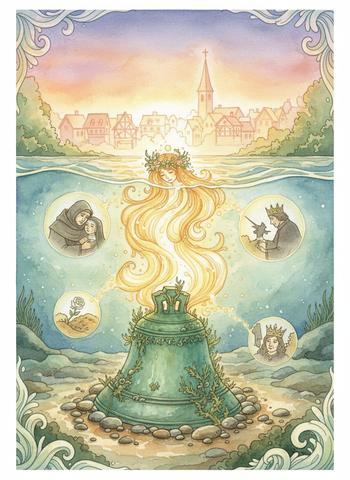
In the depths of the Odense-Au a sunken church bell talks each night with the river's water-spirit, retelling the town's darkest secrets — a monk's forbidden love, a buried nun, and the murder of a king.
"Ding-dong! ding-dong!" It sounds up from the "bell-deep" in the Odense-Au. Every child in the old town of Odense, on the island of Funen, knows the Au, which washes the gardens round about the town, and flows on under the wooden bridges from the dam to the water-mill.
«¡Din-don! ¡din-don!» Así suena desde el «pozo de la campana» en el Odense-Au. Todos los niños de la vieja ciudad de Odense, en la isla de Funen, conocen el Au, que baña los jardines de los alrededores de la ciudad, y sigue fluyendo bajo los puentes de madera desde la represa hasta el molino de agua.
In the Au grow the yellow water-lilies and brown feathery reeds; the dark velvety flag grows there, high and thick; old and decayed willows, slanting and tottering, hang far out over the stream beside the monk's meadow and by the bleaching ground; but opposite there are gardens upon gardens, each different from the rest, some with pretty flowers and bowers like little dolls' pleasure grounds, often displaying cabbage and other kitchen plants; and here and there the gardens cannot be seen at all, for the great elder trees that spread themselves out by the bank, and hang far out over the streaming waters, which are deeper here and there than an oar can fathom.
En el Au crecen los nenúfares amarillos y los cañaverales plumosos de color pardo; allí crece también la oscura y aterciopelada espadaña, alta y espesa; sauces viejos y decrépitos, inclinados y vacilantes, se asoman muy por encima de la corriente junto al prado de los monjes y junto al blanqueadero; pero enfrente hay jardines tras jardines, cada uno distinto de los demás, algunos con hermosas flores y glorietas como pequeños jardines de recreo para muñecas, mostrando a menudo repollos y otras hortalizas de cocina; y aquí y allá los jardines no pueden verse en absoluto, por los grandes saúcos que se extienden junto a la orilla, y se asoman muy por encima de las aguas corrientes, que son en algunos lugares más profundas de lo que un remo puede sondear.
Opposite the old nunnery is the deepest place, which is called the "bell-deep," and there dwells the old water spirit, the "Au-mann." This spirit sleeps through the day while the sun shines down upon the water; but in starry and moonlit nights he shows himself. He is very old.
Frente al antiguo convento de monjas está el lugar más profundo, que se llama el «pozo de la campana», y allí habita el viejo espíritu del agua, el «Au-mann». Este espíritu duerme durante el día mientras el sol brilla sobre el agua; pero en las noches estrelladas y de luna se muestra. Es muy viejo.
Grandmother says that she has heard her own grandmother tell of him; he is said to lead a solitary life, and to have nobody with whom he can converse save the great old church Bell. Once the Bell hung in the church tower; but now there is no trace left of the tower or of the church, which was called St. Alban's.
La abuela dice que ha oído a su propia abuela hablar de él; se dice que lleva una vida solitaria, y que no tiene con quién conversar salvo la gran y vieja Campana de la iglesia. Antaño la Campana colgaba en la torre de la iglesia; pero ahora no queda rastro de la torre ni de la iglesia, que se llamaba San Albano.
"Ding-dong! ding-dong!" sounded the Bell, when the tower still stood there; and one evening, while the sun was setting, and the Bell was swinging away bravely, it broke loose and came flying down through the air, the brilliant metal shining in the ruddy beam.
«¡Din-don! ¡din-don!», sonaba la Campana, cuando la torre todavía estaba en pie; y una tarde, mientras se ponía el sol, y la Campana se balanceaba valientemente, se soltó y vino volando por el aire, brillando el metal reluciente bajo el rayo rojizo.
"Ding-dong! ding-dong! Now I'll retire to rest!" sang the Bell, and flew down into the Odense-Au, where it is deepest; and that is why the place is called the "bell-deep."
«¡Din-don! ¡din-don! ¡Ahora me retiraré a descansar!», cantó la Campana, y voló hasta caer en el Odense-Au, donde es más profundo; y por eso el lugar se llama el «pozo de la campana».
But the Bell got neither rest nor sleep. Down in the Au-mann's haunt it sounds and rings, so that the tones sometimes pierce upward through the waters; and many people maintain that its strains forebode the death of some one; but that is not true, for the Bell is only talking with the Au-mann, who is now no longer alone.
Pero la Campana no encontró ni descanso ni sueño. Allá abajo, en la guarida del Au-mann, resuena y tañe, de modo que sus tonos a veces atraviesan hacia arriba a través de las aguas; y mucha gente sostiene que sus acordes presagian la muerte de alguien; pero eso no es cierto, pues la Campana solo está conversando con el Au-mann, quien ya no está solo.
And what is the Bell telling? It is old, very old, as we have already observed; it was there long before grandmother's grandmother was born; and yet it is but a child in comparison with the Au-mann, who is quite an old quiet personage, an oddity, with his hose of eel-skin, and his scaly Jacket with the yellow lilies for buttons, and a wreath of reed in his hair and seaweed in his beard; but he looks very pretty for all that.
¿Y qué cuenta la Campana? Es vieja, muy vieja, como ya hemos observado; estaba allí mucho antes de que naciera la abuela de la abuela; y sin embargo no es más que una niña en comparación con el Au-mann, quien es todo un viejo y sosegado personaje, un ser peculiar, con sus calzas de piel de anguila, y su chaqueta escamosa con nenúfares amarillos por botones, y una guirnalda de junco en el pelo y algas en la barba; pero aun así se ve muy hermoso.
What the Bell tells? To repeat it all would require years and days; for year by year it is telling the old stories, sometimes short ones, sometimes long ones, according to its whim; it tells of old times, of the dark hard times, thus:
¿Qué cuenta la Campana? Repetirlo todo llevaría años y días; pues año tras año va contando las viejas historias, a veces cortas, a veces largas, según su antojo; cuenta de tiempos antiguos, de los tiempos oscuros y duros, así:
"In the church of St. Alban, the monk had mounted up into the tower. He was young and handsome, but thoughtful exceedingly. He looked through the loophole out upon the Odense-Au, when the bed of the water was yet broad, and the monks' meadow was still a lake. He looked out over it, and over the rampart, and over the nuns' hill opposite, where the convent lay, and the light gleamed forth from the nun's cell. He had known the nun right well, and he thought of her, and his heart beat quicker as he thought. Ding-dong! ding-dong!"
«En la iglesia de San Albano, el monje había subido a la torre. Era joven y apuesto, pero sumamente pensativo. Miraba por la tronera hacia el Odense-Au, cuando el lecho del agua era aún ancho, y el prado de los monjes era todavía un lago. Miraba hacia afuera, y por encima del terraplén, y por encima de la colina de las monjas enfrente, donde estaba el convento, y la luz brillaba desde la celda de la monja. Había conocido bien a la monja, y pensaba en ella, y su corazón latía más deprisa al pensarlo. ¡Din-don! ¡din-don!»
Yes, this was the story the Bell told.
Sí, esa era la historia que contaba la Campana.
"Into the tower came also the dapper man-servant of the bishop; and when I, the Bell, who am made of metal, rang hard and loud, and swung to and fro, I might have beaten out his brains. He sat down close under me, and played with two little sticks as if they had been a stringed instrument; and he sang to it.
«También subió a la torre el elegante sirviente del obispo; y cuando yo, la Campana, hecha de metal, sonaba fuerte y alto, y me balanceaba de un lado a otro, podría haberle destrozado los sesos. Se sentaba justo debajo de mí, y jugaba con dos palitos como si fueran un instrumento de cuerda; y le cantaba.
"'Now I may sing it out aloud, though at other times I may not whisper it. I may sing of everything that is kept concealed behind lock and bars. Yonder it is cold and wet. The rats are eating her up alive! Nobody knows of it! Nobody hears of it! Not even now, for the bell is ringing and singing its loud Ding-dong, ding-dong!'
»"Ahora puedo cantarlo en voz alta, aunque en otras ocasiones no pueda ni susurrarlo. Puedo cantar de todo lo que se guarda oculto tras candado y barrotes. Allá está frío y húmedo. ¡Las ratas se la están comiendo viva! ¡Nadie lo sabe! ¡Nadie lo oye! Ni siquiera ahora, pues la campana suena y canta su fuerte Din-don, din-don!"
"There was a King in those days. They called him Canute. He bowed himself before bishop and monk; but when he offended the free peasants with heavy taxes and hard words, they seized their weapons and put him to flight like a wild beast. He sought shelter in the church, and shut gate and door behind him. The violent band surrounded the church; I heard tell of it. The crows, ravens and magpies started up in terror at the yelling and shouting that sounded around. They flew into the tower and out again, they looked down upon the throng below, and they also looked into the windows of the church, and screamed out aloud what they saw there.
»Había un Rey en aquellos días. Lo llamaban Canuto. Se inclinaba ante obispo y monje; pero cuando ofendió a los campesinos libres con pesados impuestos y palabras duras, ellos tomaron sus armas y lo pusieron en fuga como a una bestia salvaje. Buscó refugio en la iglesia, y cerró tras de sí el portón y la puerta. La turba violenta rodeó la iglesia; oí hablar de ello. Los cuervos, grajos y urracas se alzaron aterrados ante los gritos y alaridos que resonaban alrededor. Volaron a la torre y salieron de nuevo, miraron hacia abajo a la multitud, y también miraron por las ventanas de la iglesia, y gritaron a voz en cuello lo que veían allí.
"King Canute knelt before the altar in prayer; his brothers Eric and Benedict stood by him as a guard with drawn swords; but the King's servant, the treacherous Blake, betrayed his master. The throng in front of the church knew where they could hit the King, and one of them flung a stone through a pane of glass, and the King lay there dead! The cries and screams of the savage horde and of the birds sounded through the air, and I joined in it also; for I sang 'Ding-dong! ding-dong!'
»El rey Canuto se arrodillaba ante el altar en oración; sus hermanos Erico y Benedicto estaban junto a él como guardia con espadas desenvainadas; pero el sirviente del Rey, el traicionero Blake, traicionó a su amo. La turba frente a la iglesia sabía dónde podían dar con el Rey, y uno de ellos arrojó una piedra a través de un vidrio, ¡y el Rey quedó allí muerto! Los gritos y alaridos de la horda salvaje y de las aves resonaron por el aire, y yo también me uní; pues canté "¡Din-don! ¡din-don!"
"The church bell hangs high, and looks far around, and sees the birds around it, and understands their language. The wind roars in upon it through windows and loopholes; and the wind knows everything, for he gets it from the air, which encircles all things, and the church bell understands his tongue, and rings it out into the world, 'Ding-dong! ding-dong!'
»La campana de la iglesia cuelga en lo alto, y mira lejos a su alrededor, y ve a las aves que la rodean, y comprende su lenguaje. El viento ruge sobre ella a través de ventanas y troneras; y el viento lo sabe todo, pues lo obtiene del aire, que envuelve todas las cosas, y la campana de la iglesia comprende su lengua, y la hace resonar por el mundo, "¡Din-don! ¡din-don!"
"But it was too much for me to hear and to know; I was not able any longer to ring it out. I became so tired, so heavy, that the beam broke, and I flew out into the gleaming Au, where the water is deepest, and where the Au-mann lives, solitary and alone; and year by year I tell him what I have heard and what I know. Ding-dong! ding-dong!"
»Pero era demasiado para mí oír y saber; ya no era capaz de seguir haciéndolo sonar. Me volví tan cansada, tan pesada, que la viga se rompió, y salí volando hacia el reluciente Au, donde el agua es más profunda, y donde vive el Au-mann, solitario y solo; y año tras año le cuento lo que he oído y lo que sé. ¡Din-don! ¡din-don!»
Thus it sounds complainingly out of the bell-deep in the Odense-Au. That is what grandmother told us.
Así resuena, quejumbrosa, desde el pozo de la campana en el Odense-Au. Eso fue lo que nos contó la abuela.
But the schoolmaster says that there was not any bell that rung down there, for that it could not do so; and that no Au-mann dwelt yonder, for there was no Au-mann at all! And when all the other church bells are sounding sweetly, he says that it is not really the bells that are sounding, but that it is the air itself which sends forth the notes; and grandmother said to us that the Bell itself said it was the air who told it to him, consequently they are agreed on that point, and this much is sure.
Pero el maestro de escuela dice que allí abajo no sonaba campana alguna, pues no podía hacerlo; y que ningún Au-mann habitaba allá, ¡pues no existía ningún Au-mann en absoluto! Y cuando todas las demás campanas de la iglesia suenan dulcemente, dice que en realidad no son las campanas las que suenan, sino que es el aire mismo el que emite las notas; y la abuela nos dijo que la propia Campana decía que era el aire quien se lo contaba a ella, así que están de acuerdo en ese punto, y de eso al menos podemos estar seguros.
"Be cautious, cautious, and take good heed to thyself," they both say.
«Sé cauteloso, cauteloso, y ten mucho cuidado contigo mismo», dicen ambos.
The air knows everything. It is around us, it is in us, it talks of our thoughts and of our deeds, and it speaks longer of them than does the Bell down in the depths of the Odense-Au where the Au-mann dwells. It rings it out in the vault of heaven, far, far out, forever and ever, till the heaven bells sound "Ding-dong! ding-dong!"
El aire lo sabe todo. Está a nuestro alrededor, está dentro de nosotros, habla de nuestros pensamientos y de nuestras obras, y habla de ellos más tiempo del que habla la Campana allá abajo, en las profundidades del Odense-Au, donde el Au-mann habita. Lo hace resonar en la bóveda del cielo, lejos, muy lejos, por siempre jamás, hasta que las campanas del cielo suenen «¡Din-don! ¡din-don!»
