The Companions of Ulysses
A free B2-level English story for language learners, readable online in 7 languages, with an option to listen via the free Storyteller app.
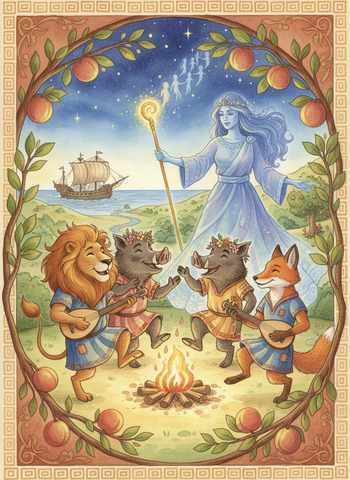
Circe transforms Ulysses' companions into animals, but when offered a chance to become human again, they refuse — choosing freedom and passion over their former lives.
That great hero-wanderer Ulysses had been with his companions driven hither and thither at the will of the winds for ten years, never knowing what their ultimate fate was to be. At length they disembarked upon a shore where Circe, the daughter of Apollo, held her court. Receiving them she brewed a delicious but baneful liquor, which she made them drink. The result of this was that first they lost their reason, and a few moments after, their bodies took the forms and features of various animals; some unwieldy, some small. Ulysses alone, having the wisdom to withstand the temptation of the treacherous cup, escaped the metamorphosis.
Aquel gran héroe errante, Ulises, había sido llevado junto con sus compañeros de un lado a otro por voluntad de los vientos durante diez años, sin saber nunca cuál sería su destino final. Al fin desembarcaron en una costa donde Circe, la hija de Apolo, tenía su corte. Al recibirlos, ella preparó un licor delicioso pero funesto, que les hizo beber. El resultado de esto fue que primero perdieron la razón, y a los pocos instantes, sus cuerpos tomaron las formas y rasgos de diversos animales; algunos torpes, algunos pequeños. Solo Ulises, que tuvo la sabiduría de resistir la tentación de la copa traicionera, escapó de la metamorfosis.
He, besides possessing wisdom, bore the look of a hero and had the gift of honeyed speech, so that it came about that the goddess herself imbibed a poison little different from her own; that is to say, she became enamoured of the hero and declared her love to him. Now was the time for Ulysses to profit by this turn of events, and he was too cunning to miss the opportunity, so he begged and obtained the boon that his friends should be restored to their natural shapes.
Él, además de poseer sabiduría, tenía el porte de un héroe y el don de la palabra melosa, de modo que ocurrió que la propia diosa bebió un veneno poco distinto del suyo; es decir, se enamoró del héroe y le declaró su amor. Ahora era el momento de que Ulises sacara provecho de este giro de los acontecimientos, y fue demasiado astuto para dejar pasar la oportunidad, así que suplicó y obtuvo el favor de que sus amigos recuperaran sus formas naturales.
"But will they be willing to accept their own forms again?" asked the nymph. "Go to them and make them the offer."
«Pero ¿estarán dispuestos a aceptar de nuevo su propia forma?», preguntó la ninfa. «Ve con ellos y hazles la propuesta».
Ulysses, glad and eager, ran to his Greeks and cried, "The poisoned cup has its remedy, and I come to offer it to you. Dear friends of mine, will you not be glad to have your manly forms again? Speak, for your speech is already restored."
Ulises, contento y ansioso, corrió hacia sus griegos y exclamó: «La copa envenenada tiene su remedio, y vengo a ofrecéroslo. Queridos amigos míos, ¿no os alegraría recuperar vuestras formas de hombres? Hablad, pues vuestro habla ya ha sido restaurada».
The lion was the first to reply. Making an effort to roar he said, "I, for one, am not such a fool. What! renounce all the great advantages that have just been given me? I have teeth. I have claws. I can pull to pieces anything that attacks me. I am, in fact, a king. Do you think it would suit me to become a citizen of Ithaca once more? Who knows but that you might make of me a common soldier again. Thank you; but I will remain as I am."
El león fue el primero en responder. Haciendo un esfuerzo por rugir, dijo: «Yo, por mi parte, no soy tan necio. ¿Cómo? ¿Renunciar a todas las grandes ventajas que acaban de darme? Tengo dientes. Tengo garras. Puedo hacer pedazos a cualquiera que me ataque. Soy, de hecho, un rey. ¿Crees que me convendría volver a ser un ciudadano de Ítaca? Quién sabe si volverías a hacer de mí un simple soldado. Gracias, pero seguiré como estoy».
Ulysses, in sad surprise, turned to the bear. "Ah, brother! what form is this you have taken, you who used to be so handsome?"
Ulises, con triste sorpresa, se volvió hacia el oso. «¡Ah, hermano! ¿Qué forma es esta que has tomado, tú que solías ser tan apuesto?».
"Well, really! I like that!" said the bear in his way. "What form is this? you ask. Why it is the form that a bear should have. Pray who instructed you that one form is more handsome than another? Is it your business to judge between us?
«¡Vaya, hombre! ¡Esa sí que es buena!», dijo el oso a su manera. «¿Que qué forma es esta, preguntas? Pues es la forma que un oso debe tener. Dime, ¿quién te enseñó que una forma es más hermosa que otra? ¿Acaso es asunto tuyo juzgar entre nosotros?
I prefer to appeal to the sight of the gentler sex in our ursine race. Do I displease you? Then pass on. Go your ways and leave me to mine. I am free and content as I am, and I tell you frankly and flatly that I will not change my state."
Prefiero apelar a la mirada de las hembras de nuestra raza osuna. ¿Te desagrado? Entonces sigue tu camino. Ve por tu senda y déjame por la mía. Soy libre y estoy contento tal como soy, y te digo con toda franqueza y sin rodeos que no cambiaré mi condición».
The princely Greek then turned to a wolf with the same proposals, and risking a similar rebuff said: "Comrade, it overwhelms me that a sweet young shepherdess should be driven to complain to the echoing crags of the gluttonous appetite that impelled you to devour her sheep. Time was when you would have protected her sheepfold. In those days you led an honest life. Leave your lairs and become, instead of a wolf, an honest man again."
El noble griego se dirigió entonces a un lobo con la misma propuesta, y arriesgándose a un rechazo similar, dijo: «Camarada, me abruma que una dulce joven pastora se haya visto obligada a quejarse ante los riscos resonantes del apetito glotón que te impulsó a devorar sus ovejas. Hubo un tiempo en que habrías protegido su redil. En aquellos días llevabas una vida honrada. Deja tu guarida y vuélvete, en lugar de lobo, un hombre honrado otra vez».
"What is that?" answered the wolf. "I don't see your point. You come here treating me as though I were a carnivorous beast. But what are you, who are talking in this strain? Would not you and yours have eaten these sheep, which all the village is deploring, if I had not? Now say, on your oath, do you really think I should have loved slaughter any less if I had remained a man?
«¿Qué es eso?», respondió el lobo. «No entiendo tu punto. Vienes aquí tratándome como si fuera una bestia carnívora. Pero ¿qué eres tú, que hablas en ese tono? ¿No os habríais comido tú y los tuyos estas ovejas, que todo el pueblo lamenta, si yo no lo hubiera hecho? Ahora dime, bajo juramento, ¿de verdad crees que habría amado menos la matanza si hubiera seguido siendo hombre?
For a mere word, you men are at times ready to strangle each other. Are you not, therefore, as wolves one to another? All things considered, I maintain as a matter of fact that, rascal for rascal, it is better to be a wolf than a man. I decline to make any change in my condition."
Por una simple palabra, vosotros los hombres estáis a veces dispuestos a estrangularos unos a otros. ¿No sois, entonces, lobos los unos para los otros? Considerando todo, sostengo, como cosa cierta, que, granuja por granuja, es mejor ser lobo que hombre. Me niego a hacer ningún cambio en mi condición».
In this way did Ulysses go from one to another making the same representations and receiving from all, large and small alike, the same refusals. Liberty, unbridled lust of appetite, the ambushes of the woods, all these things were their supreme delight. They all renounced the glory attaching to great deeds.
De esta manera fue Ulises de uno a otro haciendo las mismas proposiciones y recibiendo de todos, grandes y pequeños por igual, las mismas negativas. La libertad, el apetito sin freno, las emboscadas de los bosques, todas estas cosas eran su supremo deleite. Todos renunciaron a la gloria que acompaña a las grandes hazañas.
They thought that in following their passions they were enjoying freedom, not seeing that they were but slaves to themselves.
Creían que, siguiendo sus pasiones, gozaban de libertad, sin ver que no eran sino esclavos de sí mismos.
