Tatterhood
A free B1-level English story for language learners, readable online in 7 languages, with an option to listen via the free Storyteller app.
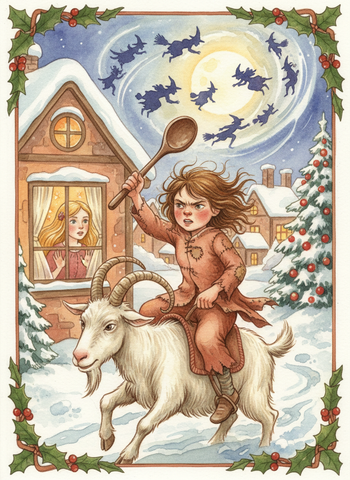
Born wild and unlovely while her twin is born beautiful, Tatterhood rides a goat and swings a wooden spoon — and she is the only one brave enough to face the witches who attack on Christmas Eve.
Once on a time there was a king and a queen who had no children, and that gave the queen much grief; she scarce had one happy hour. She was always bewailing and bemoaning herself, and saying how dull and lonesome it was in the palace.
Era uma vez um rei e uma rainha que não tinham filhos, e isso causava grande tristeza à rainha; ela quase não tinha uma hora feliz sequer. Vivia sempre se lamentando e se lastimando, dizendo como era monótono e solitário no palácio.
“If we had children there’d be life enough”, she said.
— Se tivéssemos filhos, haveria vida de sobra — dizia ela.
Wherever she went in all her realm she found God’s blessing in children, even in the vilest hut; and wherever she came she heard the Goodies scolding the bairns, and saying how they had done that and that wrong. All this the queen heard, and thought it would be so nice to do as other women did. At last the king and queen took into their palace a stranger lassie to rear up, that they might have her always with them, to love her if she did well, and scold her if she did wrong, like their own child.
Onde quer que fosse em todo o seu reino, encontrava a bênção de Deus em forma de crianças, até mesmo na mais humilde cabana; e onde quer que chegasse, ouvia as boas mulheres repreendendo seus filhos, e dizendo como tinham feito isso e aquilo de errado. Tudo isso a rainha ouvia, e pensava como seria bom fazer como as outras mulheres faziam. Por fim, o rei e a rainha acolheram no palácio uma menina estranha para criar, para que a tivessem sempre com eles, para amá-la se fizesse bem, e repreendê-la se fizesse mal, como se fosse sua própria filha.
So one day the little lassie whom they had taken as their own, ran down into the palace yard, and was playing with a gold apple. Just then an old beggar wife came by, who had a little girl with her, and it wasn’t long before the little lassie and the beggar’s bairn were great friends, and began to play together, and to toss the gold apple about between them.
Então, certo dia, a menininha que tinham acolhido como sua correu para o pátio do palácio, e estava brincando com uma maçã de ouro. Bem nessa hora, passou uma velha mendiga, que tinha uma menininha com ela, e não demorou muito para que a menininha e a filha da mendiga se tornassem grandes amigas, e começassem a brincar juntas, e a jogar a maçã de ouro uma para a outra.
When the Queen saw this, as she sat at a window in the palace, she tapped on the pane for her foster-daughter to come up. She went at once, but the beggar-girl went up too; and as they went into the Queen’s bower, each held the other by the hand. Then the Queen began to scold the little lady, and to say:
Quando a Rainha viu isso, sentada à janela do palácio, bateu na vidraça para que sua filha adotiva subisse. Ela foi na mesma hora, mas a menina mendiga subiu também; e enquanto entravam nos aposentos da Rainha, cada uma segurava a mão da outra. Então a Rainha começou a repreender a pequena dama, dizendo:
“You ought to be above running about and playing with a tattered beggar’s brat.”
— Você devia estar acima de correr por aí brincando com a cria maltrapilha de uma mendiga.
And so she wanted to drive the lassie downstairs.
E assim quis expulsar a menininha escada abaixo.
“If the Queen only knew my mother’s power, she’d not drive me out”, said the little lassie; and when the Queen asked what she meant more plainly, she told her how her mother could get her children if she chose. The Queen wouldn’t believe it, but the lassie held her own, and said every word of it was true, and bade the Queen only to try and make her mother do it. So the Queen sent the lassie down to fetch up her mother.
— Se a Rainha soubesse do poder de minha mãe, não me expulsaria — disse a menininha; e quando a Rainha perguntou o que ela queria dizer com mais clareza, ela contou como sua mãe podia lhe dar filhos, se quisesse. A Rainha não quis acreditar, mas a menina se manteve firme, e disse que cada palavra daquilo era verdade, e pediu que a Rainha simplesmente tentasse fazer com que sua mãe fizesse isso. Então a Rainha mandou a menina descer para buscar sua mãe.
“Do you know what your daughter says?” asked the Queen of the old woman, as soon as ever she came into the room.
— Você sabe o que sua filha diz? — perguntou a Rainha à velha, assim que ela entrou no quarto.
No; the beggar wife knew nothing about it.
Não; a mendiga não sabia de nada.
“Well, she says you can get me children if you will”, answered the Queen.
— Bem, ela diz que você pode me arranjar filhos, se quiser — respondeu a Rainha.
“Queens shouldn’t listen to beggar lassies’ silly stories”, said the old wife, and strode out of the room.
— Rainhas não deveriam dar ouvidos às histórias bobas de meninas mendigas — disse a velha, e saiu do quarto a passos largos.
Then the Queen got angry, and wanted again to drive out the little lassie; but she declared it was true every word that she had said.
Então a Rainha ficou zangada, e quis expulsar a menininha de novo; mas ela insistia que cada palavra que tinha dito era verdade.
“Let the Queen only give my mother a drop to drink,” said the lassie; “when she gets merry she’ll soon find out a way to help you.”
— Que a Rainha dê apenas um gole de bebida à minha mãe — disse a menina —; quando ela ficar alegre, logo vai encontrar um jeito de ajudar a senhora.
The Queen was ready to try this; so the beggar wife was fetched up again once more, and treated both with wine and mead as much as she chose; and so it was not long before her tongue began to wag. Then the Queen came out again with the same question she had asked before.
A Rainha estava disposta a tentar isso; então a mendiga foi chamada mais uma vez, e foi tratada com vinho e hidromel à vontade; e assim não demorou muito para que sua língua começasse a soltar. Então a Rainha voltou com a mesma pergunta que tinha feito antes.
“One way to help you perhaps I know”, said the beggar wife. “Your Majesty must make them bring in two pails of water some evening before you go to bed. In each of them you must wash yourself, and afterwards throw away the water under the bed. When you look under the bed next morning, two flowers will have sprung up, one fair and one ugly. The fair one you must eat, the ugly one you must let stand; but mind you don’t forget the last.”
— Um jeito de ajudar a senhora, talvez eu saiba — disse a mendiga. — Sua Majestade deve mandar trazerem dois baldes de água numa noite antes de ir para a cama. Em cada um deles, a senhora deve se lavar, e depois jogar a água fora debaixo da cama. Quando a senhora olhar debaixo da cama na manhã seguinte, duas flores terão brotado, uma bonita e uma feia. A bonita a senhora deve comer, a feia a senhora deve deixar ficar; mas cuidado para não esquecer isso último.
That was what the beggar wife said.
Foi isso o que a mendiga disse.
Yes; the Queen did what the beggar wife advised her to do; she had the water brought up in two pails, washed herself in them, and emptied them under the bed; and lo! when she looked under the bed next morning, there stood two flowers; one was ugly and foul, and had black leaves; but the other was so bright, and fair, and lovely, she had never seen its like; so she ate it up at once. But the pretty flower tasted so sweet, that she couldn’t help herself. She ate the other up too, for, she thought, “it can’t hurt or help one much either way, I’ll be bound”.
Sim; a Rainha fez como a mendiga lhe aconselhou; mandou trazer a água em dois baldes, lavou-se neles, e os esvaziou debaixo da cama; e eis que, quando olhou debaixo da cama na manhã seguinte, ali estavam duas flores; uma era feia e repugnante, e tinha folhas negras; mas a outra era tão brilhante, e bonita, e adorável, que ela nunca tinha visto nada igual; então a comeu na hora. Mas a flor bonita tinha um gosto tão doce, que ela não conseguiu se conter. Comeu a outra também, pois, pensou ela, “não pode fazer mal nem bem demais de um jeito ou de outro, tenho certeza”.
Well, sure enough, after a while the Queen was brought to bed. First of all, she had a girl who had a wooden spoon in her hand, and rode upon a goat; loathly and ugly she was, and the very moment she came into the world, she bawled out “Mamma”.
Bem, com certeza, depois de um tempo a Rainha entrou em trabalho de parto. Primeiro, teve uma menina que segurava uma colher de pau na mão, e cavalgava um bode; era feia e repugnante, e no exato momento em que veio ao mundo, gritou “Mamãe”.
“If I’m your mamma”, said the Queen, “God give me grace to mend my ways.”
— Se eu sou sua mamãe — disse a Rainha —, que Deus me dê a graça de melhorar meus modos.
“Oh, don’t be sorry”, said the girl, who rode on the goat, “for one will soon come after me who is better looking.”
— Ah, não fique triste — disse a menina que cavalgava o bode —, pois logo virá outra atrás de mim, que é mais bonita.
So, after a while, the Queen had another girl, who was so fair and sweet, no one had ever set eyes on such a lovely child, and with her you may fancy the Queen was very well pleased. The elder twin they called “Tatterhood”, because she was always so ugly and ragged, and because she had a hood which hung about her ears in tatters. The Queen could scarce bear to look at her, and the nurses tried to shut her up in a room by herself, but it was all no good; where the younger twin was, there she must also be, and no one could ever keep them apart.
Então, depois de um tempo, a Rainha teve outra menina, que era tão bonita e doce, que ninguém jamais tinha posto os olhos numa criança tão adorável, e com ela, podem imaginar, a Rainha ficou muito satisfeita. À gêmea mais velha chamavam de “Capuz-de-Trapos”, porque ela era sempre tão feia e esfarrapada, e porque tinha um capuz que pendia em farrapos ao redor de suas orelhas. A Rainha mal conseguia suportar olhar para ela, e as amas tentaram trancá-la sozinha num quarto, mas de nada adiantou; onde estivesse a gêmea mais nova, ali ela também tinha que estar, e ninguém jamais conseguia mantê-las separadas.
Well, one Christmas eve, when they were half grown up, there rose such a frightful noise and clatter in the gallery outside the Queen’s bower. So Tatterhood asked what it was that dashed and crashed so out in the passage.
Bem, certa véspera de Natal, quando já estavam quase crescidas, ergueu-se um barulho tão apavorante e um estrépito na galeria fora dos aposentos da Rainha. Então Capuz-de-Trapos perguntou o que era aquilo que batia e estrondava tanto lá fora, no corredor.
“Oh!” said the Queen, “it isn’t worth asking about.”
— Ah! — disse a Rainha —, não vale a pena perguntar sobre isso.
But Tatterhood wouldn’t give over till she found out all about it and so the Queen told her it was a pack of Trolls and witches who had come there to keep Christmas. So Tatterhood said she’d just go out and drive them away; and in spite of all they could say, and however much they begged and prayed her to let the Trolls alone, she must and would go out to drive the witches off; but she begged the Queen to mind and keep all the doors close shut, so that not one of them came so much as the least bit ajar.
Mas Capuz-de-Trapos não desistiu até descobrir tudo sobre aquilo, e então a Rainha lhe contou que era uma horda de Trolls e bruxas que tinham vindo comemorar o Natal ali. Então Capuz-de-Trapos disse que ia sair e expulsá-los; e apesar de tudo o que pudessem dizer, e por mais que implorassem e rogassem que deixasse os Trolls em paz, ela tinha que ir, e ia mesmo, expulsar as bruxas; mas pediu à Rainha que se lembrasse de manter todas as portas bem fechadas, para que nenhuma delas ficasse sequer um pouquinho entreaberta.
Having said this, off she went with her wooden spoon, and began to hunt and sweep away the hags; and all this while there was such a pother out in the gallery, the like of it was never heard. The whole Palace creaked and groaned as if every joint and beam were going to be torn out of its place.
Tendo dito isso, saiu com sua colher de pau, e começou a caçar e a varrer as bruxas para longe; e durante todo esse tempo houve um alvoroço tão grande lá fora, na galeria, como nunca se ouviu igual. O Palácio inteiro rangia e gemia como se cada junta e cada viga fossem ser arrancadas de seu lugar.
Now, how it was, I’m sure I can’t tell; but somehow or other one door did get the least bit ajar, then her twin sister just peeped out to see how things were going with Tatterhood, and put her head a tiny bit through the opening. But, POP! up came an old witch, and whipped off her head, and stuck a calf’s head on her shoulders instead; and so the Princess ran back into the room on all-fours, and began to “moo” like a calf.
Ora, como foi que aconteceu, isso eu realmente não sei dizer; mas de algum jeito uma porta ficou um pouquinho entreaberta, e então sua irmã gêmea apenas espiou para ver como iam as coisas com Capuz-de-Trapos, e pôs a cabeça um pouquinho para fora pela abertura. Mas, pum! Surgiu uma velha bruxa, e arrancou-lhe a cabeça de um golpe, e colocou uma cabeça de bezerro em seus ombros no lugar; e assim a Princesa correu de volta para o quarto de quatro patas, e começou a “mugir” como um bezerro.
When Tatterhood came back and saw her sister, she scolded them all round, and was very angry because they hadn’t kept better watch, and asked them what they thought of their heedlessness now, when her sister was turned into a calf.
Quando Capuz-de-Trapos voltou e viu sua irmã, repreendeu a todos, e ficou muito zangada porque não tinham vigiado melhor, e perguntou o que achavam agora de sua imprudência, quando a irmã tinha se transformado num bezerro.
“But still I’ll see if I can’t set her free”, she said.
— Mas ainda assim vou ver se não consigo libertá-la — disse ela.
Then she asked the King for a ship in full trim, and well fitted with stores; but captain and sailors she wouldn’t have. No; she would sail away with her sister all alone; and as there was no holding her back, at last they let her have her own way.
Então pediu ao Rei um navio bem equipado, e bem provido de mantimentos; mas capitão e marinheiros ela não queria. Não; ela navegaria sozinha com sua irmã; e como não havia como detê-la, por fim deixaram que fizesse à sua maneira.
Then Tatterhood sailed off, and steered her ship right under the land where the witches dwelt, and when she came to the landing-place, she told her sister to stay quite still on board the ship; but she herself rode on her goat up to the witches’ castle. When she got there, one of the windows in the gallery was open, and there she saw her sister’s head hung up on the window frame; so she leapt her goat through the window into the gallery, snapped up the head, and set off with it.
Então Capuz-de-Trapos partiu navegando, e conduziu seu navio bem para a terra onde viviam as bruxas, e quando chegou ao local de desembarque, disse à sua irmã para ficar bem quieta a bordo do navio; mas ela mesma cavalgou seu bode até o castelo das bruxas. Quando chegou lá, uma das janelas da galeria estava aberta, e ali ela viu a cabeça de sua irmã pendurada na moldura da janela; então fez seu bode saltar pela janela até a galeria, agarrou a cabeça, e partiu com ela.
After her came the witches to try to get the head again, and they flocked about her as thick as a swarm of bees or a nest of ants; but the goat snorted, and puffed, and butted with his horns, and Tatterhood beat and banged them about with her wooden spoon; and so the pack of witches had to give it up. So Tatterhood got back to her ship, took the calf’s head off her sister, and put her own on again, and then she became a girl as she had been before. After that she sailed a long, long way, to a strange king’s realm.
Atrás dela vieram as bruxas para tentar recuperar a cabeça, e a cercaram densas como um enxame de abelhas ou um formigueiro; mas o bode bufava, e resfolegava, e dava marradas com os chifres, e Capuz-de-Trapos as espancava e as golpeava com sua colher de pau; e assim a horda de bruxas teve que desistir. Então Capuz-de-Trapos voltou ao seu navio, tirou a cabeça de bezerro de sua irmã, e colocou a dela de volta, e então ela voltou a ser uma menina como era antes. Depois disso, navegou por um longo, longo caminho, até o reino de um rei estrangeiro.
Now the king of that land was a widower, and had an only son. So when he saw the strange sail, he sent messengers down to the strand to find out whence it came, and who owned it; but when the king’s men came down there, they saw never a living soul on board but Tatterhood, and there she was, riding round and round the deck on her goat at full speed, till her elf locks streamed again in the wind.
Ora, o rei daquela terra era viúvo, e tinha um único filho. Então, quando viu a vela estranha, mandou mensageiros até a praia para descobrir de onde vinha, e a quem pertencia; mas quando os homens do rei chegaram lá, não viram nenhuma alma viva a bordo além de Capuz-de-Trapos, e lá estava ela, cavalgando em círculos pelo convés em seu bode a toda velocidade, até seus cabelos desgrenhados esvoaçarem ao vento.
The folk from the palace were all amazed at this sight, and asked, were there not more on board? Yes, there were; she had a sister with her, said Tatterhood. Her, too, they wanted to see, but Tatterhood said “No”:
O povo do palácio ficou todo espantado com aquela visão, e perguntou se não havia mais alguém a bordo. Sim, havia; ela tinha uma irmã com ela, disse Capuz-de-Trapos. A ela também queriam ver, mas Capuz-de-Trapos disse “Não”:
“No one shall see her, unless the king comes himself”, she said; and so she began to gallop about on her goat till the deck thundered again.
— Ninguém vai vê-la, a menos que o próprio rei venha — disse ela; e começou a galopar em seu bode até o convés trovejar de novo.
So when the servants got back to the palace, and told what they had seen and heard down at the ship, the king was for setting out at once, that he might see the lassie that rode on the goat. When he got down, Tatterhood led out her sister, and she was so fair and gentle, the king fell over head and ears in love with her as he stood. He brought them both back with him to the Palace, and wanted to have the sister for his queen; but Tatterhood said “No”; the king couldn’t have her in any way, unless the king’s son chose to have Tatterhood.
Então, quando os criados voltaram ao palácio, e contaram o que tinham visto e ouvido lá embaixo, no navio, o rei já se preparava para sair na mesma hora, para poder ver a moça que cavalgava o bode. Quando chegou lá embaixo, Capuz-de-Trapos trouxe sua irmã, e ela era tão bela e gentil, que o rei se apaixonou perdidamente por ela ali mesmo, onde estava. Ele os trouxe ambos de volta consigo para o Palácio, e quis fazer da irmã sua rainha; mas Capuz-de-Trapos disse “Não”; o rei não poderia tê-la de jeito nenhum, a menos que o filho do rei escolhesse ter Capuz-de-Trapos.
That you may fancy the prince was very loath to do, such an ugly hussy as Tatterhood was; but at last the king and all the others in the palace talked him over, and he yielded, giving his word to take her for his queen; but it went sore against the grain, and he was a doleful man.
Podem imaginar que o príncipe estava bem relutante em fazer isso, sendo Capuz-de-Trapos uma megera tão feia; mas por fim o rei e todos os outros no palácio o convenceram, e ele cedeu, dando sua palavra de que a teria como rainha; mas isso lhe custou muito, e ele ficou um homem triste.
Now they set about the wedding, both with brewing and baking; and when all was ready, they were to go to church; but the prince thought it the weariest churching he had ever had in all his life. First, the king drove off with his bride, and she was so lovely and so grand, all the people stopped to look after her all along the road, and they stared at her till she was out of sight.
Agora começaram os preparativos do casamento, tanto com cervejaria quanto com panificação; e quando tudo estava pronto, deviam ir à igreja; mas o príncipe achou aquela a mais cansativa ida à igreja que já tinha tido em toda a sua vida. Primeiro, o rei partiu com sua noiva, e ela era tão linda e tão magnífica, que todo o povo parava para olhar para ela por todo o caminho, e ficavam olhando até ela sumir de vista.
After them came the prince on horseback by the side of Tatterhood, who trotted along on her goat with her wooden spoon in her fist, and to look at him, it was more like going to a burial than a wedding, and that his own; so sorrowful he seemed, and with never a word to say.
Depois deles vinha o príncipe a cavalo ao lado de Capuz-de-Trapos, que trotava em seu bode com a colher de pau no punho, e olhando para ele, parecia mais um enterro do que um casamento, e ainda por cima o seu próprio; tão pesaroso ele parecia, e sem uma palavra a dizer.
“Why don’t you talk?” asked Tatterhood, when they had ridden a bit.
— Por que você não fala? — perguntou Capuz-de-Trapos, depois que já tinham cavalgado um pouco.
“Why, what should I talk about?” answered the prince.
— Ora, sobre o que eu deveria falar? — respondeu o príncipe.
“Well, you might at least ask me why I ride upon this ugly goat”, said Tatterhood.
— Bem, você poderia ao menos me perguntar por que eu cavalgo neste bode feio — disse Capuz-de-Trapos.
“Why do you ride on that ugly goat?” asked the prince.
— Por que você cavalga nesse bode feio? — perguntou o príncipe.
“Is it an ugly goat? why, it’s the grandest horse bride ever rode on”, answered Tatterhood; and in a trice the goat became a horse, and that the finest the prince had ever set eyes on.
— É um bode feio? Ora, é o cavalo mais magnífico em que uma noiva já cavalgou — respondeu Capuz-de-Trapos; e num instante o bode se transformou num cavalo, e o mais belo que o príncipe já tinha visto.
Then they rode on again a bit, but the prince was just as woeful as before, and couldn’t get a word out. So Tatterhood asked him again why he didn’t talk, and when the Prince answered he didn’t know what to talk about, she said:
Então cavalgaram mais um pouco, mas o príncipe estava tão triste quanto antes, e não conseguia dizer uma palavra sequer. Então Capuz-de-Trapos lhe perguntou de novo por que não falava, e quando o Príncipe respondeu que não sabia sobre o que falar, ela disse:
“You can at least ask me why I ride with this ugly spoon in my fist.”
— Você pode ao menos me perguntar por que eu cavalgo com esta colher feia no punho.
“Why do you ride with that ugly spoon? “asked the prince.
— Por que você cavalga com essa colher feia? — perguntou o príncipe.
“Is it an ugly spoon? why, it’s the loveliest silver wand bride ever bore”, said Tatterhood; and in a trice it became a silver wand, so dazzling bright, the sunbeams glistened from it.
— É uma colher feia? Ora, é a mais linda varinha de prata que uma noiva já carregou — disse Capuz-de-Trapos; e num instante ela se transformou numa varinha de prata, tão deslumbrantemente brilhante, que os raios de sol reluziam nela.
So they rode on another bit, but the Prince was just as sorrowful, and said never a word. In a little while, Tatterhood asked him again why he didn’t talk, and bade him ask why she wore that ugly grey hood on her head.
Então cavalgaram mais um pouco, mas o Príncipe estava tão triste quanto antes, e não disse uma palavra sequer. Pouco depois, Capuz-de-Trapos lhe perguntou de novo por que não falava, e pediu que perguntasse por que ela usava aquele capuz cinzento tão feio na cabeça.
“Why do you wear that ugly grey hood on your head?” asked the Prince.
— Por que você usa esse capuz cinzento tão feio na cabeça? — perguntou o Príncipe.
“Is it an ugly hood? why, it’s the brightest golden crown bride ever wore”, answered Tatterhood, and it became a crown on the spot.
— É um capuz feio? Ora, é a mais brilhante coroa de ouro que uma noiva já usou — respondeu Capuz-de-Trapos, e na mesma hora se transformou numa coroa.
Now, they rode on a long while again, and the Prince was so woeful, that he sat without sound or speech just as before. So his bride asked him again why he didn’t talk, and bade him ask now, why her face was so ugly and ashen-grey?
Ora, cavalgaram por um longo tempo mais uma vez, e o Príncipe estava tão pesaroso, que ficou sentado sem som nem palavra, exatamente como antes. Então sua noiva lhe perguntou de novo por que ele não falava, e mandou que perguntasse agora por que o rosto dela era tão feio e cinza-cadavérico.
“Ah!” asked the Prince, “why is your face so ugly and ashen-grey?”
— Ah! — perguntou o Príncipe —, por que seu rosto é tão feio e cinza-cadavérico?
“I ugly”, said the bride; “you think my sister pretty, but I am ten times prettier”; and lo! when the Prince looked at her, she was so lovely, he thought there never was so lovely a woman in all the world. After that, I shouldn’t wonder if the Prince found his tongue, and no longer rode along hanging down his head.
— Eu, feia — disse a noiva —; você acha minha irmã bonita, mas eu sou dez vezes mais bonita —; e eis que, quando o Príncipe olhou para ela, ela estava tão linda, que ele pensou que nunca tinha havido mulher tão linda em todo o mundo. Depois disso, não me espantaria se o Príncipe tivesse encontrado sua voz, e não cavalgasse mais com a cabeça pendida.
So they drank the bridal cup both deep and long, and, after that, both Prince and King set out with their brides to the Princess’s father’s palace, and there they had another bridal feast, and drank anew, both deep and long. There was no end to the fun; and, if you make haste and run to the King’s palace, I dare say you’ll find there’s still a drop of the bridal ale left for you.
Então beberam a taça nupcial, longa e fartamente, e, depois disso, tanto o Príncipe quanto o Rei partiram com suas noivas para o palácio do pai da Princesa, e ali tiveram outra festa nupcial, e beberam de novo, longa e fartamente. Não havia fim para a diversão; e, se você se apressar e correr até o palácio do Rei, ouso dizer que ainda vai encontrar lá uma gota da cerveja nupcial esperando por você.
