Tatterhood
A free B1-level English story for language learners, readable online in 7 languages, with an option to listen via the free Storyteller app.
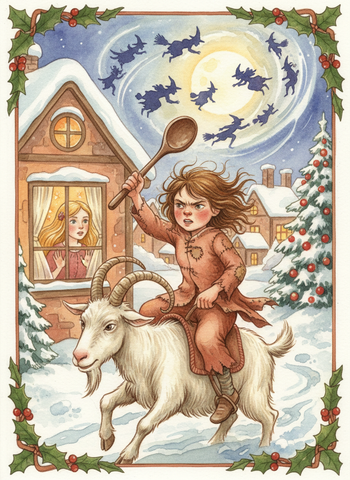
Born wild and unlovely while her twin is born beautiful, Tatterhood rides a goat and swings a wooden spoon — and she is the only one brave enough to face the witches who attack on Christmas Eve.
Once on a time there was a king and a queen who had no children, and that gave the queen much grief; she scarce had one happy hour. She was always bewailing and bemoaning herself, and saying how dull and lonesome it was in the palace.
Érase una vez un rey y una reina que no tenían hijos, y eso le causaba a la reina mucha pena; apenas tenía una hora feliz. Siempre estaba lamentándose y quejándose, y diciendo lo aburrido y solitario que era el palacio.
“If we had children there’d be life enough”, she said.
“Si tuviéramos hijos habría bastante vida”, decía.
Wherever she went in all her realm she found God’s blessing in children, even in the vilest hut; and wherever she came she heard the Goodies scolding the bairns, and saying how they had done that and that wrong. All this the queen heard, and thought it would be so nice to do as other women did. At last the king and queen took into their palace a stranger lassie to rear up, that they might have her always with them, to love her if she did well, and scold her if she did wrong, like their own child.
Adondequiera que iba por todo su reino encontraba la bendición de Dios en forma de niños, hasta en la más miserable choza; y adondequiera que llegaba oía a las buenas mujeres regañando a sus criaturas, y diciendo cómo habían hecho esto y aquello mal. Todo esto lo oía la reina, y pensaba que sería tan lindo hacer como hacían las demás mujeres. Al fin el rey y la reina tomaron en su palacio a una muchacha desconocida para criarla, para tenerla siempre con ellos, para quererla si se portaba bien, y regañarla si se portaba mal, como si fuera su propia hija.
So one day the little lassie whom they had taken as their own, ran down into the palace yard, and was playing with a gold apple. Just then an old beggar wife came by, who had a little girl with her, and it wasn’t long before the little lassie and the beggar’s bairn were great friends, and began to play together, and to toss the gold apple about between them.
Así que un día la pequeña muchacha a quien habían tomado como suya, bajó corriendo al patio del palacio, y estaba jugando con una manzana de oro. Justo entonces una vieja mendiga pasó por allí, que llevaba consigo a una niña pequeña, y no pasó mucho tiempo antes de que la pequeña muchacha y la criatura de la mendiga fueran grandes amigas, y comenzaran a jugar juntas, y a lanzarse la manzana de oro la una a la otra.
When the Queen saw this, as she sat at a window in the palace, she tapped on the pane for her foster-daughter to come up. She went at once, but the beggar-girl went up too; and as they went into the Queen’s bower, each held the other by the hand. Then the Queen began to scold the little lady, and to say:
Cuando la reina vio esto, mientras estaba sentada junto a una ventana del palacio, golpeó el cristal para que su hija adoptiva subiera. Ella subió de inmediato, pero la niña mendiga subió también; y mientras entraban en el aposento de la reina, cada una tomaba a la otra de la mano. Entonces la reina comenzó a regañar a la pequeña dama, y a decir:
“You ought to be above running about and playing with a tattered beggar’s brat.”
“Deberías estar por encima de andar corriendo y jugando con la mocosa harapienta de una mendiga.”
And so she wanted to drive the lassie downstairs.
Y así quiso echar a la muchacha escaleras abajo.
“If the Queen only knew my mother’s power, she’d not drive me out”, said the little lassie; and when the Queen asked what she meant more plainly, she told her how her mother could get her children if she chose. The Queen wouldn’t believe it, but the lassie held her own, and said every word of it was true, and bade the Queen only to try and make her mother do it. So the Queen sent the lassie down to fetch up her mother.
“Si la reina solo conociera el poder de mi madre, no me echaría”, dijo la pequeña muchacha; y cuando la reina le preguntó qué quería decir más claramente, le contó cómo su madre podía conseguirle hijos si quisiera. La reina no quiso creerlo, pero la muchacha se mantuvo firme, y dijo que cada palabra era cierta, y le pidió a la reina que solo intentara hacer que su madre lo hiciera. Así que la reina envió a la muchacha a buscar a su madre.
“Do you know what your daughter says?” asked the Queen of the old woman, as soon as ever she came into the room.
“¿Sabes lo que dice tu hija?” le preguntó la reina a la anciana en cuanto entró en la habitación.
No; the beggar wife knew nothing about it.
No; la mendiga no sabía nada de eso.
“Well, she says you can get me children if you will”, answered the Queen.
“Bueno, ella dice que puedes conseguirme hijos si quieres”, respondió la reina.
“Queens shouldn’t listen to beggar lassies’ silly stories”, said the old wife, and strode out of the room.
“Las reinas no deberían escuchar los cuentos tontos de las muchachas mendigas”, dijo la anciana, y salió a grandes zancadas de la habitación.
Then the Queen got angry, and wanted again to drive out the little lassie; but she declared it was true every word that she had said.
Entonces la reina se enojó, y quiso de nuevo echar a la pequeña muchacha; pero esta declaró que cada palabra que había dicho era verdad.
“Let the Queen only give my mother a drop to drink,” said the lassie; “when she gets merry she’ll soon find out a way to help you.”
“Que la reina le dé a mi madre un trago de beber”, dijo la muchacha; “cuando se ponga alegre pronto encontrará una manera de ayudarla.”
The Queen was ready to try this; so the beggar wife was fetched up again once more, and treated both with wine and mead as much as she chose; and so it was not long before her tongue began to wag. Then the Queen came out again with the same question she had asked before.
La reina estuvo dispuesta a probar esto; así que fueron a buscar de nuevo a la mendiga, y le sirvieron tanto vino y aguamiel como quiso; y así no pasó mucho tiempo antes de que su lengua empezara a soltarse. Entonces la reina volvió a salir con la misma pregunta que había hecho antes.
“One way to help you perhaps I know”, said the beggar wife. “Your Majesty must make them bring in two pails of water some evening before you go to bed. In each of them you must wash yourself, and afterwards throw away the water under the bed. When you look under the bed next morning, two flowers will have sprung up, one fair and one ugly. The fair one you must eat, the ugly one you must let stand; but mind you don’t forget the last.”
“Quizás conozco una manera de ayudarla”, dijo la mendiga. “Su Majestad debe hacer que le traigan dos cubos de agua alguna tarde antes de irse a la cama. En cada uno debe lavarse, y después tirar el agua debajo de la cama. Cuando mire debajo de la cama a la mañana siguiente, habrán brotado dos flores, una hermosa y una fea. La hermosa debe comérsela, la fea debe dejarla en pie; pero cuide de no olvidar esto último.”
That was what the beggar wife said.
Eso fue lo que dijo la mendiga.
Yes; the Queen did what the beggar wife advised her to do; she had the water brought up in two pails, washed herself in them, and emptied them under the bed; and lo! when she looked under the bed next morning, there stood two flowers; one was ugly and foul, and had black leaves; but the other was so bright, and fair, and lovely, she had never seen its like; so she ate it up at once. But the pretty flower tasted so sweet, that she couldn’t help herself. She ate the other up too, for, she thought, “it can’t hurt or help one much either way, I’ll be bound”.
Sí; la reina hizo lo que la mendiga le aconsejó; hizo que le trajeran el agua en dos cubos, se lavó en ellos, y los vació bajo la cama; ¡y he aquí! cuando miró bajo la cama a la mañana siguiente, allí había dos flores; una era fea y repugnante, y tenía hojas negras; pero la otra era tan brillante, y hermosa, y encantadora, que nunca había visto nada igual; así que se la comió de inmediato. Pero la bonita flor sabía tan dulce, que no pudo contenerse. Se comió también la otra, pues pensó: “no puede ni hacerle daño ni ayudarla mucho de cualquier manera, seguro”.
Well, sure enough, after a while the Queen was brought to bed. First of all, she had a girl who had a wooden spoon in her hand, and rode upon a goat; loathly and ugly she was, and the very moment she came into the world, she bawled out “Mamma”.
Bueno, en efecto, al cabo de un tiempo la reina dio a luz. Primero de todo, tuvo una niña que llevaba una cuchara de madera en la mano, y montaba en una cabra; era repugnante y fea, y en el mismo momento en que vino al mundo, gritó “Mamá”.
“If I’m your mamma”, said the Queen, “God give me grace to mend my ways.”
“Si soy tu mamá”, dijo la reina, “que Dios me dé la gracia de enmendar mis maneras.”
“Oh, don’t be sorry”, said the girl, who rode on the goat, “for one will soon come after me who is better looking.”
“Ay, no te apenes”, dijo la niña, que montaba en la cabra, “pues pronto vendrá tras de mí otra que es más bonita.”
So, after a while, the Queen had another girl, who was so fair and sweet, no one had ever set eyes on such a lovely child, and with her you may fancy the Queen was very well pleased. The elder twin they called “Tatterhood”, because she was always so ugly and ragged, and because she had a hood which hung about her ears in tatters. The Queen could scarce bear to look at her, and the nurses tried to shut her up in a room by herself, but it was all no good; where the younger twin was, there she must also be, and no one could ever keep them apart.
Así que, al cabo de un tiempo, la reina tuvo otra niña, que era tan hermosa y dulce, que nadie había visto jamás una criatura tan encantadora, y con ella, ya se imaginarán, la reina quedó muy complacida. A la gemela mayor la llamaron “Tatterhood”, porque siempre estaba tan fea y andrajosa, y porque tenía una capucha que le colgaba de las orejas hecha jirones. La reina apenas podía soportar mirarla, y las nodrizas trataron de encerrarla en un cuarto aparte, pero de nada sirvió; donde estuviera la gemela menor, allí tenía que estar ella también, y nadie podía nunca separarlas.
Well, one Christmas eve, when they were half grown up, there rose such a frightful noise and clatter in the gallery outside the Queen’s bower. So Tatterhood asked what it was that dashed and crashed so out in the passage.
Bueno, una Nochebuena, cuando ya habían crecido bastante, se levantó un ruido y un estrépito tan espantosos en la galería fuera del aposento de la reina. Así que Tatterhood preguntó qué era lo que golpeaba y estrellaba así afuera en el pasillo.
“Oh!” said the Queen, “it isn’t worth asking about.”
“¡Ay!” dijo la reina, “no vale la pena preguntar por eso.”
But Tatterhood wouldn’t give over till she found out all about it and so the Queen told her it was a pack of Trolls and witches who had come there to keep Christmas. So Tatterhood said she’d just go out and drive them away; and in spite of all they could say, and however much they begged and prayed her to let the Trolls alone, she must and would go out to drive the witches off; but she begged the Queen to mind and keep all the doors close shut, so that not one of them came so much as the least bit ajar.
Pero Tatterhood no cejó hasta averiguar todo al respecto, y la reina le contó que era una banda de trolls y brujas que habían venido allí a celebrar la Navidad. Así que Tatterhood dijo que iría a espantarlos; y a pesar de todo lo que pudieron decir, y por mucho que le rogaron y suplicaron que dejara a los trolls tranquilos, ella tenía que salir y salió a espantar a las brujas; pero le rogó a la reina que mantuviera todas las puertas bien cerradas, de modo que ni una de ellas quedara entreabierta ni un poquito.
Having said this, off she went with her wooden spoon, and began to hunt and sweep away the hags; and all this while there was such a pother out in the gallery, the like of it was never heard. The whole Palace creaked and groaned as if every joint and beam were going to be torn out of its place.
Habiendo dicho esto, salió con su cuchara de madera, y comenzó a perseguir y a barrer a las brujas; y todo este tiempo hubo tal alboroto afuera en la galería, como nunca se había oído. Todo el palacio crujía y gemía como si cada junta y cada viga fueran a ser arrancadas de su sitio.
Now, how it was, I’m sure I can’t tell; but somehow or other one door did get the least bit ajar, then her twin sister just peeped out to see how things were going with Tatterhood, and put her head a tiny bit through the opening. But, POP! up came an old witch, and whipped off her head, and stuck a calf’s head on her shoulders instead; and so the Princess ran back into the room on all-fours, and began to “moo” like a calf.
Ahora bien, cómo fue, la verdad es que no sabría decirlo; pero de alguna manera una puerta quedó entreabierta un poquito, y entonces su hermana gemela solo se asomó a ver cómo le iba a Tatterhood, y sacó la cabeza un poquito por la abertura. Pero, ¡pum! apareció una vieja bruja, y le arrancó la cabeza de un tirón, y le puso en su lugar una cabeza de ternero sobre los hombros; y así la princesa corrió de vuelta al cuarto a cuatro patas, y comenzó a “mugir” como un ternero.
When Tatterhood came back and saw her sister, she scolded them all round, and was very angry because they hadn’t kept better watch, and asked them what they thought of their heedlessness now, when her sister was turned into a calf.
Cuando Tatterhood volvió y vio a su hermana, las regañó a todas, y estaba muy enojada porque no habían vigilado mejor, y les preguntó qué pensaban de su descuido ahora, cuando su hermana se había convertido en ternero.
“But still I’ll see if I can’t set her free”, she said.
“Pero aun así veré si no puedo liberarla”, dijo.
Then she asked the King for a ship in full trim, and well fitted with stores; but captain and sailors she wouldn’t have. No; she would sail away with her sister all alone; and as there was no holding her back, at last they let her have her own way.
Entonces le pidió al rey un barco totalmente equipado, y bien provisto de suministros; pero capitán y marineros no quiso llevar. No; ella navegaría a solas con su hermana; y como no había manera de detenerla, al fin la dejaron hacer a su manera.
Then Tatterhood sailed off, and steered her ship right under the land where the witches dwelt, and when she came to the landing-place, she told her sister to stay quite still on board the ship; but she herself rode on her goat up to the witches’ castle. When she got there, one of the windows in the gallery was open, and there she saw her sister’s head hung up on the window frame; so she leapt her goat through the window into the gallery, snapped up the head, and set off with it.
Entonces Tatterhood se hizo a la mar, y llevó su barco justo bajo la tierra donde habitaban las brujas, y cuando llegó al lugar de desembarco, le dijo a su hermana que se quedara bien quieta a bordo del barco; pero ella misma montó en su cabra hasta el castillo de las brujas. Cuando llegó allí, una de las ventanas de la galería estaba abierta, y allí vio la cabeza de su hermana colgada del marco de la ventana; así que hizo saltar a su cabra por la ventana hacia la galería, agarró la cabeza, y partió con ella.
After her came the witches to try to get the head again, and they flocked about her as thick as a swarm of bees or a nest of ants; but the goat snorted, and puffed, and butted with his horns, and Tatterhood beat and banged them about with her wooden spoon; and so the pack of witches had to give it up. So Tatterhood got back to her ship, took the calf’s head off her sister, and put her own on again, and then she became a girl as she had been before. After that she sailed a long, long way, to a strange king’s realm.
Tras ella fueron las brujas para intentar recuperar la cabeza, y se agolparon a su alrededor tan espesas como un enjambre de abejas o un nido de hormigas; pero la cabra resopló, y bufó, y embistió con los cuernos, y Tatterhood las golpeó y las apaleó con su cuchara de madera; y así la banda de brujas tuvo que darse por vencida. Así que Tatterhood volvió a su barco, le quitó la cabeza de ternero a su hermana, y le puso la suya de nuevo, y entonces volvió a ser una muchacha como antes había sido. Después de eso navegó un largo, largo trecho, hasta el reino de un rey extraño.
Now the king of that land was a widower, and had an only son. So when he saw the strange sail, he sent messengers down to the strand to find out whence it came, and who owned it; but when the king’s men came down there, they saw never a living soul on board but Tatterhood, and there she was, riding round and round the deck on her goat at full speed, till her elf locks streamed again in the wind.
Ahora bien, el rey de esa tierra era viudo, y tenía un único hijo. Así que cuando vio la vela extraña, envió mensajeros a la orilla para averiguar de dónde venía, y de quién era; pero cuando los hombres del rey llegaron allí, no vieron ni un alma viva a bordo salvo a Tatterhood, y allí estaba ella, cabalgando en círculos por la cubierta sobre su cabra a toda velocidad, hasta que sus mechones de duende volaban al viento.
The folk from the palace were all amazed at this sight, and asked, were there not more on board? Yes, there were; she had a sister with her, said Tatterhood. Her, too, they wanted to see, but Tatterhood said “No”:
La gente del palacio quedó asombrada ante esta escena, y preguntaron, ¿no había más a bordo? Sí, había; tenía a una hermana con ella, dijo Tatterhood. A ella también quisieron verla, pero Tatterhood dijo “No”:
“No one shall see her, unless the king comes himself”, she said; and so she began to gallop about on her goat till the deck thundered again.
“Nadie la verá, a menos que venga el mismo rey”, dijo; y así comenzó a galopar en su cabra hasta que la cubierta volvió a tronar.
So when the servants got back to the palace, and told what they had seen and heard down at the ship, the king was for setting out at once, that he might see the lassie that rode on the goat. When he got down, Tatterhood led out her sister, and she was so fair and gentle, the king fell over head and ears in love with her as he stood. He brought them both back with him to the Palace, and wanted to have the sister for his queen; but Tatterhood said “No”; the king couldn’t have her in any way, unless the king’s son chose to have Tatterhood.
Así que cuando los criados volvieron al palacio, y contaron lo que habían visto y oído allá abajo en el barco, el rey estuvo dispuesto a partir de inmediato, para poder ver a la muchacha que montaba en la cabra. Cuando bajó, Tatterhood sacó a su hermana, y era tan hermosa y dulce, que el rey se enamoró perdidamente de ella nada más verla. Se los llevó a ambas de vuelta al palacio, y quiso tener a la hermana por reina; pero Tatterhood dijo “No”; el rey no podría tenerla de ninguna manera, a menos que el hijo del rey quisiera tener a Tatterhood.
That you may fancy the prince was very loath to do, such an ugly hussy as Tatterhood was; but at last the king and all the others in the palace talked him over, and he yielded, giving his word to take her for his queen; but it went sore against the grain, and he was a doleful man.
Ya se imaginarán que el príncipe estaba muy poco dispuesto a hacerlo, siendo Tatterhood una arpía tan fea; pero al fin el rey y todos los demás en el palacio lo convencieron, y él cedió, dando su palabra de tomarla por reina; pero le costaba mucho hacerlo, y era un hombre afligido.
Now they set about the wedding, both with brewing and baking; and when all was ready, they were to go to church; but the prince thought it the weariest churching he had ever had in all his life. First, the king drove off with his bride, and she was so lovely and so grand, all the people stopped to look after her all along the road, and they stared at her till she was out of sight.
Ahora se pusieron a organizar la boda, tanto con la cerveza como con el horneado; y cuando todo estuvo listo, debían ir a la iglesia; pero el príncipe pensó que era la boda más pesada que había tenido en toda su vida. Primero, el rey partió con su novia, y ella era tan encantadora y tan magnífica, que toda la gente se detenía a mirarla por todo el camino, y la miraban hasta que se perdía de vista.
After them came the prince on horseback by the side of Tatterhood, who trotted along on her goat with her wooden spoon in her fist, and to look at him, it was more like going to a burial than a wedding, and that his own; so sorrowful he seemed, and with never a word to say.
Tras ellos venía el príncipe a caballo al lado de Tatterhood, que trotaba en su cabra con su cuchara de madera en el puño, y al verlo, parecía más bien que iba a un entierro que a una boda, y encima la suya; tan afligido parecía, y sin decir ni una palabra.
“Why don’t you talk?” asked Tatterhood, when they had ridden a bit.
“¿Por qué no hablas?” preguntó Tatterhood, cuando ya habían cabalgado un rato.
“Why, what should I talk about?” answered the prince.
“Vaya, ¿de qué habría de hablar?” respondió el príncipe.
“Well, you might at least ask me why I ride upon this ugly goat”, said Tatterhood.
“Bueno, al menos podrías preguntarme por qué monto en esta cabra fea”, dijo Tatterhood.
“Why do you ride on that ugly goat?” asked the prince.
“¿Por qué montas en esa cabra fea?” preguntó el príncipe.
“Is it an ugly goat? why, it’s the grandest horse bride ever rode on”, answered Tatterhood; and in a trice the goat became a horse, and that the finest the prince had ever set eyes on.
“¿Es una cabra fea? pues es el caballo más magnífico en que jamás haya montado una novia”, respondió Tatterhood; y en un instante la cabra se convirtió en un caballo, y el más fino que el príncipe hubiera visto jamás.
Then they rode on again a bit, but the prince was just as woeful as before, and couldn’t get a word out. So Tatterhood asked him again why he didn’t talk, and when the Prince answered he didn’t know what to talk about, she said:
Entonces cabalgaron otro trecho, pero el príncipe seguía tan afligido como antes, y no lograba sacar ni una palabra. Así que Tatterhood le preguntó de nuevo por qué no hablaba, y cuando el príncipe respondió que no sabía de qué hablar, ella dijo:
“You can at least ask me why I ride with this ugly spoon in my fist.”
“Al menos podrías preguntarme por qué llevo esta cuchara fea en el puño.”
“Why do you ride with that ugly spoon? “asked the prince.
“¿Por qué llevas esa cuchara fea?” preguntó el príncipe.
“Is it an ugly spoon? why, it’s the loveliest silver wand bride ever bore”, said Tatterhood; and in a trice it became a silver wand, so dazzling bright, the sunbeams glistened from it.
“¿Es una cuchara fea? pues es la más hermosa vara de plata que jamás haya llevado una novia”, dijo Tatterhood; y en un instante se convirtió en una vara de plata, tan deslumbrantemente brillante que los rayos del sol relucían en ella.
So they rode on another bit, but the Prince was just as sorrowful, and said never a word. In a little while, Tatterhood asked him again why he didn’t talk, and bade him ask why she wore that ugly grey hood on her head.
Así que cabalgaron otro trecho, pero el príncipe seguía tan afligido, y no dijo ni una palabra. Al poco rato, Tatterhood volvió a preguntarle por qué no hablaba, y le pidió que le preguntara por qué llevaba esa fea capucha gris en la cabeza.
“Why do you wear that ugly grey hood on your head?” asked the Prince.
“¿Por qué llevas esa fea capucha gris en la cabeza?” preguntó el príncipe.
“Is it an ugly hood? why, it’s the brightest golden crown bride ever wore”, answered Tatterhood, and it became a crown on the spot.
“¿Es una capucha fea? pues es la corona de oro más brillante que jamás haya llevado una novia”, respondió Tatterhood, y se convirtió en una corona al instante.
Now, they rode on a long while again, and the Prince was so woeful, that he sat without sound or speech just as before. So his bride asked him again why he didn’t talk, and bade him ask now, why her face was so ugly and ashen-grey?
Ahora bien, cabalgaron un buen trecho más, y el príncipe seguía tan afligido, que iba sentado sin ruido ni palabra tal como antes. Así que su novia le preguntó de nuevo por qué no hablaba, y le pidió que ahora preguntara por qué su rostro era tan feo y de un gris ceniciento.
“Ah!” asked the Prince, “why is your face so ugly and ashen-grey?”
“¡Ah!” preguntó el príncipe, “¿por qué es tu rostro tan feo y de un gris ceniciento?”
“I ugly”, said the bride; “you think my sister pretty, but I am ten times prettier”; and lo! when the Prince looked at her, she was so lovely, he thought there never was so lovely a woman in all the world. After that, I shouldn’t wonder if the Prince found his tongue, and no longer rode along hanging down his head.
“Yo fea”, dijo la novia; “tú piensas que mi hermana es bonita, pero yo soy diez veces más bonita”; ¡y he aquí! cuando el príncipe la miró, era tan hermosa, que pensó que nunca hubo mujer tan hermosa en todo el mundo. Después de eso, no me sorprendería que el príncipe recobrara el habla, y ya no cabalgara cabizbajo.
So they drank the bridal cup both deep and long, and, after that, both Prince and King set out with their brides to the Princess’s father’s palace, and there they had another bridal feast, and drank anew, both deep and long. There was no end to the fun; and, if you make haste and run to the King’s palace, I dare say you’ll find there’s still a drop of the bridal ale left for you.
Así que bebieron la copa nupcial larga y profundamente, y, después de eso, tanto el príncipe como el rey partieron con sus novias hacia el palacio del padre de la princesa, y allí tuvieron otro banquete nupcial, y bebieron de nuevo, tanto profunda como largamente. No hubo fin a la diversión; y, si se dan prisa y corren al palacio del rey, me atrevo a decir que aún encontrarán una gota de la cerveza nupcial para ustedes.
