The Elephant's Child
A free B2-level English story for language learners, readable online in 7 languages, with an option to listen via the free Storyteller app.
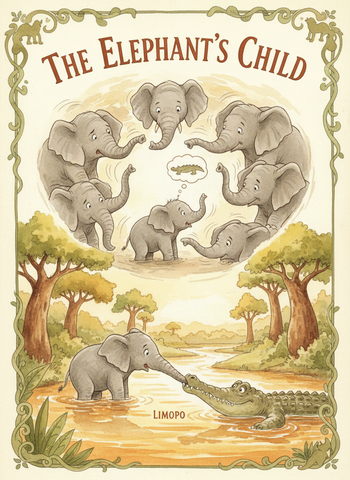
An impossibly curious young elephant refuses to stop asking questions, no matter how many relatives swat him for it — until one especially nosy question by the Limpopo River changes his shape forever.
In the High and Far-Off Times the Elephant, O Best Beloved, had no trunk. He had only a blackish, bulgy nose, as big as a boot, that he could wriggle about from side to side; but he couldn’t pick up things with it. But there was one Elephant—a new Elephant—an Elephant’s Child—who was full of ‘satiable curtiosity, and that means he asked ever so many questions. And he lived in Africa, and he filled all Africa with his ‘satiable curtiosities.
Nos Tempos Elevados e Distantes, o Elefante, ó Bem-Amado, não tinha tromba. Tinha apenas um nariz escurecido e inchado, do tamanho de uma bota, que conseguia balançar de um lado para o outro; mas não conseguia pegar nada com ele. Mas havia um Elefante — um Elefante novo — um Filhote de Elefante — que era cheio de 'saciável curiosidade, o que quer dizer que fazia perguntas demais. E ele vivia na África, e enchia toda a África com suas 'saciáveis curiosidades.
He asked his tall aunt, the Ostrich, why her tail-feathers grew just so, and his tall aunt the Ostrich spanked him with her hard, hard claw. He asked his tall uncle, the Giraffe, what made his skin spotty, and his tall uncle, the Giraffe, spanked him with his hard, hard hoof. And still he was full of ‘satiable curtiosity!
Perguntou à sua tia alta, a Avestruz, por que suas penas da cauda cresciam assim, e sua tia alta, a Avestruz, deu-lhe uma palmada com sua garra dura, duríssima. Perguntou ao seu tio alto, a Girafa, o que fazia sua pele manchada, e seu tio alto, a Girafa, deu-lhe uma palmada com seu casco duro, duríssimo. E ainda assim ele continuava cheio de 'saciável curiosidade!
He asked his broad aunt, the Hippopotamus, why her eyes were red, and his broad aunt, the Hippopotamus, spanked him with her broad, broad hoof; and he asked his hairy uncle, the Baboon, why melons tasted just so, and his hairy uncle, the Baboon, spanked him with his hairy, hairy paw. And still he was full of ‘satiable curtiosity!
Perguntou à sua tia larga, a Hipopótamo, por que seus olhos eram vermelhos, e sua tia larga, a Hipopótamo, deu-lhe uma palmada com seu casco largo, larguíssimo; e perguntou ao seu tio peludo, o Babuíno, por que os melões tinham aquele gosto, e seu tio peludo, o Babuíno, deu-lhe uma palmada com sua pata peluda, peludíssima. E ainda assim ele continuava cheio de 'saciável curiosidade!
He asked questions about everything that he saw, or heard, or felt, or smelt, or touched, and all his uncles and his aunts spanked him. And still he was full of ‘satiable curtiosity!
Fazia perguntas sobre tudo o que via, ou ouvia, ou sentia, ou cheirava, ou tocava, e todos os seus tios e tias lhe davam palmadas. E ainda assim ele continuava cheio de 'saciável curiosidade!
One fine morning in the middle of the Precession of the Equinoxes this ‘satiable Elephant’s Child asked a new fine question that he had never asked before. He asked, ‘What does the Crocodile have for dinner?’ Then everybody said, ‘Hush!’ in a loud and dretful tone, and they spanked him immediately and directly, without stopping, for a long time.
Numa bela manhã, no meio da Precessão dos Equinócios, esse 'saciável Filhote de Elefante fez uma nova e bela pergunta que nunca havia feito antes. Perguntou: "O que o Crocodilo come no jantar?" Então todo mundo disse "Psiu!" num tom alto e horrível, e lhe deram palmadas imediatamente e sem parar, por um bom tempo.
By and by, when that was finished, he came upon Kolokolo Bird sitting in the middle of a wait-a-bit thorn-bush, and he said, ‘My father has spanked me, and my mother has spanked me; all my aunts and uncles have spanked me for my ‘satiable curtiosity; and still I want to know what the Crocodile has for dinner!’
Pouco depois, quando aquilo terminou, ele encontrou o Pássaro Kolokolo sentado no meio de uma moita de espinhos, e disse: "Meu pai me deu palmada, e minha mãe me deu palmada; todos os meus tios e tias me deram palmada por causa da minha 'saciável curiosidade; e ainda assim quero saber o que o Crocodilo come no jantar!"
Then Kolokolo Bird said, with a mournful cry, ‘Go to the banks of the great grey-green, greasy Limpopo River, all set about with fever-trees, and find out.’
Então o Pássaro Kolokolo disse, com um pio triste: "Vá até as margens do grande Rio Limpopo, cinza-esverdeado e gorduroso, todo cercado de árvores-da-febre, e descubra."
That very next morning, when there was nothing left of the Equinoxes, because the Precession had preceded according to precedent, this ‘satiable Elephant’s Child took a hundred pounds of bananas (the little short red kind), and a hundred pounds of sugar-cane (the long purple kind), and seventeen melons (the greeny-crackly kind), and said to all his dear families, ‘Goodbye. I am going to the great grey-green, greasy Limpopo River, all set about with fever-trees, to find out what the Crocodile has for dinner.’ And they all spanked him once more for luck, though he asked them most politely to stop.
Bem na manhã seguinte, quando já não restava nada dos Equinócios, pois a Precessão havia precedido conforme o precedente, esse 'saciável Filhote de Elefante pegou cem quilos de bananas (das pequenas e vermelhas), e cem quilos de cana-de-açúcar (das compridas e roxas), e dezessete melões (dos verdes e crocantes), e disse a toda a sua querida família: "Adeus. Vou até o grande Rio Limpopo, cinza-esverdeado e gorduroso, todo cercado de árvores-da-febre, para descobrir o que o Crocodilo come no jantar." E todos lhe deram mais uma palmada para dar sorte, embora ele tenha pedido educadamente que parassem.
Then he went away, a little warm, but not at all astonished, eating melons, and throwing the rind about, because he could not pick it up.
Então ele foi embora, um pouco quente, mas nem um pouco espantado, comendo melões e jogando as cascas por aí, porque não conseguia pegá-las de volta.
He went from Graham’s Town to Kimberley, and from Kimberley to Khama’s Country, and from Khama’s Country he went east by north, eating melons all the time, till at last he came to the banks of the great grey-green, greasy Limpopo River, all set about with fever-trees, precisely as Kolokolo Bird had said.
Foi de Graham's Town a Kimberley, e de Kimberley à Terra de Khama, e da Terra de Khama seguiu para leste, um pouco ao norte, comendo melões o tempo todo, até que finalmente chegou às margens do grande Rio Limpopo, cinza-esverdeado e gorduroso, todo cercado de árvores-da-febre, exatamente como o Pássaro Kolokolo tinha dito.
Now you must know and understand, O Best Beloved, that till that very week, and day, and hour, and minute, this ‘satiable Elephant’s Child had never seen a Crocodile, and did not know what one was like. It was all his ‘satiable curtiosity.
Ora, é preciso que saibam e compreendam, ó Bem-Amado, que até aquela mesma semana, e dia, e hora, e minuto, esse 'saciável Filhote de Elefante nunca tinha visto um Crocodilo, e não sabia como era um. Tudo por causa de sua 'saciável curiosidade.
The first thing that he found was a Bi-Coloured-Python-Rock-Snake curled round a rock.
A primeira coisa que encontrou foi uma Píton-das-Rochas-Bicolor enrolada em torno de uma pedra.
‘’Scuse me,’ said the Elephant’s Child most politely, ‘but have you seen such a thing as a Crocodile in these promiscuous parts?’
"Com licença", disse o Filhote de Elefante muito educadamente, "mas o senhor por acaso viu algo como um Crocodilo por estas paragens promíscuas?"
‘Have I seen a Crocodile?’ said the Bi-Coloured-Python-Rock-Snake, in a voice of dretful scorn. ‘What will you ask me next?’
"Se eu já vi um Crocodilo?" disse a Píton-das-Rochas-Bicolor, num tom de horrível desdém. "O que você vai me perguntar agora?"
‘’Scuse me,’ said the Elephant’s Child, ‘but could you kindly tell me what he has for dinner?’
"Com licença", disse o Filhote de Elefante, "mas o senhor poderia gentilmente me dizer o que ele come no jantar?"
Then the Bi-Coloured-Python-Rock-Snake uncoiled himself very quickly from the rock, and spanked the Elephant’s Child with his scalesome, flailsome tail.
Então a Píton-das-Rochas-Bicolor se desenrolou muito depressa da pedra, e deu uma palmada no Filhote de Elefante com sua cauda escamosa e chicoteante.
‘That is odd,’ said the Elephant’s Child, ‘because my father and my mother, and my uncle and my aunt, not to mention my other aunt, the Hippopotamus, and my other uncle, the Baboon, have all spanked me for my ‘satiable curtiosity—and I suppose this is the same thing.
"Isso é estranho", disse o Filhote de Elefante, "porque meu pai e minha mãe, e meu tio e minha tia, sem falar da minha outra tia, a Hipopótamo, e do meu outro tio, o Babuíno, todos me deram palmada por minha 'saciável curiosidade — e suponho que seja a mesma coisa."
So he said good-bye very politely to the Bi-Coloured-Python-Rock-Snake, and helped to coil him up on the rock again, and went on, a little warm, but not at all astonished, eating melons, and throwing the rind about, because he could not pick it up, till he trod on what he thought was a log of wood at the very edge of the great grey-green, greasy Limpopo River, all set about with fever-trees.
Então ele se despediu muito educadamente da Píton-das-Rochas-Bicolor, e ajudou a enrolá-la de novo na pedra, e seguiu em frente, um pouco quente, mas nem um pouco espantado, comendo melões e jogando as cascas por aí, porque não conseguia pegá-las de volta, até que pisou no que pensou ser um tronco de madeira bem na beira do grande Rio Limpopo, cinza-esverdeado e gorduroso, todo cercado de árvores-da-febre.
But it was really the Crocodile, O Best Beloved, and the Crocodile winked one eye—like this!
Mas era mesmo o Crocodilo, ó Bem-Amado, e o Crocodilo piscou um olho — assim!
‘’Scuse me,’ said the Elephant’s Child most politely, ‘but do you happen to have seen a Crocodile in these promiscuous parts?’
"Com licença", disse o Filhote de Elefante muito educadamente, "mas o senhor por acaso viu um Crocodilo por estas paragens promíscuas?"
Then the Crocodile winked the other eye, and lifted half his tail out of the mud; and the Elephant’s Child stepped back most politely, because he did not wish to be spanked again.
Então o Crocodilo piscou o outro olho, e ergueu metade da cauda para fora da lama; e o Filhote de Elefante deu um passo para trás muito educadamente, porque não queria levar outra palmada.
‘Come hither, Little One,’ said the Crocodile. ‘Why do you ask such things?’
"Vem cá, Pequenino", disse o Crocodilo. "Por que você pergunta essas coisas?"
‘’Scuse me,’ said the Elephant’s Child most politely, ‘but my father has spanked me, my mother has spanked me, not to mention my tall aunt, the Ostrich, and my tall uncle, the Giraffe, who can kick ever so hard, as well as my broad aunt, the Hippopotamus, and my hairy uncle, the Baboon, and including the Bi-Coloured-Python-Rock-Snake, with the scalesome, flailsome tail, just up the bank, who spanks harder than any of them; and so, if it’s quite all the same to you, I don’t want to be spanked any more.’
"Com licença", disse o Filhote de Elefante muito educadamente, "mas meu pai me deu palmada, minha mãe me deu palmada, sem falar da minha tia alta, a Avestruz, e do meu tio alto, a Girafa, que dá coices duríssimos, assim como a minha tia larga, a Hipopótamo, e o meu tio peludo, o Babuíno, e incluindo a Píton-das-Rochas-Bicolor, de cauda escamosa e chicoteante, logo ali na margem, que dá palmadas mais fortes que todos eles; e assim, se não for problema para o senhor, não quero levar mais nenhuma palmada."
‘Come hither, Little One,’ said the Crocodile, ‘for I am the Crocodile,’ and he wept crocodile-tears to show it was quite true.
"Vem cá, Pequenino", disse o Crocodilo, "pois eu sou o Crocodilo", e chorou lágrimas de crocodilo para provar que era mesmo verdade.
Then the Elephant’s Child grew all breathless, and panted, and kneeled down on the bank and said, ‘You are the very person I have been looking for all these long days. Will you please tell me what you have for dinner?’
Então o Filhote de Elefante ficou todo ofegante, e respirou fundo, e ajoelhou-se na margem e disse: "O senhor é exatamente a pessoa que venho procurando há tantos dias. Poderia, por favor, me dizer o que come no jantar?"
‘Come hither, Little One,’ said the Crocodile, ‘and I’ll whisper.’
"Vem cá, Pequenino", disse o Crocodilo, "e eu vou lhe contar num sussurro."
Then the Elephant’s Child put his head down close to the Crocodile’s musky, tusky mouth, and the Crocodile caught him by his little nose, which up to that very week, day, hour, and minute, had been no bigger than a boot, though much more useful.
Então o Filhote de Elefante baixou a cabeça bem perto da boca almiscarada e presuda do Crocodilo, e o Crocodilo o agarrou pelo seu narizinho, que até aquela mesma semana, dia, hora e minuto, não era maior que uma bota, embora bem mais útil.
‘I think, said the Crocodile—and he said it between his teeth, like this—‘I think to-day I will begin with Elephant’s Child!’
"Acho", disse o Crocodilo — e disse isso entre os dentes, assim — "acho que hoje vou começar com o Filhote de Elefante!"
At this, O Best Beloved, the Elephant’s Child was much annoyed, and he said, speaking through his nose, like this, ‘Led go! You are hurtig be!’
Diante disso, ó Bem-Amado, o Filhote de Elefante ficou muito aborrecido, e disse, falando pelo nariz, assim: "Solde-be! Você está be bachucando!"
Then the Bi-Coloured-Python-Rock-Snake scuffled down from the bank and said, ‘My young friend, if you do not now, immediately and instantly, pull as hard as ever you can, it is my opinion that your acquaintance in the large-pattern leather ulster’ (and by this he meant the Crocodile) ‘will jerk you into yonder limpid stream before you can say Jack Robinson.’
Então a Píton-das-Rochas-Bicolor desceu esbaforida da margem e disse: "Meu jovem amigo, se você não puxar agora, imediata e instantaneamente, com toda a força que tiver, é minha opinião que seu conhecido no sobretudo de couro de estampa grande" (e com isso queria dizer o Crocodilo) "vai arremessá-lo naquele riacho límpido antes que você consiga dizer Zé Pereira."
This is the way Bi-Coloured-Python-Rock-Snakes always talk.
É desse jeito que as Píton-das-Rochas-Bicolor sempre falam.
Then the Elephant’s Child sat back on his little haunches, and pulled, and pulled, and pulled, and his nose began to stretch. And the Crocodile floundered into the water, making it all creamy with great sweeps of his tail, and he pulled, and pulled, and pulled.
Então o Filhote de Elefante se recostou sobre suas ancazinhas, e puxou, e puxou, e puxou, e seu nariz começou a esticar. E o Crocodilo se debateu na água, deixando-a toda espumosa com grandes golpes da cauda, e puxou, e puxou, e puxou.
And the Elephant’s Child’s nose kept on stretching; and the Elephant’s Child spread all his little four legs and pulled, and pulled, and pulled, and his nose kept on stretching; and the Crocodile threshed his tail like an oar, and he pulled, and pulled, and pulled, and at each pull the Elephant’s Child’s nose grew longer and longer—and it hurt him hijjus!
E o nariz do Filhote de Elefante continuava a esticar; e o Filhote de Elefante abriu bem suas quatro perninhas e puxou, e puxou, e puxou, e seu nariz continuava a esticar; e o Crocodilo golpeava a cauda como um remo, e puxou, e puxou, e puxou, e a cada puxão o nariz do Filhote de Elefante ficava mais e mais comprido — e doía terrivelbente!
Then the Elephant’s Child felt his legs slipping, and he said through his nose, which was now nearly five feet long, ‘This is too butch for be!’
Então o Filhote de Elefante sentiu as pernas escorregando, e disse pelo nariz, que já tinha quase um metro e meio de comprimento: "Isso é buito para bib!"
Then the Bi-Coloured-Python-Rock-Snake came down from the bank, and knotted himself in a double-clove-hitch round the Elephant’s Child’s hind legs, and said, ‘Rash and inexperienced traveller, we will now seriously devote ourselves to a little high tension, because if we do not, it is my impression that yonder self-propelling man-of-war with the armour-plated upper deck’ (and by this, O Best Beloved, he meant the Crocodile), ‘will permanently vitiate your future career.
Então a Píton-das-Rochas-Bicolor desceu da margem, e amarrou-se com um nó duplo em torno das patas traseiras do Filhote de Elefante, e disse: "Viajante precipitado e inexperiente, agora vamos nos dedicar seriamente a uma boa tensão, porque, se não o fizermos, é minha impressão de que aquele navio de guerra autopropulsado, de convés blindado" (e com isso, ó Bem-Amado, queria dizer o Crocodilo), "vai viciar permanentemente o seu futuro."
That is the way all Bi-Coloured-Python-Rock-Snakes always talk.
É desse jeito que todas as Píton-das-Rochas-Bicolor sempre falam.
So he pulled, and the Elephant’s Child pulled, and the Crocodile pulled; but the Elephant’s Child and the Bi-Coloured-Python-Rock-Snake pulled hardest; and at last the Crocodile let go of the Elephant’s Child’s nose with a plop that you could hear all up and down the Limpopo.
Então ele puxou, e o Filhote de Elefante puxou, e o Crocodilo puxou; mas o Filhote de Elefante e a Píton-das-Rochas-Bicolor puxaram com mais força; e por fim o Crocodilo largou o nariz do Filhote de Elefante com um baque que se ouviu por todo o Limpopo, rio acima e rio abaixo.
Then the Elephant’s Child sat down most hard and sudden; but first he was careful to say ‘Thank you’ to the Bi-Coloured-Python-Rock-Snake; and next he was kind to his poor pulled nose, and wrapped it all up in cool banana leaves, and hung it in the great grey-green, greasy Limpopo to cool.
Então o Filhote de Elefante sentou-se de repente e com toda a força; mas antes teve o cuidado de dizer "Obrigado" à Píton-das-Rochas-Bicolor; e depois foi gentil com seu pobre nariz esticado, e o enrolou todo em folhas frescas de bananeira, e o pendurou no grande Limpopo, cinza-esverdeado e gorduroso, para esfriar.
‘What are you doing that for?’ said the Bi-Coloured-Python-Rock-Snake.
"Por que está fazendo isso?" perguntou a Píton-das-Rochas-Bicolor.
‘’Scuse me,’ said the Elephant’s Child, ‘but my nose is badly out of shape, and I am waiting for it to shrink.
"Com licença", disse o Filhote de Elefante, "mas meu nariz está muito fora de forma, e estou esperando que ele encolha."
‘Then you will have to wait a long time, said the Bi-Coloured-Python-Rock-Snake. ‘Some people do not know what is good for them.’
"Então vai ter que esperar muito tempo", disse a Píton-das-Rochas-Bicolor. "Tem gente que não sabe o que é bom para si."
The Elephant’s Child sat there for three days waiting for his nose to shrink. But it never grew any shorter, and, besides, it made him squint. For, O Best Beloved, you will see and understand that the Crocodile had pulled it out into a really truly trunk same as all Elephants have to-day.
O Filhote de Elefante ficou ali três dias esperando que seu nariz encolhesse. Mas ele nunca ficou mais curto, e, além disso, o fazia vesgo. Pois, ó Bem-Amado, vocês vão ver e compreender que o Crocodilo o havia esticado até virar uma verdadeira e legítima tromba, igual à que todos os Elefantes têm hoje em dia.
At the end of the third day a fly came and stung him on the shoulder, and before he knew what he was doing he lifted up his trunk and hit that fly dead with the end of it.
No fim do terceiro dia, uma mosca veio e o picou no ombro, e antes que percebesse o que estava fazendo, ele ergueu a tromba e matou a mosca na hora com a ponta dela.
‘’Vantage number one!’ said the Bi-Coloured-Python-Rock-Snake. ‘You couldn’t have done that with a mere-smear nose. Try and eat a little now.’
"Vantagem número um!" disse a Píton-das-Rochas-Bicolor. "Você não conseguiria fazer isso com um nariz qualquer, sem graça. Agora tente comer um pouco."
Before he thought what he was doing the Elephant’s Child put out his trunk and plucked a large bundle of grass, dusted it clean against his fore-legs, and stuffed it into his own mouth.
Antes de pensar no que estava fazendo, o Filhote de Elefante esticou a tromba e arrancou um grande maço de capim, sacudiu-o bem contra as patas dianteiras, e enfiou-o na própria boca.
‘Vantage number two!’ said the Bi-Coloured-Python-Rock-Snake. ‘You couldn’t have done that with a mere-smear nose. Don’t you think the sun is very hot here?’
"Vantagem número dois!" disse a Píton-das-Rochas-Bicolor. "Você não conseguiria fazer isso com um nariz qualquer, sem graça. Você não acha que o sol está muito quente aqui?"
‘It is,’ said the Elephant’s Child, and before he thought what he was doing he schlooped up a schloop of mud from the banks of the great grey-green, greasy Limpopo, and slapped it on his head, where it made a cool schloopy-sloshy mud-cap all trickly behind his ears.
"Está sim", disse o Filhote de Elefante, e antes de pensar no que estava fazendo, sugou uma sugada de lama das margens do grande Rio Limpopo, cinza-esverdeado e gorduroso, e a lambuzou na cabeça, onde formou um fresco barrete de lama, todo escorregadio atrás das orelhas.
‘Vantage number three!’ said the Bi-Coloured-Python-Rock-Snake. ‘You couldn’t have done that with a mere-smear nose. Now how do you feel about being spanked again?’
"Vantagem número três!" disse a Píton-das-Rochas-Bicolor. "Você não conseguiria fazer isso com um nariz qualquer, sem graça. E então, o que você acha de levar outra palmada?"
‘’Scuse me,’ said the Elephant’s Child, ‘but I should not like it at all.’
"Com licença", disse o Filhote de Elefante, "mas eu não gostaria nada disso."
‘How would you like to spank somebody?’ said the Bi-Coloured-Python-Rock-Snake.
"E o que você acharia de dar uma palmada em alguém?" disse a Píton-das-Rochas-Bicolor.
‘I should like it very much indeed,’ said the Elephant’s Child.
"Eu gostaria muitíssimo", disse o Filhote de Elefante.
‘Well,’ said the Bi-Coloured-Python-Rock-Snake, ‘you will find that new nose of yours very useful to spank people with.’
"Pois bem", disse a Píton-das-Rochas-Bicolor, "você vai descobrir que esse seu novo nariz é muito útil para dar palmadas nas pessoas."
‘Thank you,’ said the Elephant’s Child, ‘I’ll remember that; and now I think I’ll go home to all my dear families and try.’
"Obrigado", disse o Filhote de Elefante, "vou me lembrar disso; e agora acho que vou voltar para casa, para toda a minha querida família, e experimentar."
So the Elephant’s Child went home across Africa frisking and whisking his trunk. When he wanted fruit to eat he pulled fruit down from a tree, instead of waiting for it to fall as he used to do. When he wanted grass he plucked grass up from the ground, instead of going on his knees as he used to do. When the flies bit him he broke off the branch of a tree and used it as fly-whisk; and he made himself a new, cool, slushy-squshy mud-cap whenever the sun was hot. When he felt lonely walking through Africa he sang to himself down his trunk, and the noise was louder than several brass bands.
Então o Filhote de Elefante voltou para casa atravessando a África, saltitando e balançando a tromba. Quando queria comer fruta, puxava a fruta da árvore, em vez de esperar que caísse como costumava fazer. Quando queria capim, arrancava o capim do chão, em vez de se ajoelhar como costumava fazer. Quando as moscas o picavam, quebrava um galho de árvore e o usava como espanta-moscas; e fazia para si um novo e fresco barrete de lama sempre que o sol estava quente. Quando se sentia sozinho caminhando pela África, cantava para si mesmo pela tromba, e o som era mais alto que várias bandas de metais.
He went especially out of his way to find a broad Hippopotamus (she was no relation of his), and he spanked her very hard, to make sure that the Bi-Coloured-Python-Rock-Snake had spoken the truth about his new trunk. The rest of the time he picked up the melon rinds that he had dropped on his way to the Limpopo—for he was a Tidy Pachyderm.
Foi especialmente fora do seu caminho para encontrar uma Hipopótamo larga (que não era parente dele), e deu-lhe uma palmada bem forte, para se certificar de que a Píton-das-Rochas-Bicolor tinha dito a verdade sobre sua nova tromba. O resto do tempo, foi recolhendo as cascas de melão que havia deixado cair a caminho do Limpopo — pois era um Paquiderme Arrumadinho.
One dark evening he came back to all his dear families, and he coiled up his trunk and said, ‘How do you do?’ They were very glad to see him, and immediately said, ‘Come here and be spanked for your ‘satiable curtiosity.’
Numa noite escura, voltou para toda a sua querida família, enrolou a tromba e disse: "Como vão vocês?" Todos ficaram muito felizes em vê-lo, e imediatamente disseram: "Venha cá e leve uma palmada por sua 'saciável curiosidade."
‘Pooh,’ said the Elephant’s Child. ‘I don’t think you peoples know anything about spanking; but I do, and I’ll show you.’ Then he uncurled his trunk and knocked two of his dear brothers head over heels.
"Ora essa", disse o Filhote de Elefante. "Acho que vocês não entendem nada de dar palmada; mas eu entendo, e vou mostrar." Então desenrolou a tromba e derrubou de cabeça para baixo dois de seus queridos irmãos.
‘O Bananas!’ said they, ‘where did you learn that trick, and what have you done to your nose?’
"Puxa vida!" disseram eles, "onde você aprendeu esse truque, e o que fez com o seu nariz?"
‘I got a new one from the Crocodile on the banks of the great grey-green, greasy Limpopo River,’ said the Elephant’s Child. ‘I asked him what he had for dinner, and he gave me this to keep.’
"Ganhei um novo do Crocodilo, nas margens do grande Rio Limpopo, cinza-esverdeado e gorduroso", disse o Filhote de Elefante. "Perguntei a ele o que comia no jantar, e ele me deu isto para ficar."
‘It looks very ugly,’ said his hairy uncle, the Baboon.
"É muito feio", disse seu tio peludo, o Babuíno.
‘It does,’ said the Elephant’s Child. ‘But it’s very useful,’ and he picked up his hairy uncle, the Baboon, by one hairy leg, and hove him into a hornet’s nest.
"É mesmo", disse o Filhote de Elefante. "Mas é muito útil", e pegou seu tio peludo, o Babuíno, por uma perna peluda, e o atirou dentro de um ninho de vespas.
Then that bad Elephant’s Child spanked all his dear families for a long time, till they were very warm and greatly astonished. He pulled out his tall Ostrich aunt’s tail-feathers; and he caught his tall uncle, the Giraffe, by the hind-leg, and dragged him through a thorn-bush; and he shouted at his broad aunt, the Hippopotamus, and blew bubbles into her ear when she was sleeping in the water after meals; but he never let any one touch Kolokolo Bird.
Então aquele Filhote de Elefante malcriado deu palmadas em toda a sua querida família por um bom tempo, até que ficaram todos muito quentes e muito espantados. Arrancou as penas da cauda de sua tia alta, a Avestruz; e agarrou seu tio alto, a Girafa, pela pata traseira, e o arrastou por uma moita de espinhos; e gritou com sua tia larga, a Hipopótamo, e soprou bolhas no ouvido dela enquanto ela dormia na água depois das refeições; mas nunca deixou ninguém tocar no Pássaro Kolokolo.
At last things grew so exciting that his dear families went off one by one in a hurry to the banks of the great grey-green, greasy Limpopo River, all set about with fever-trees, to borrow new noses from the Crocodile. When they came back nobody spanked anybody any more; and ever since that day, O Best Beloved, all the Elephants you will ever see, besides all those that you won’t, have trunks precisely like the trunk of the ‘satiable Elephant’s Child.
Por fim as coisas ficaram tão emocionantes que toda a sua querida família foi, um a um, apressada, até as margens do grande Rio Limpopo, cinza-esverdeado e gorduroso, todo cercado de árvores-da-febre, para pedir emprestado ao Crocodilo narizes novos. Quando voltaram, ninguém mais dava palmada em ninguém; e desde aquele dia, ó Bem-Amado, todos os Elefantes que vocês algum dia verão, além de todos os que não verão, têm trombas exatamente iguais à tromba do 'saciável Filhote de Elefante.
I Keep six honest serving-men: (They taught me all I knew) Their names are What and Where and When And How and Why and Who. I send them over land and sea, I send them east and west; But after they have worked for me, I give them all a rest.
Eu tenho seis criados honestos: (Foram eles que me ensinaram tudo) Seus nomes são O Quê e Onde e Quando E Como e Por Que e Quem. Eu os mando por terra e mar, Eu os mando a leste e a oeste; Mas depois que trabalham para mim, Eu dou a todos um descanso.
I let them rest from nine till five. For I am busy then, As well as breakfast, lunch, and tea, For they are hungry men: But different folk have different views: I know a person small— She keeps ten million serving-men, Who get no rest at all! She sends ‘em abroad on her own affairs, From the second she opens her eyes— One million Hows, two million Wheres, And seven million Whys!
Eu os deixo descansar das nove às cinco. Pois nessa hora estou ocupado, Assim como no café, no almoço e no chá, Pois são homens famintos: Mas gente diferente tem opiniões diferentes: Conheço uma pessoa pequena — Ela tem dez milhões de criados, Que não descansam nunca! Ela os manda pelo mundo a cuidar dos seus assuntos, Desde o instante em que abre os olhos — Um milhão de Comos, dois milhões de Ondes, E sete milhões de Porquês!
