The Last Leaf
A free B2-level English story for language learners, readable online in 7 languages, with an option to listen via the free Storyteller app.
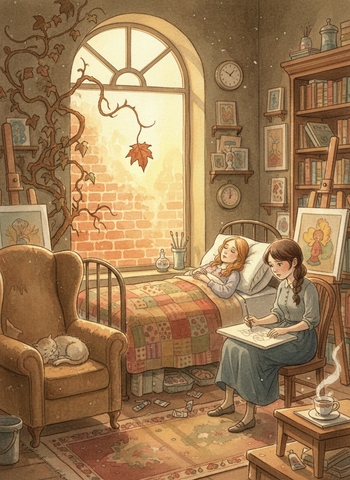
In a shabby Greenwich Village studio, two young painters share a life devoted to art — until one falls gravely ill and ties her hope to the last leaf clinging to a vine outside her window.
In a little district west of Washington Square the streets have run crazy and broken themselves into small strips called “places.” These “places” make strange angles and curves. One street crosses itself a time or two. An artist once discovered a valuable possibility in this street. Suppose a collector with a bill for paints, paper and canvas should, in traversing this route, suddenly meet himself coming back, without a cent having been paid on account!
在华盛顿广场西边的一小片街区里,街道仿佛发了疯,纷纷断裂成一条条被称作“巷子”的小街。这些“巷子”构成了奇怪的角度和曲线。有一条街甚至自己和自己交叉了一两次。曾有一位画家发现了这条街道的一种奇妙可能:假如一个拿着颜料、画纸和画布欠款账单的收账人,沿着这条路线走下去,说不定会突然与自己迎面相遇,却一分钱也没能收到!
So, to quaint old Greenwich Village the art people soon came prowling, hunting for north windows and eighteenth-century gables and Dutch attics and low rents. Then they imported some pewter mugs and a chafing dish or two from Sixth avenue, and became a “colony.”
于是,艺术家们很快便寻到了这个古雅的老格林尼治村,四处搜寻朝北的窗户、十八世纪的山墙、荷兰式的阁楼,以及低廉的房租。接着他们又从第六大道运来几只白镴酒杯和一两只暖锅,于是便自成了一个“艺术家聚居地”。
At the top of a squatty, three-story brick Sue and Johnsy had their studio. “Johnsy” was familiar for Joanna. One was from Maine; the other from California. They had met at the table d’hôte of an Eighth street “Delmonico’s,” and found their tastes in art, chicory salad and bishop sleeves so congenial that the joint studio resulted.
在一栋低矮的三层砖楼顶层,苏和琼西共用一间画室。“琼西”是乔安娜的昵称。一个来自缅因州,另一个来自加利福尼亚。她们相识于第八街一家“德尔莫尼科”式的包餐餐馆,发现彼此在艺术、菊苣沙拉和主教袖式样上的品味竟如此投合,于是便合租了这间画室。
That was in May. In November a cold, unseen stranger, whom the doctors called Pneumonia, stalked about the colony, touching one here and there with his icy fingers. Over on the east side this ravager strode boldly, smiting his victims by scores, but his feet trod slowly through the maze of the narrow and moss-grown “places.”
那是在五月。到了十一月,一个医生们称之为“肺炎”的、冷酷而无形的陌生人,在这片艺术家聚居地里四处游荡,用他冰冷的手指东点一下、西点一下。在东城那边,这个肆虐者迈着大胆的步伐,成群地击倒受害者,但他的脚步在这片长满青苔、狭窄曲折的“巷子”迷宫里,却走得缓慢许多。
Mr. Pneumonia was not what you would call a chivalric old gentleman. A mite of a little woman with blood thinned by California zephyrs was hardly fair game for the red-fisted, short-breathed old duffer. But Johnsy he smote; and she lay, scarcely moving, on her painted iron bedstead, looking through the small Dutch window-panes at the blank side of the next brick house.
肺炎先生算不上是位有骑士风度的老绅士。一个被加利福尼亚的和风吹得血液稀薄的娇小女子,本不该是那个红拳头、气短促的老家伙的对手。可他偏偏就盯上了琼西;她几乎一动不动地躺在那张漆成彩色的铁床上,透过荷兰式的小窗棂,望着隔壁那栋砖房空白的墙面。
One morning the busy doctor invited Sue into the hallway with a shaggy, gray eyebrow.
一天早晨,忙碌的医生扬起他那浓密灰白的眉毛,把苏叫到了走廊里。
“She has one chance in—let us say, ten,” he said, as he shook down the mercury in his clinical thermometer. “And that chance is for her to want to live. This way people have of lining-up on the side of the undertaker makes the entire pharmacopeia look silly. Your little lady has made up her mind that she’s not going to get well. Has she anything on her mind?”
“她的希望——姑且说是十分之一吧,”他一边说,一边把体温计里的水银甩下去。“而那份希望,得靠她自己想活下去。人们若这样一心一意地站到殡葬承办人那一边去,任凭再多的药典也显得滑稽可笑了。你这位小姐已经打定主意,认为自己好不了了。她心里是不是还惦记着什么事?”
“She—she wanted to paint the Bay of Naples some day,” said Sue.
“她——她曾想有朝一日画一画那不勒斯湾,”苏说道。
“Paint?—bosh! Has she anything on her mind worth thinking about twice—a man, for instance?”
“画画?——胡说!她心里有没有什么更值得反复琢磨的事——比如说,一个男人?”
“A man?” said Sue, with a jew’s-harp twang in her voice. “Is a man worth—but, no, doctor; there is nothing of the kind.”
“一个男人?”苏说道,声音里带着一种口弦琴般的颤音。“一个男人值得——不,医生,绝没有那样的事。”
“Well, it is the weakness, then,” said the doctor. “I will do all that science, so far as it may filter through my efforts, can accomplish. But whenever my patient begins to count the carriages in her funeral procession I subtract 50 per cent. from the curative power of medicines. If you will get her to ask one question about the new winter styles in cloak sleeves I will promise you a one-in-five chance for her, instead of one in ten.”
“唔,那就是体质虚弱的缘故了,”医生说道。“凡是科学所能做到的,只要能借我的努力发挥出来,我都会尽力去做。可是每当我的病人开始数着自己出殡队伍里马车的数目时,药物的疗效在我这里就要打对折。如果你能让她开口问一句关于今年冬季斗篷袖新款式的问题,我就答应你,她的希望能从十分之一提高到五分之一。”
After the doctor had gone Sue went into the workroom and cried a Japanese napkin to a pulp. Then she swaggered into Johnsy’s room with her drawing board, whistling ragtime.
医生走后,苏走进工作室,把一条日本餐巾纸哭得湿透稀烂。随后她拿起画板,大摇大摆地走进琼西的房间,嘴里吹着拉格泰姆的调子。
Johnsy lay, scarcely making a ripple under the bedclothes, with her face toward the window. Sue stopped whistling, thinking she was asleep.
琼西躺在被子底下,几乎纹丝不动,脸朝着窗户。苏以为她睡着了,便停止了吹口哨。
She arranged her board and began a pen-and-ink drawing to illustrate a magazine story. Young artists must pave their way to Art by drawing pictures for magazine stories that young authors write to pave their way to Literature.
她支好画板,开始为一篇杂志小说画一幅钢笔墨水插图。年轻的画家们总得靠为杂志小说画插图,来给自己铺就通往艺术的道路,正如那些年轻的作者也得靠写这些小说,来给自己铺就通往文学的道路。
As Sue was sketching a pair of elegant horseshow riding trousers and a monocle on the figure of the hero, an Idaho cowboy, she heard a low sound, several times repeated. She went quickly to the bedside.
苏正在给画中那位主人公——一个爱达荷州牛仔——画上一条讲究的骑装长裤和一副单片眼镜时,忽然听见一个低低的声音,重复了好几次。她赶紧走到床边。
Johnsy’s eyes were open wide. She was looking out the window and counting—counting backward.
琼西的眼睛睁得大大的。她望着窗外,正在数数——倒着数。
“Twelve,” she said, and a little later “eleven;” and then “ten,” and “nine;” and then “eight” and “seven,” almost together.
“十二,”她说道,稍后又说“十一”;接着是“十”,“九”;然后几乎同时说出“八”和“七”。
Sue looked solicitously out the window. What was there to count? There was only a bare, dreary yard to be seen, and the blank side of the brick house twenty feet away. An old, old ivy vine, gnarled and decayed at the roots, climbed half way up the brick wall. The cold breath of autumn had stricken its leaves from the vine until its skeleton branches clung, almost bare, to the crumbling bricks.
苏担忧地望向窗外。窗外有什么好数的呢?只看得见一个光秃秃、萧索的院子,以及二十英尺外那栋砖房空白的墙面。一株老得不能再老的常春藤,根部已经扭曲腐朽,顺着砖墙爬了半墙高。深秋的寒气已经把藤上的叶子摧落殆尽,只剩下几乎光秃的骨架般的枝条,攀附在那剥落的砖墙上。
“What is it, dear?” asked Sue.
“怎么了,亲爱的?”苏问道。
“Six,” said Johnsy, in almost a whisper. “They’re falling faster now. Three days ago there were almost a hundred. It made my head ache to count them. But now it’s easy. There goes another one. There are only five left now.”
“六,”琼西几乎是耳语般说道。“它们现在掉得更快了。三天前差不多还有一百片呢。数它们数得我头都疼了。可现在容易多了。又掉了一片。现在只剩五片了。”
“Five what, dear. Tell your Sudie.”
“五片什么呀,亲爱的。告诉你的苏迪。”
“Leaves. On the ivy vine. When the last one falls I must go, too. I’ve known that for three days. Didn’t the doctor tell you?”
“叶子。常春藤上的叶子。等最后一片掉下来,我也该走了。我三天前就知道了。医生没告诉你吗?”
“Oh, I never heard of such nonsense,” complained Sue, with magnificent scorn. “What have old ivy leaves to do with your getting well? And you used to love that vine so, you naughty girl. Don’t be a goosey. Why, the doctor told me this morning that your chances for getting well real soon were—let’s see exactly what he said—he said the chances were ten to one!
“哦,我从没听过这么荒唐的话,”苏带着满腔的轻蔑抱怨道。“老常春藤的叶子跟你能不能好起来有什么关系?你以前多喜欢那株藤啊,你这淘气的姑娘。别犯傻了。喔,医生今天早晨还跟我说,你很快就能痊愈的希望是——让我想想他到底怎么说的——他说希望是十比一呢!
“Why, that’s almost as good a chance as we have in New York when we ride on the street cars or walk past a new building. Try to take some broth now, and let Sudie go back to her drawing, so she can sell the editor man with it, and buy port wine for her sick child, and pork chops for her greedy self.”
“唔,那几乎和我们在纽约乘电车或是走过一栋新建筑时的机会一样大呢。现在试着喝点肉汤吧,让苏迪回去画画,好把画卖给那位编辑先生,给她生病的孩子买点波特酒,也给她这个馋嘴的自己买几块猪排。”
“You needn’t get any more wine,” said Johnsy, keeping her eyes fixed out the window. “There goes another. No, I don’t want any broth. That leaves just four. I want to see the last one fall before it gets dark. Then I’ll go, too.”
“你不必再买酒了,”琼西说道,眼睛依旧盯着窗外。“又掉了一片。不,我不要喝肉汤。这样就只剩四片了。我想在天黑之前看着最后一片掉下来。然后我也该走了。”
“Johnsy, dear,” said Sue, bending over her, “will you promise me to keep your eyes closed, and not look out the window until I am done working? I must hand those drawings in by to-morrow. I need the light, or I would draw the shade down.”
“琼西,亲爱的,”苏俯下身说道,“你能答应我闭上眼睛,别再看窗外,等我画完了再说吗?我明天必须把这些画交出去。我需要光线,不然我早就把窗帘拉下来了。”
“Couldn’t you draw in the other room?” asked Johnsy, coldly.
“你不能到别的房间去画吗?”琼西冷冷地问道。
“I’d rather be here by you,” said Sue. “Besides I don’t want you to keep looking at those silly ivy leaves.”
“我情愿待在这儿陪着你,”苏说道。“再说,我也不想让你老盯着那些傻乎乎的常春藤叶子看。”
“Tell me as soon as you have finished,” said Johnsy, closing her eyes, and lying white and still as a fallen statue, “because I want to see the last one fall. I’m tired of waiting. I’m tired of thinking. I want to turn loose my hold on everything, and go sailing down, down, just like one of those poor, tired leaves.”
“你一画完就告诉我,”琼西说道,闭上了眼睛,苍白而静止地躺着,像一尊倒下的雕像,“因为我想看着最后一片叶子掉下来。我等得累了。我想得也累了。我想松开手,放开一切,一直往下飘,往下飘,就像那些可怜的、疲惫的叶子一样。”
“Try to sleep,” said Sue. “I must call Behrman up to be my model for the old hermit miner. I’ll not be gone a minute. Don’t try to move ’till I come back.”
“试着睡一会儿吧,”苏说道。“我得去叫贝尔曼上来,给我那幅老隐士矿工画当模特。我去去就回。在我回来之前,别乱动。”
Old Behrman was a painter who lived on the ground floor beneath them. He was past sixty and had a Michael Angelo’s Moses beard curling down from the head of a satyr along the body of an imp. Behrman was a failure in art. Forty years he had wielded the brush without getting near enough to touch the hem of his Mistress’s robe. He had been always about to paint a masterpiece, but had never yet begun it. For several years he had painted nothing except now and then a daub in the line of commerce or advertising.
老贝尔曼是住在她们楼下的一位画家。他年过六十,蓄着一把米开朗琪罗笔下摩西像那样的胡须,从半羊人般的头颅一直卷曲垂到小鬼般的身躯上。贝尔曼在艺术上是个失败者。四十年来他挥舞着画笔,却始终未能触及他那位艺术女神衣袍的边缘。他总说要画一幅传世杰作,却始终未曾动笔。这些年来,他除了偶尔画些商业广告类的粗糙涂鸦,什么也没画过。
He earned a little by serving as a model to those young artists in the colony who could not pay the price of a professional. He drank gin to excess, and still talked of his coming masterpiece. For the rest he was a fierce little old man, who scoffed terribly at softness in any one, and who regarded himself as especial mastiff-in-waiting to protect the two young artists in the studio above.
他靠给那些付不起职业模特费用的年轻艺术家们当模特,挣点微薄的收入。他嗜酒如命,喝的是杜松子酒,却依旧念叨着他那即将问世的杰作。除此之外,他是个凶巴巴的小老头,见谁软弱就要狠狠嘲讽一番,并且自认为是专门守护楼上那两位年轻画家的看门犬。
Sue found Behrman smelling strongly of juniper berries in his dimly lighted den below. In one corner was a blank canvas on an easel that had been waiting there for twenty-five years to receive the first line of the masterpiece. She told him of Johnsy’s fancy, and how she feared she would, indeed, light and fragile as a leaf herself, float away when her slight hold upon the world grew weaker.
苏在楼下他那间光线昏暗的小窝里找到了贝尔曼,一身浓重的杜松子酒味。屋角立着一块空白的画布,架在画架上,二十五年来一直在那儿等着,等着接受那幅杰作的第一笔。她把琼西的奇想告诉了他,说她担心琼西真的会像一片轻盈脆弱的叶子一样,在她那本已微弱的求生意志再度松懈时,随风飘走。
Old Behrman, with his red eyes plainly streaming, shouted his contempt and derision for such idiotic imaginings.
老贝尔曼那双通红的眼睛里分明泛着泪光,他大声地表示对这种荒唐幻想的蔑视和嘲笑。
“Vass!” he cried. “Is dere people in de world mit der foolishness to die because leafs dey drop off from a confounded vine? I haf not heard of such a thing. No, I will not bose as a model for your fool hermit-dunderhead. Vy do you allow dot silly pusiness to come in der prain of her? Ach, dot poor lettle Miss Johnsy.”
“什么话!”他喊道。“世上竟还有人蠢到因为该死的藤上掉几片叶子就要死掉?我从没听过这种事。不,我才不给你那愚蠢的隐士呆瓜画当模特呢。你怎么能由着这种傻念头钻进她的脑子里?唉,可怜的小琼西小姐。”
“She is very ill and weak,” said Sue, “and the fever has left her mind morbid and full of strange fancies. Very well, Mr. Behrman, if you do not care to pose for me, you needn’t. But I think you are a horrid old—old flibbertigibbet.”
“她病得很重,也很虚弱,”苏说道,“高烧已经让她的心思变得病态,充满了古怪的幻想。好吧,贝尔曼先生,你要是不愿意给我当模特,那就算了。不过我觉得你真是个讨厌的——讨厌的老古怪。”
“You are just like a woman!” yelled Behrman. “Who said I will not bose? Go on. I come mit you. For half an hour I haf peen trying to say dot I am ready to bose. Gott! dis is not any blace in which one so goot as Miss Yohnsy shall lie sick. Some day I vill baint a masterpiece, and ve shall all go away. Gott! yes.”
“你这话说得倒真像个女人!”贝尔曼喊道。“谁说我不肯当模特了?走吧。我跟你去。这半个钟头我一直想说,我早就准备好当模特了。老天!这可不是个能让像琼西小姐这么好的人卧病的地方。总有一天我要画一幅杰作,到时候我们大家都搬走。老天,没错!”
Johnsy was sleeping when they went upstairs. Sue pulled the shade down to the window-sill, and motioned Behrman into the other room. In there they peered out the window fearfully at the ivy vine. Then they looked at each other for a moment without speaking. A persistent, cold rain was falling, mingled with snow. Behrman, in his old blue shirt, took his seat as the hermit-miner on an upturned kettle for a rock.
他们上楼时,琼西正睡着。苏把窗帘一直拉到窗台,示意贝尔曼到另一个房间去。在那儿,他们提心吊胆地望着窗外那株常春藤。随后,两人相视无言,沉默了片刻。外面正下着又冷又缠绵的雨,还夹杂着雪花。贝尔曼穿着他那件旧蓝衬衫,坐到一只倒扣的水壶上,当作那位隐士矿工坐的岩石。
When Sue awoke from an hour’s sleep the next morning she found Johnsy with dull, wide-open eyes staring at the drawn green shade.
第二天早晨,苏睡了一个钟头醒来,发现琼西正睁大着黯淡无神的双眼,盯着那拉下的绿色窗帘。
“Pull it up; I want to see,” she ordered, in a whisper.
“把它拉起来,我要看,”她小声地命令道。
Wearily Sue obeyed.
苏疲惫地照办了。
But, lo! after the beating rain and fierce gusts of wind that had endured through the livelong night, there yet stood out against the brick wall one ivy leaf. It was the last on the vine. Still dark green near its stem, but with its serrated edges tinted with the yellow of dissolution and decay, it hung bravely from a branch some twenty feet above the ground.
可是,瞧啊!经过了那漫长一夜里倾盆的暴雨和猛烈的狂风,竟还有一片常春藤叶子傲然屹立在砖墙上。那是藤上最后的一片叶子了。近茎处仍是深绿色,但锯齿状的边缘已染上了枯萎腐朽的黄色,它却依然勇敢地悬挂在离地约二十英尺高的枝头上。
“It is the last one,” said Johnsy. “I thought it would surely fall during the night. I heard the wind. It will fall to-day, and I shall die at the same time.”
“这是最后一片了,”琼西说道。“我原以为它昨夜一定会掉下来。我听见风声了。它今天会掉下来的,我也会在同时死去。”
“Dear, dear!” said Sue, leaning her worn face down to the pillow, “think of me, if you won’t think of yourself. What would I do?”
“亲爱的,亲爱的!”苏说着,把她那张憔悴的脸俯在枕头上,“就算你不为自己想,也替我想想吧。我该怎么办呢?”
But Johnsy did not answer. The lonesomest thing in all the world is a soul when it is making ready to go on its mysterious, far journey. The fancy seemed to possess her more strongly as one by one the ties that bound her to friendship and to earth were loosed.
可是琼西没有回答。世上最孤单的事,莫过于一个灵魂正准备踏上那神秘而遥远的旅程时的心境。随着一根根维系她与友情、与人世的纽带渐渐松开,这种幻念似乎更加牢牢地攫住了她。
The day wore away, and even through the twilight they could see the lone ivy leaf clinging to its stem against the wall. And then, with the coming of the night the north wind was again loosed, while the rain still beat against the windows and pattered down from the low Dutch eaves.
白昼渐渐流逝,就连在暮色之中,她们也能看见那片孤零零的常春藤叶子仍紧贴着藤茎,攀附在墙上。随后,随着夜幕降临,北风又一次呼啸而起,雨水仍旧敲打着窗户,从低矮的荷兰式屋檐上淅淅沥沥地滴落下来。
When it was light enough Johnsy, the merciless, commanded that the shade be raised.
天一亮,那毫不留情的琼西便吩咐把窗帘拉起来。
The ivy leaf was still there.
那片常春藤叶子依然还在那儿。
Johnsy lay for a long time looking at it. And then she called to Sue, who was stirring her chicken broth over the gas stove.
琼西久久地望着它躺着。随后她唤了苏一声,苏正在煤气炉上搅动着她的鸡汤。
“I’ve been a bad girl, Sudie,” said Johnsy. “Something has made that last leaf stay there to show me how wicked I was. It is a sin to want to die. You may bring me a little broth now, and some milk with a little port in it, and—no; bring me a hand-mirror first, and then pack some pillows about me, and I will sit up and watch you cook.”
“我一直是个坏女孩,苏迪,”琼西说道。“一定是有什么东西让那最后一片叶子留在那儿,好让我明白自己有多坏。渴望死去是一种罪过。你现在可以给我端点肉汤来,再来点掺了波特酒的牛奶——不,先给我拿面小镜子来,然后在我周围垫些枕头,我要坐起来看你做饭。”
An hour later she said.
一个钟头后,她说道。
“Sudie, some day I hope to paint the Bay of Naples.”
“苏迪,将来有一天我希望能画一画那不勒斯湾。”
The doctor came in the afternoon, and Sue had an excuse to go into the hallway as he left.
医生下午来了,苏借故送他出门,走到了走廊里。
“Even chances,” said the doctor, taking Sue’s thin, shaking hand in his. “With good nursing you’ll win. And now I must see another case I have downstairs. Behrman, his name is—some kind of an artist, I believe. Pneumonia, too. He is an old, weak man, and the attack is acute. There is no hope for him; but he goes to the hospital to-day to be made more comfortable.”
“希望对半吧,”医生握着苏那只瘦弱颤抖的手说道。“只要好好护理,你就能赢。现在我还得去楼下看另一个病人。他姓贝尔曼——我想是个搞什么艺术的。也是肺炎。他年纪大了,身体又弱,病得很急。他大概没什么希望了;不过今天就送他去医院,好让他舒服一些。”
The next day the doctor said to Sue: “She’s out of danger. You’ve won. Nutrition and care now—that’s all.”
第二天,医生对苏说:“她脱离危险了。你赢了。现在只需要加强营养和护理——仅此而已。”
And that afternoon Sue came to the bed where Johnsy lay, contentedly knitting a very blue and very useless woolen shoulder scarf, and put one arm around her, pillows and all.
那天下午,苏走到琼西的床边,她正心满意足地织着一条极蓝、也极没用的毛线披肩,苏伸出一条胳膊搂住她,连同枕头一起。
“I have something to tell you, white mouse,” she said. “Mr. Behrman died of pneumonia to-day in the hospital. He was ill only two days. The janitor found him on the morning of the first day in his room downstairs helpless with pain. His shoes and clothing were wet through and icy cold. They couldn’t imagine where he had been on such a dreadful night.
“我有件事要告诉你,小白鼠,”她说道。“贝尔曼先生今天在医院里因肺炎去世了。他只病了两天。看门人是在第一天早晨发现他的,当时他正一个人在楼下的房间里痛苦难当。他的鞋子和衣服湿透了,冰凉刺骨。大家都想不出,在那样可怕的一夜里,他究竟去了哪里。
“And then they found a lantern, still lighted, and a ladder that had been dragged from its place, and some scattered brushes, and a palette with green and yellow colors mixed on it, and—look out the window, dear, at the last ivy leaf on the wall. Didn’t you wonder why it never fluttered or moved when the wind blew? Ah, darling, it’s Behrman’s masterpiece—he painted it there the night that the last leaf fell.”
“后来他们发现了一盏还亮着的灯笼,一架被人从原处拖出来的梯子,几支散落的画笔,还有一块调色板,上面调着绿色和黄色的颜料——再看看窗外,亲爱的,看看墙上那最后一片常春藤叶子。你难道没有奇怪过,为什么刮风的时候它从来不曾颤动,也不曾晃动?啊,亲爱的,那正是贝尔曼的杰作——就在最后一片真正的叶子落下的那个夜里,他把它画在了那儿。”
