The Story of the Old Man Who Made Withered Trees to Flower
A free B1-level English story for language learners, readable online in 7 languages, with an option to listen via the free Storyteller app.
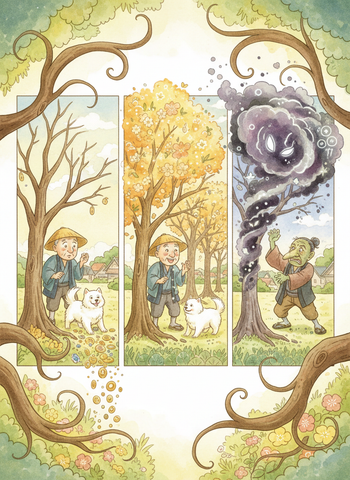
A loyal dog's devotion uncovers a hidden treasure, but his master's jealous neighbor wants the same luck for himself — with consequences that turn ashes into a strange kind of magic.
Long, long ago there lived an old man and his wife who supported themselves by cultivating a small plot of land. Their life had been a very happy and peaceful one save for one great sorrow, and this was they had no child. Their only pet was a dog named Shiro, and on him they lavished all the affection of their old age. Indeed, they loved him so much that whenever they had anything nice to eat they denied themselves to give it to Shiro. Now Shiro means “white,” and he was so called because of his color. He was a real Japanese dog, and very like a small wolf in appearance.
Hace mucho, mucho tiempo vivían un anciano y su esposa que se mantenían cultivando un pequeño terreno. Su vida había sido muy feliz y tranquila, salvo por una gran pena: no tenían hijos. Su única mascota era un perro llamado Shiro, y en él volcaban todo el cariño de su vejez. Lo querían tanto que, cuando tenían algo bueno para comer, se privaban de ello para dárselo a Shiro. Shiro significa «blanco», y así lo llamaban por su color. Era un auténtico perro japonés, muy parecido a un pequeño lobo en su aspecto.
The happiest hour of the day both for the old man and his dog was when the man returned from his work in the field, and having finished his frugal supper of rice and vegetables, would take what he had saved from the meal out to the little veranda that ran round the cottage. Sure enough, Shiro was waiting for his master and the evening tit-bit. Then the old man said “Chin, chin!” and Shiro sat up and begged, and his master gave him the food.
La hora más feliz del día, tanto para el anciano como para su perro, era cuando el hombre volvía de trabajar en el campo y, tras terminar su frugal cena de arroz y verduras, llevaba lo que había guardado de la comida hasta el pequeño porche que rodeaba la casa. Allí, sin falta, Shiro esperaba a su amo y su bocado de la tarde. Entonces el anciano decía «¡Chin, chin!», y Shiro se sentaba y suplicaba, y su amo le daba la comida.
Next door to this good old couple there lived another old man and his wife who were both wicked and cruel, and who hated their good neighbors and the dog Shiro with all their might. Whenever Shiro happened to look into their kitchen they at once kicked him or threw something at him, sometimes even wounding him.
Junto a esta buena pareja de ancianos vivían otro anciano y su esposa, ambos malvados y crueles, que odiaban a sus buenos vecinos y al perro Shiro con todas sus fuerzas. Cada vez que Shiro se asomaba a mirar su cocina, lo pateaban o le arrojaban algo, a veces incluso hiriéndolo.
One day Shiro was heard barking for a long time in the field at the back of his master’s house. The old man, thinking that perhaps some birds were attacking the corn, hurried out to see what was the matter. As soon as Shiro saw his master he ran to meet him, wagging his tail, and, seizing the end of his kimono, dragged him under a large yenoki tree. Here he began to dig very industriously with his paws, yelping with joy all the time. The old man, unable to understand what it all meant, stood looking on in bewilderment. But Shiro went on barking and digging with all his might.
Un día se oyó a Shiro ladrar durante largo rato en el campo detrás de la casa de su amo. El anciano, pensando que quizá unos pájaros estaban atacando el maíz, salió corriendo a ver qué ocurría. En cuanto Shiro vio a su amo, corrió a su encuentro moviendo la cola y, agarrando el borde de su kimono, lo arrastró bajo un gran árbol yenoki. Allí se puso a cavar con gran empeño usando sus patas, gimiendo de alegría todo el tiempo. El anciano, incapaz de entender qué significaba aquello, se quedó mirando desconcertado. Pero Shiro seguía ladrando y cavando con todas sus fuerzas.
The thought that something might be hidden beneath the tree, and that the dog had scented it, at last struck the old man. He ran back to the house, fetched his spade and began to dig the ground at that spot. What was his astonishment when, after digging for some time, he came upon a heap of old and valuable coins, and the deeper he dug the more gold coins did he find. So intent was the old man on his work that he never saw the cross face of his neighbor peering at him through the bamboo hedge.
Por fin se le ocurrió al anciano que quizá había algo escondido bajo el árbol, y que el perro lo había olido. Corrió de vuelta a casa, trajo su pala y comenzó a cavar la tierra en ese punto. Cuál no fue su asombro cuando, tras cavar un rato, dio con un montón de monedas antiguas y valiosas, y cuanto más cavaba, más monedas de oro encontraba. Tan concentrado estaba el anciano en su tarea que nunca vio el rostro enfadado de su vecino espiándolo entre el seto de bambú.
At last all the gold coins lay shining on the ground. Shiro sat by erect with pride and looking fondly at his master as if to say, “You see, though only a dog, I can make some return for all the kindness you show me.”
Al fin todas las monedas de oro yacían brillando en el suelo. Shiro se sentó erguido, orgulloso, mirando a su amo con cariño, como si dijera: «Ya ves, aunque solo soy un perro, puedo devolver algo de toda la bondad que me muestras».
The old man ran in to call his wife, and together they carried home the treasure. Thus in one day the poor old man became rich. His gratitude to the faithful dog knew no bounds, and he loved and petted him more than ever, if that were possible.
El anciano entró corriendo a llamar a su esposa, y juntos llevaron el tesoro a casa. Así, en un solo día, el pobre anciano se hizo rico. Su gratitud hacia el fiel perro no tuvo límites, y lo quiso y lo mimó más que nunca, si es que eso era posible.
The cross old neighbor, attracted by Shiro’s barking, had been an unseen and envious witness of the finding of the treasure. He began to think that he, too, would like to find a fortune. So a few days later he called at the old man’s house and very ceremoniously asked permission to borrow Shiro for a short time.
El malhumorado vecino, atraído por los ladridos de Shiro, había sido testigo, sin ser visto, y lleno de envidia, del hallazgo del tesoro. Comenzó a pensar que él también quería encontrar una fortuna. Así que, unos días después, fue a casa del anciano y, muy ceremoniosamente, le pidió permiso para tomar prestado a Shiro por poco tiempo.
Shiro’s master thought this a strange request, because he knew quite well that not only did his neighbor not love his pet dog, but that he never lost an opportunity of striking and tormenting him whenever the dog crossed his path. But the good old man was too kind-hearted to refuse his neighbor, so he consented to lend the dog on condition that he should be taken great care of.
Al amo de Shiro le pareció una petición extraña, porque sabía muy bien que su vecino no solo no quería a su perro, sino que jamás perdía la oportunidad de golpearlo y atormentarlo cada vez que se cruzaba en su camino. Pero el buen anciano era demasiado bondadoso para negarse a su vecino, así que aceptó prestarle el perro con la condición de que lo cuidara bien.
The wicked old man returned to his home with an evil smile on his face, and told his wife how he had succeeded in his crafty intentions. He then took his spade and hastened to his own field, forcing the unwilling Shiro to follow him. As soon as he reached a yenoki tree, he said to the dog, threateningly:
El malvado anciano regresó a su casa con una sonrisa maliciosa en el rostro y le contó a su esposa cómo había logrado su artera intención. Luego tomó su pala y se apresuró hacia su propio campo, obligando al reacio Shiro a seguirlo. En cuanto llegó junto a un árbol yenoki, le dijo al perro amenazadoramente:
“If there were gold coins under your master’s tree, there must also be gold coins under my tree. You must find them for me! Where are they? Where? Where?”
«Si había monedas de oro bajo el árbol de tu amo, también debe de haberlas bajo el mío. ¡Debes encontrarlas para mí! ¿Dónde están? ¿Dónde? ¿Dónde?»
And catching hold of Shiro’s neck he held the dog’s head to the ground, so that Shiro began to scratch and dig in order to free himself from the horrid old man’s grasp.
Y agarrando a Shiro por el cuello, le apretó la cabeza contra el suelo, de modo que Shiro comenzó a rascar y cavar para librarse de las garras de aquel horrible anciano.
The old man was very pleased when he saw the dog begin to scratch and dig, for he at once supposed that some gold coins lay buried under his tree as well as under his neighbor’s, and that the dog had scented them as before; so pushing Shiro away he began to dig himself, but there was nothing to be found. As he went on digging a foul smell was noticeable, and he at last came upon a refuse heap.
El anciano se alegró mucho al ver al perro empezar a rascar y cavar, pues enseguida supuso que también bajo su árbol había monedas de oro enterradas, igual que bajo el de su vecino, y que el perro las había olido como antes; así que, apartando a Shiro de un empujón, se puso a cavar él mismo, pero no encontró nada. A medida que cavaba, se notaba un olor repugnante, y por fin dio con un montón de desperdicios.
The old man’s disgust can be imagined. This soon gave way to anger. He had seen his neighbor’s good fortune, and hoping for the same luck himself, he had borrowed the dog Shiro; and now, just as he seemed on the point of finding what he sought, only a horrid smelling refuse heap had rewarded him for a morning’s digging. Instead of blaming his own greed for his disappointment, he blamed the poor dog.
El disgusto del anciano puede imaginarse. Pronto dio paso a la ira. Había visto la buena fortuna de su vecino y, esperando la misma suerte, había pedido prestado al perro Shiro; y ahora, justo cuando parecía a punto de encontrar lo que buscaba, solo un horrible montón de basura maloliente había premiado su mañana de cavar. En vez de culpar a su propia codicia por su decepción, culpó al pobre perro.
He seized his spade, and with all his strength struck Shiro and killed him on the spot. He then threw the dog’s body into the hole which he had dug in the hope of finding a treasure of gold coins, and covered it over with the earth. Then he returned to the house, telling no one, not even his wife, what he had done.
Agarró su pala y, con todas sus fuerzas, golpeó a Shiro y lo mató en el acto. Luego arrojó el cuerpo del perro al agujero que había cavado con la esperanza de encontrar un tesoro de monedas de oro, y lo cubrió de tierra. Después volvió a la casa, sin contarle a nadie, ni siquiera a su esposa, lo que había hecho.
After waiting several days, as the dog Shiro did not return, his master began to grow anxious. Day after day went by and the good old man waited in vain. Then he went to his neighbor and asked him to give him back his dog. Without any shame or hesitation, the wicked neighbor answered that he had killed Shiro because of his bad behavior.
Tras esperar varios días, al ver que el perro Shiro no volvía, su amo empezó a inquietarse. Pasaron los días y el buen anciano esperó en vano. Entonces fue a ver a su vecino y le pidió que le devolviera a su perro. Sin ninguna vergüenza ni vacilación, el malvado vecino respondió que había matado a Shiro por su mal comportamiento.
At this dreadful news Shiro’s master wept many sad and bitter tears. Great indeed, was his woful surprise, but he was too good and gentle to reproach his bad neighbor. Learning that Shiro was buried under the yenoki tree in the field, he asked the old man to give him the tree, in remembrance of his poor dog Shiro.
Ante esta terrible noticia, el amo de Shiro lloró muchas lágrimas tristes y amargas. Grande fue en verdad su dolorosa sorpresa, pero era demasiado bueno y gentil para reprochárselo a su mal vecino. Al saber que Shiro estaba enterrado bajo el árbol yenoki del campo, le pidió al anciano que le diera el árbol, en recuerdo de su pobre perro Shiro.
Even the cross old neighbor could not refuse such a simple request, so he consented to give the old man the tree under which Shiro lay buried. Shiro’s master then cut the tree down and carried it home. Out of the trunk he made a mortar. In this his wife put some rice, and he began to pound it with the intention of making a festival to the memory of his dog Shiro.
Ni siquiera el malhumorado vecino pudo negarse a una petición tan sencilla, así que accedió a darle al anciano el árbol bajo el cual yacía Shiro. El amo de Shiro entonces taló el árbol y lo llevó a casa. Con el tronco hizo un mortero. Su esposa puso arroz dentro, y él comenzó a majarlo con la intención de celebrar una fiesta en memoria de su perro Shiro.
A strange thing happened! His wife put the rice into the mortar, and no sooner had he begun to pound it to make the cakes, than it began to increase in quantity gradually till it was about five times the original amount, and the cakes were turned out of the mortar as if an invisible hand were at work.
¡Ocurrió algo extraño! Su esposa echó el arroz en el mortero, y apenas había empezado él a majarlo para hacer los pasteles, cuando este comenzó a aumentar poco a poco de cantidad hasta llegar a unas cinco veces la cantidad original, y los pasteles salían del mortero como si una mano invisible estuviera trabajando.
When the old man and his wife saw this, they understood that it was a reward to them from Shiro for their faithful love to him. They tasted the cakes and found them nicer than any other food. So from this time they never troubled about food, for they lived upon the cakes with which the mortar never ceased to supply them.
Cuando el anciano y su esposa vieron esto, comprendieron que era una recompensa de Shiro por su fiel amor hacia él. Probaron los pasteles y los encontraron más deliciosos que cualquier otro alimento. Así que, desde entonces, nunca más se preocuparon por la comida, pues vivieron de los pasteles que el mortero no dejaba de proveerles.
The greedy neighbor, hearing of this new piece of good luck, was filled with envy as before, and called on the old man and asked leave to borrow the wonderful mortar for a short time, pretending that he, too, sorrowed for the death of Shiro, and wished to make cakes for a festival to the dog’s memory.
El vecino codicioso, al enterarse de esta nueva racha de buena suerte, se llenó de envidia como antes, y fue a ver al anciano para pedirle prestado el maravilloso mortero por poco tiempo, fingiendo que él también lamentaba la muerte de Shiro y deseaba hacer pasteles para una fiesta en memoria del perro.
The old man did not in the least wish to lend it to his cruel neighbor, but he was too kind to refuse. So the envious man carried home the mortar, but he never brought it back.
El anciano no tenía ningún deseo de prestárselo a su cruel vecino, pero era demasiado bondadoso para negarse. Así que el envidioso hombre se llevó el mortero a casa, pero nunca lo devolvió.
Several days passed, and Shiro’s master waited in vain for the mortar, so he went to call on the borrower, and asked him to be good enough to return the mortar if he had finished with it. He found him sitting by a big fire made of pieces of wood. On the ground lay what looked very much like pieces of a broken mortar. In answer to the old man’s inquiry, the wicked neighbor answered haughtily:
Pasaron varios días, y el amo de Shiro esperó en vano el mortero, así que fue a visitar al que se lo había llevado, y le pidió que tuviera la bondad de devolvérselo si ya había terminado de usarlo. Lo encontró sentado junto a una gran hoguera hecha de trozos de madera. En el suelo había lo que parecían pedazos de un mortero roto. En respuesta a la pregunta del anciano, el malvado vecino contestó con altanería:
“Have you come to ask me for your mortar? I broke it to pieces, and now I am making a fire of the wood, for when I tried to pound cakes in it only some horrid smelling stuff came out.”
«¿Has venido a pedirme tu mortero? Lo rompí en pedazos, y ahora estoy haciendo fuego con la madera, porque cuando traté de majar pasteles en él, solo salió algo de olor horrible».
The good old man said:
El buen anciano dijo:
“I am very sorry for that. It is a great pity you did not ask me for the cakes if you wanted them. I would have given you as many as ever you wanted. Now please give me the ashes of the mortar, as I wish to keep them in remembrance of my dog.”
«Lo siento mucho por eso. Es una gran lástima que no me pidieras a mí los pasteles si los querías. Te habría dado todos los que hubieras querido. Ahora, por favor, dame las cenizas del mortero, pues deseo conservarlas en recuerdo de mi perro».
The neighbor consented at once, and the old man carried home a basket full of ashes.
El vecino accedió de inmediato, y el anciano se llevó a casa una cesta llena de cenizas.
Not long after this the old man accidentally scattered some of the ashes made by the burning of the mortar on the trees of his garden. A wonderful thing happened!
No mucho después de esto, el anciano esparció por accidente parte de las cenizas producidas al quemar el mortero sobre los árboles de su jardín. ¡Ocurrió algo maravilloso!
It was late in autumn and all the trees had shed their leaves, but no sooner did the ashes touch their branches than the cherry trees, the plum trees, and all other blossoming shrubs burst into bloom, so that the old man’s garden was suddenly transformed into a beautiful picture of spring. The old man’s delight knew no bounds, and he carefully preserved the remaining ashes.
Era ya finales de otoño y todos los árboles habían perdido sus hojas, pero en cuanto las cenizas tocaron sus ramas, los cerezos, los ciruelos y todos los demás arbustos florecientes estallaron en flor, de modo que el jardín del anciano se transformó de pronto en una hermosa estampa de primavera. La alegría del anciano no tuvo límites, y guardó con cuidado las cenizas que le quedaban.
The story of the old man’s garden spread far and wide, and people from far and near came to see the wonderful sight.
La historia del jardín del anciano se difundió por todas partes, y gente de cerca y de lejos venía a ver aquel maravilloso espectáculo.
One day, soon after this, the old man heard some one knocking at his door, and going to the porch to see who it was he was surprised to see a Knight standing there. This Knight told him that he was a retainer of a great Daimio (Earl); that one of the favorite cherry trees in this nobleman’s garden had withered, and that though every one in his service had tried all manner of means to revive it, none took effect.
Un día, poco después de esto, el anciano oyó que alguien llamaba a su puerta, y al ir al porche a ver quién era, se sorprendió al ver a un Caballero de pie allí. Este Caballero le dijo que era vasallo de un gran Daimio (Conde); que uno de los cerezos favoritos en el jardín de aquel noble se había marchitado, y que, aunque todos a su servicio habían probado toda clase de medios para revivirlo, ninguno había surtido efecto.
The Knight was sore perplexed when he saw what great displeasure the loss of his favorite cherry tree caused the Daimio. At this point, fortunately, they had heard that there was a wonderful old man who could make withered trees to blossom, and that his Lord had sent him to ask the old man to come to him.
El Caballero estaba muy apesadumbrado al ver el gran disgusto que la pérdida de su cerezo favorito había causado al Daimio. En ese momento, por fortuna, habían oído que existía un anciano maravilloso capaz de hacer florecer árboles marchitos, y que su Señor lo había enviado a pedirle al anciano que fuera con él.
“And,” added the Knight, “I shall be very much obliged if you will come at once.”
«Y», añadió el Caballero, «le quedaré muy agradecido si viene de inmediato».
The good old man was greatly surprised at what he heard, but respectfully followed the Knight to the nobleman’s Palace.
El buen anciano se sorprendió mucho al oír esto, pero siguió respetuosamente al Caballero hasta el Palacio del noble.
The Daimio, who had been impatiently awaiting the old man’s coming, as soon as he saw him asked him at once:
El Daimio, que había estado esperando con impaciencia la llegada del anciano, en cuanto lo vio le preguntó de inmediato:
“Are you the old man who can make withered trees flower even out of season?”
«¿Eres tú el anciano que puede hacer florecer los árboles marchitos incluso fuera de temporada?»
The old man made an obeisance, and replied:
El anciano hizo una reverencia y respondió:
“I am that old man!”
«¡Soy ese anciano!»
Then the Daimio said:
Entonces el Daimio dijo:
“You must make that dead cherry tree in my garden blossom again by means of your famous ashes. I shall look on.”
«Debes hacer florecer de nuevo ese cerezo muerto de mi jardín mediante tus famosas cenizas. Yo observaré».
Then they all went into the garden—the Daimio and his retainers and the ladies-in waiting, who carried the Daimio’s sword.
Entonces todos entraron al jardín: el Daimio, sus vasallos y las damas de compañía, que llevaban la espada del Daimio.
The old man now tucked up his kimono and made ready to climb the tree. Saying “Excuse me,” he took the pot of ashes which he had brought with him, and began to climb the tree, every one watching his movements with great interest.
El anciano se remangó el kimono y se preparó para subir al árbol. Diciendo «Con permiso», tomó la olla de cenizas que había traído consigo y comenzó a trepar por el árbol, mientras todos observaban sus movimientos con gran interés.
At last he climbed to the spot where the tree divided into two great branches, and taking up his position here, the old man sat down and scattered the ashes right and left all over the branches and twigs.
Por fin trepó hasta el punto donde el árbol se dividía en dos grandes ramas, y, tomando allí su posición, el anciano se sentó y esparció las cenizas a derecha e izquierda por todas las ramas y ramitas.
Wonderful, indeed, was the result! The withered tree at once burst into full bloom! The Daimio was so transported with joy that he looked as if he would go mad. He rose to his feet and spread out his fan, calling the old man down from the tree. He himself gave the old man a wine cup filled with the best SAKE, and rewarded him with much silver and gold and many other precious things. The Daimio ordered that henceforth the old man should call himself by the name of Hana-Saka-Jijii, or “The Old Man who makes the Trees to Blossom,” and that henceforth all were to recognize him by this name, and he sent him home with great honor.
¡Maravilloso, en verdad, fue el resultado! ¡El árbol marchito estalló al instante en plena floración! El Daimio se transportó de tal alegría que parecía a punto de enloquecer. Se puso en pie y desplegó su abanico, llamando al anciano para que bajara del árbol. Él mismo le dio al anciano una copa de vino llena del mejor SAKE, y lo recompensó con mucha plata y oro y muchas otras cosas preciosas. El Daimio ordenó que, de allí en adelante, el anciano se llamara a sí mismo Hana-Saka-Jijii, o «El Anciano que hace florecer los árboles», y que en adelante todos lo reconocieran por ese nombre, y lo envió a casa con gran honor.
The wicked neighbor, as before, heard of the good old man’s fortune, and of all that had so auspiciously befallen him, and he could not suppress all the envy and jealousy that filled his heart. He called to mind how he had failed in his attempt to find the gold coins, and then in making the magic cakes; this time surely he must succeed if he imitated the old man, who made withered trees to flower simply by sprinkling ashes on them. This would be the simplest task of all.
El malvado vecino, como antes, se enteró de la fortuna del buen anciano y de todo lo auspicioso que le había ocurrido, y no pudo contener toda la envidia y los celos que llenaban su corazón. Recordó cómo había fracasado en su intento de encontrar las monedas de oro, y luego en hacer los pasteles mágicos; esta vez seguramente tendría éxito si imitaba al anciano, que hacía florecer árboles marchitos con solo esparcirles cenizas. Esta sería la tarea más sencilla de todas.
So he set to work and gathered together all the ashes which remained in the fire-place from the burning of the wonderful mortar. Then he set out in the hope of finding some great man to employ him, calling out loudly as he went along:
Así que se puso manos a la obra y reunió todas las cenizas que quedaban en el hogar de la quema del maravilloso mortero. Luego salió con la esperanza de encontrar a algún gran hombre que lo empleara, gritando en voz alta mientras caminaba:
“Here comes the wonderful man who can make withered trees blossom! Here comes the old man who can make dead trees blossom!”
«¡Aquí viene el hombre maravilloso que puede hacer florecer los árboles marchitos! ¡Aquí viene el anciano que puede hacer florecer los árboles muertos!»
The Daimio in his Palace heard this cry, and said:
El Daimio, en su Palacio, oyó este pregón y dijo:
“That must be the Hana-Saka-Jijii passing. I have nothing to do to-day. Let him try his art again; it will amuse me to look on.”
«Ese debe de ser el Hana-Saka-Jijii que pasa. Hoy no tengo nada que hacer. Que pruebe su arte de nuevo; me divertirá observarlo».
So the retainers went out and brought in the impostor before their Lord. The satisfaction of false old man can now be imagined.
Así que los vasallos salieron y trajeron al impostor ante su Señor. Puede imaginarse la satisfacción del falso anciano.
But the Daimio looking at him, thought it strange that he was not at all like the old man he had seen before, so he asked him:
Pero el Daimio, mirándolo, pensó que era extraño que no se pareciera en nada al anciano que había visto antes, así que le preguntó:
“Are you the man whom I named Hana-Saka-Jijii?”
«¿Eres tú el hombre a quien llamé Hana-Saka-Jijii?»
And the envious neighbor answered with a lie:
Y el envidioso vecino respondió con una mentira:
“Yes, my Lord!”
«¡Sí, mi Señor!»
“That is strange!” said the Daimio. “I thought there was only one Hana-Saka-Jijii in the world! Has he now some disciples?”
«¡Qué extraño!», dijo el Daimio. «¡Pensaba que solo había un Hana-Saka-Jijii en el mundo! ¿Acaso ahora tiene discípulos?»
“I am the true Hana-Saka-Jijii. The one who came to you before was only my disciple!” replied the old man again.
«Yo soy el verdadero Hana-Saka-Jijii. El que vino a verlo antes era solo mi discípulo», respondió el anciano de nuevo.
“Then you must be more skillful than the other. Try what you can do and let me see!”
«Entonces debes de ser más hábil que el otro. ¡Prueba lo que puedes hacer y déjame ver!»
The envious neighbor, with the Daimio and his Court following, then went into the garden, and approaching a dead tree, took out a handful of the ashes which he carried with him, and scattered them over the tree.
El envidioso vecino, seguido por el Daimio y su Corte, entró entonces al jardín y, acercándose a un árbol muerto, sacó un puñado de las cenizas que llevaba consigo y las esparció sobre el árbol.
But not only did the tree not burst into flower, but not even a bud came forth. Thinking that he had not used enough ashes, the old man took handfuls and again sprinkled them over the withered tree. But all to no effect. After trying several times, the ashes were blown into the Daimio’s eyes. This made him very angry, and he ordered his retainers to arrest the false Hana-Saka-Jijii at once and put him in prison for an impostor. From this imprisonment the wicked old man was never freed. Thus did he meet with punishment at last for all his evil doings.
Pero no solo el árbol no estalló en flor, sino que ni siquiera brotó un capullo. Pensando que no había usado suficientes cenizas, el anciano tomó puñados y volvió a rociarlos sobre el árbol marchito. Pero todo sin efecto. Tras intentarlo varias veces, las cenizas volaron a los ojos del Daimio. Esto lo enfureció mucho, y ordenó a sus vasallos que arrestaran de inmediato al falso Hana-Saka-Jijii y lo encerraran en prisión por impostor. De esa prisión el malvado anciano nunca fue liberado. Así, al fin, recibió su castigo por todas sus malas acciones.
The good old man, however, with the treasure of gold coins which Shiro had found for him, and with all the gold and the silver which the Daimio had showered on him, became a rich and prosperous man in his old age, and lived a long and happy life, beloved and respected by all.
El buen anciano, en cambio, con el tesoro de monedas de oro que Shiro había encontrado para él, y con todo el oro y la plata que el Daimio había derramado sobre él, se convirtió en un hombre rico y próspero en su vejez, y vivió una vida larga y feliz, amado y respetado por todos.
