The Devil With the Three Golden Hairs
A free B1-level English story for language learners, readable online in 7 languages, with an option to listen via the free Storyteller app.
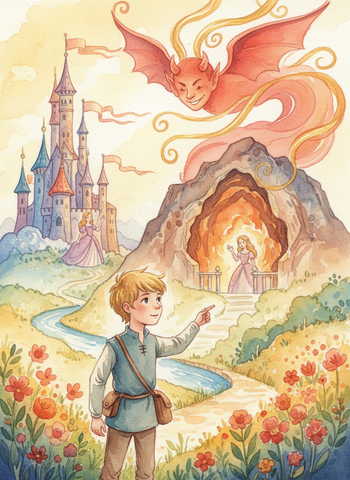
A boy born with a lucky caul is destined to marry a princess, so a jealous king sends him on an impossible errand to fetch three golden hairs from the devil's own head.
There was once a poor woman who gave birth to a little son; and as he came into the world with a caul on, it was predicted that in his fourteenth year he would have the King’s daughter for his wife. It happened that soon afterwards the King came into the village, and no one knew that he was the King, and when he asked the people what news there was, they answered, “A child has just been born with a caul on; whatever any one so born undertakes turns out well. It is prophesied, too, that in his fourteenth year he will have the King’s daughter for his wife.”
Era uma vez uma mulher pobre que deu à luz um filhinho; e como ele veio ao mundo envolto numa membrana amniótica, foi predito que em seu décimo quarto ano ele teria a filha do Rei por esposa. Aconteceu que, pouco depois, o Rei foi à aldeia, e ninguém sabia que era o Rei, e quando ele perguntou às pessoas que novidades havia, responderam: "Acaba de nascer uma criança envolta numa membrana; tudo o que alguém assim nascido empreender dará certo. Predizem também que, em seu décimo quarto ano, terá a filha do Rei por esposa."
The King, who had a bad heart, and was angry about the prophecy, went to the parents, and, seeming quite friendly, said, “You poor people, let me have your child, and I will take care of it.” At first they refused, but when the stranger offered them a large amount of gold for it, and they thought, “It is a luck-child, and everything must turn out well for it,” they at last consented, and gave him the child.
O Rei, que tinha o coração ruim, e ficou irritado com a profecia, foi até os pais e, parecendo bastante amigável, disse: "Boa gente, deixem-me ficar com seu filho, e eu cuidarei dele." A princípio recusaram, mas quando o estranho lhes ofereceu uma grande quantidade de ouro por ele, e pensaram: "É uma criança de sorte, e tudo há de dar certo para ela", acabaram consentindo e lhe entregaram o filho.
The King put it in a box and rode away with it until he came to a deep piece of water; then he threw the box into it and thought, “I have freed my daughter from her unlooked-for suitor.”
O Rei o colocou numa caixa e cavalgou com ela até chegar a um trecho profundo de água; então jogou a caixa dentro dele e pensou: "Livrei minha filha de seu pretendente inesperado."
The box, however, did not sink, but floated like a boat, and not a drop of water made its way into it. And it floated to within two miles of the King’s chief city, where there was a mill, and it came to a stand-still at the mill-dam. A miller’s boy, who by good luck was standing there, noticed it and pulled it out with a hook, thinking that he had found a great treasure, but when he opened it there lay a pretty boy inside, quite fresh and lively.
A caixa, porém, não afundou, mas flutuou como um barco, e nem uma gota d'água entrou nela. E ela flutuou até chegar a menos de três quilômetros da cidade principal do Rei, onde havia um moinho, e parou junto à represa do moinho. Um rapaz do moinho, que por sorte estava ali parado, notou-a e a puxou com um gancho, pensando ter encontrado um grande tesouro, mas quando a abriu, ali dentro estava um menino bonito, bem fresco e cheio de vida.
He took him to the miller and his wife, and as they had no children they were glad, and said, “God has given him to us.” They took great care of the foundling, and he grew up in all goodness.
Levou-o ao moleiro e à sua esposa, e como não tinham filhos, ficaram felizes e disseram: "Deus nos deu este menino." Cuidaram muito bem do enjeitado, e ele cresceu em toda bondade.
It happened that once in a storm, the King went into the mill, and he asked the mill-folk if the tall youth was their son. “No,” answered they, “he’s a foundling. Fourteen years ago he floated down to the mill-dam in a box, and the mill-boy pulled him out of the water.”
Aconteceu que uma vez, durante uma tempestade, o Rei entrou no moinho e perguntou à gente do moinho se o rapaz alto era filho deles. "Não", responderam, "é um enjeitado. Há catorze anos ele flutuou até a represa do moinho dentro de uma caixa, e o rapaz do moinho o tirou da água."
Then the King knew that it was none other than the luck-child which he had thrown into the water, and he said, “My good people, could not the youth take a letter to the Queen; I will give him two gold pieces as a reward?” “Just as the King commands,” answered they, and they told the boy to hold himself in readiness. Then the King wrote a letter to the Queen, wherein he said, “As soon as the boy arrives with this letter, let him be killed and buried, and all must be done before I come home.”
Então o Rei soube que não era outro senão a criança de sorte que ele havia jogado na água, e disse: "Minha boa gente, o rapaz não poderia levar uma carta à Rainha? Eu lhe darei duas moedas de ouro como recompensa." "Como o Rei ordenar", responderam eles, e disseram ao rapaz que se mantivesse pronto. Então o Rei escreveu uma carta à Rainha, na qual dizia: "Assim que o rapaz chegar com esta carta, que ele seja morto e enterrado, e tudo deve estar feito antes que eu volte para casa."
The boy set out with this letter; but he lost his way, and in the evening came to a large forest. In the darkness he saw a small light; he went towards it and reached a cottage. When he went in, an old woman was sitting by the fire quite alone. She started when she saw the boy, and said, “Whence do you come, and whither are you going?” “I come from the mill,” he answered, “and wish to go to the Queen, to whom I am taking a letter; but as I have lost my way in the forest I should like to stay here over night.”
O rapaz partiu com essa carta; mas perdeu o caminho, e à tardinha chegou a uma grande floresta. Na escuridão viu uma pequena luz; foi em direção a ela e chegou a uma cabana. Quando entrou, uma velha estava sentada junto ao fogo, completamente sozinha. Ela se assustou ao ver o rapaz, e disse: "De onde você vem, e para onde vai?" "Venho do moinho", respondeu ele, "e desejo ir até a Rainha, a quem levo uma carta; mas como perdi o caminho na floresta, gostaria de passar a noite aqui."
“You poor boy,” said the woman, “you have come into a den of thieves, and when they come home they will kill you.” “Let them come,” said the boy, “I am not afraid; but I am so tired that I cannot go any farther:” and he stretched himself upon a bench and fell asleep.
"Pobre rapaz", disse a mulher, "você caiu num covil de ladrões, e quando eles voltarem para casa vão matar você." "Que venham", disse o rapaz, "não tenho medo; mas estou tão cansado que não consigo ir mais longe": e se estendeu num banco e adormeceu.
Soon afterwards the robbers came, and angrily asked what strange boy was lying there? “Ah,” said the old woman, “it is an innocent child who has lost himself in the forest, and out of pity I have let him come in; he has to take a letter to the Queen.” The robbers opened the letter and read it, and in it was written that the boy as soon as he arrived should be put to death.
Pouco depois os ladrões chegaram, e perguntaram com raiva que estranho rapaz estava ali deitado. "Ah", disse a velha, "é uma criança inocente que se perdeu na floresta, e por pena deixei que entrasse; ele tem de levar uma carta à Rainha." Os ladrões abriram a carta e a leram, e nela estava escrito que o rapaz, assim que chegasse, deveria ser morto.
Then the hard-hearted robbers felt pity, and their leader tore up the letter and wrote another, saying, that as soon as the boy came, he should be married at once to the King’s daughter. Then they let him lie quietly on the bench until the next morning, and when he awoke they gave him the letter, and showed him the right way.
Então os ladrões, de coração duro, sentiram pena, e seu chefe rasgou a carta e escreveu outra, dizendo que, assim que o rapaz chegasse, deveria ser casado imediatamente com a filha do Rei. Então o deixaram deitado tranquilamente no banco até a manhã seguinte, e quando ele acordou, deram-lhe a carta e lhe mostraram o caminho certo.
And the Queen, when she had received the letter and read it, did as was written in it, and had a splendid wedding-feast prepared, and the King’s daughter was married to the luck-child, and as the youth was handsome and agreeable she lived with him in joy and contentment.
E a Rainha, ao receber a carta e lê-la, fez o que nela estava escrito, e mandou preparar um esplêndido banquete de casamento, e a filha do Rei casou-se com a criança de sorte, e como o rapaz era bonito e agradável, ela viveu com ele em alegria e contentamento.
After some time the King returned to his palace and saw that the prophecy was fulfilled, and the luck-child married to his daughter. “How has that come to pass?” said he; “I gave quite another order in my letter.”
Depois de algum tempo, o Rei voltou ao seu palácio e viu que a profecia se cumprira, e que a criança de sorte se casara com sua filha. "Como isso aconteceu?" disse ele; "eu dei uma ordem bem diferente naquela carta."
So the Queen gave him the letter, and said that he might see for himself what was written in it. The King read the letter and saw quite well that it had been exchanged for the other. He asked the youth what had become of the letter entrusted to him, and why he had brought another instead of it. “I know nothing about it,” answered he; “it must have been changed in the night, when I slept in the forest.”
Então a Rainha lhe deu a carta, e disse que ele mesmo poderia ver o que nela estava escrito. O Rei leu a carta e viu claramente que ela havia sido trocada por outra. Perguntou ao rapaz o que tinha acontecido com a carta que lhe fora confiada, e por que trouxera outra em seu lugar. "Não sei de nada sobre isso", respondeu ele; "deve ter sido trocada durante a noite, quando dormi na floresta."
The King said in a passion, “You shall not have everything quite so much your own way; whosoever marries my daughter must fetch me from hell three golden hairs from the head of the devil; bring me what I want, and you shall keep my daughter.” In this way the King hoped to be rid of him for ever. But the luck-child answered, “I will fetch the golden hairs, I am not afraid of the Devil;” thereupon he took leave of them and began his journey.
O Rei disse, em fúria: "Você não vai conseguir tudo do seu jeito assim tão facilmente; quem quer que se case com minha filha deve me trazer do inferno três fios de cabelo dourado da cabeça do diabo; traga-me o que peço, e poderá ficar com minha filha." Dessa forma o Rei esperava se livrar dele para sempre. Mas a criança de sorte respondeu: "Eu trarei os cabelos dourados, não tenho medo do Diabo"; então se despediu deles e partiu em sua jornada.
The road led him to a large town, where the watchman by the gates asked him what his trade was, and what he knew. “I know everything,” answered the luck-child. “Then you can do us a favour,” said the watchman, “if you will tell us why our market-fountain, which once flowed with wine has become dry, and no longer gives even water?” “That you shall know,” answered he; “only wait until I come back.”
O caminho o levou a uma grande cidade, onde o guarda dos portões lhe perguntou qual era seu ofício, e o que sabia. "Sei de tudo", respondeu a criança de sorte. "Então você pode nos fazer um favor", disse o guarda, "se nos disser por que nossa fonte do mercado, que antes jorrava vinho, secou e não dá nem mais água?" "Isso vocês saberão", respondeu ele; "apenas esperem até eu voltar."
Then he went farther and came to another town, and there also the gatekeeper asked him what was his trade, and what he knew. “I know everything,” answered he. “Then you can do us a favour and tell us why a tree in our town which once bore golden apples now does not even put forth leaves?” “You shall know that,” answered he; “only wait until I come back.”
Então seguiu adiante e chegou a outra cidade, e ali também o guarda dos portões lhe perguntou qual era seu ofício, e o que sabia. "Sei de tudo", respondeu ele. "Então você pode nos fazer um favor e nos dizer por que uma árvore em nossa cidade, que antes dava maçãs douradas, agora nem sequer brota folhas?" "Vocês saberão isso", respondeu ele; "apenas esperem até eu voltar."
Then he went on and came to a wide river over which he must go. The ferryman asked him what his trade was, and what he knew. “I know everything,” answered he. “Then you can do me a favour,” said the ferryman, “and tell me why I must always be rowing backwards and forwards, and am never set free?” “You shall know that,” answered he; “only wait until I come back.”
Então seguiu em frente e chegou a um rio largo que precisava atravessar. O barqueiro lhe perguntou qual era seu ofício, e o que sabia. "Sei de tudo", respondeu ele. "Então você pode me fazer um favor", disse o barqueiro, "e me dizer por que devo sempre remar de um lado para o outro, e nunca sou libertado?" "Você saberá isso", respondeu ele; "apenas espere até eu voltar."
When he had crossed the water he found the entrance to Hell. It was black and sooty within, and the Devil was not at home, but his grandmother was sitting in a large arm-chair. “What do you want?” said she to him, but she did not look so very wicked. “I should like to have three golden hairs from the devil’s head,” answered he, “else I cannot keep my wife.” “That is a good deal to ask for,” said she; “if the devil comes home and finds you, it will cost you your life; but as I pity you, I will see if I cannot help you.”
Quando atravessou a água, encontrou a entrada do Inferno. Era negro e fuliginoso lá dentro, e o Diabo não estava em casa, mas sua avó estava sentada numa grande poltrona. "O que você quer?" perguntou ela, mas não parecia tão malvada assim. "Gostaria de ter três fios de cabelo dourado da cabeça do diabo", respondeu ele, "senão não posso ficar com minha esposa." "Isso é pedir bastante", disse ela; "se o diabo voltar para casa e encontrar você aqui, isso lhe custará a vida; mas como tenho pena de você, vou ver se não posso ajudá-lo."
She changed him into an ant and said, “Creep into the folds of my dress, you will be safe there.” “Yes,” answered he, “so far, so good; but there are three things besides that I want to know: why a fountain which once flowed with wine has become dry, and no longer gives even water; why a tree which once bore golden apples does not even put forth leaves; and why a ferry-man must always be going backwards and forwards, and is never set free?”
Ela o transformou numa formiga e disse: "Esconda-se nas dobras do meu vestido, ali você estará seguro." "Sim", respondeu ele, "até aí, tudo bem; mas há mais três coisas que quero saber: por que uma fonte que antes jorrava vinho secou e não dá nem mais água; por que uma árvore que antes dava maçãs douradas não brota nem mais folhas; e por que um barqueiro deve sempre ir de um lado para o outro, e nunca é libertado?"
“Those are difficult questions,” answered she, “but only be silent and quiet and pay attention to what the devil says when I pull out the three golden hairs.”
"Essas são perguntas difíceis", respondeu ela, "mas fique apenas quieto e calado, e preste atenção ao que o diabo disser quando eu arrancar os três fios de cabelo dourado."
As the evening came on, the devil returned home. No sooner had he entered than he noticed that the air was not pure. “I smell man’s flesh,” said he; “all is not right here.” Then he pried into every corner, and searched, but could not find anything. His grandmother scolded him. “It has just been swept,” said she, “and everything put in order, and now you are upsetting it again; you have always got man’s flesh in your nose. Sit down and eat your supper.”
Ao cair da noite, o diabo voltou para casa. Mal havia entrado quando notou que o ar não estava puro. "Sinto cheiro de carne humana", disse ele; "aqui há algo errado." Então vasculhou cada canto e procurou, mas não encontrou nada. Sua avó o repreendeu. "Acabei de varrer tudo", disse ela, "e coloquei tudo em ordem, e agora você vem bagunçar de novo; você sempre sente cheiro de carne humana no nariz. Sente-se e coma seu jantar."
When he had eaten and drunk he was tired, and laid his head in his grandmother’s lap, and before long he was fast asleep, snoring and breathing heavily. Then the old woman took hold of a golden hair, pulled it out, and laid it down near her. “Oh!” cried the devil, “what are you doing?” “I have had a bad dream,” answered the grandmother, “so I seized hold of your hair.” “What did you dream then?” said the devil.
Depois de comer e beber, ficou cansado, e deitou a cabeça no colo da avó, e não demorou a cair num sono profundo, roncando e respirando pesadamente. Então a velha segurou um fio de cabelo dourado, arrancou-o e o colocou perto de si. "Ai!" gritou o diabo, "o que você está fazendo?" "Tive um sonho ruim", respondeu a avó, "por isso segurei seu cabelo." "E o que você sonhou, então?" perguntou o diabo.
“I dreamed that a fountain in a market-place from which wine once flowed was dried up, and not even water would flow out of it; what is the cause of it?” “Oh, ho! if they did but know it,” answered the devil; “there is a toad sitting under a stone in the well; if they killed it, the wine would flow again.”
"Sonhei que uma fonte numa praça de mercado, da qual antes jorrava vinho, secou, e nem mesmo água mais sai dela; qual é a causa disso?" "Ah, se ao menos soubessem!" respondeu o diabo; "há um sapo sentado debaixo de uma pedra no poço; se o matassem, o vinho voltaria a jorrar."
He went to sleep again and snored until the windows shook. Then she pulled the second hair out. “Ha! what are you doing?” cried the devil angrily. “Do not take it ill,” said she, “I did it in a dream.” “What have you dreamt this time?” asked he. “I dreamt that in a certain kingdom there stood an apple-tree which had once borne golden apples, but now would not even bear leaves. What, think you, was the reason?”
Ele voltou a dormir e roncou até as janelas tremerem. Então ela arrancou o segundo fio. "Ha! O que você está fazendo?" gritou o diabo com raiva. "Não leve a mal", disse ela, "eu fiz isso num sonho." "E o que você sonhou desta vez?" perguntou ele. "Sonhei que em certo reino havia uma macieira que antes dava maçãs douradas, mas agora nem sequer dá folhas. Qual acha que é o motivo?"
“Oh! if they did but know,” answered the devil. “A mouse is gnawing at the root; if they killed this they would have golden apples again, but if it gnaws much longer the tree will wither altogether. But leave me alone with your dreams: if you disturb me in my sleep again you will get a box on the ear.”
"Ah! Se ao menos soubessem", respondeu o diabo. "Um camundongo está roendo a raiz; se o matassem, teriam maçãs douradas de novo, mas se ele roer por muito mais tempo, a árvore vai murchar de vez. Mas deixe-me em paz com seus sonhos: se você me perturbar no sono outra vez, vai levar um tapa na orelha."
The grandmother spoke gently to him until he fell asleep again and snored. Then she took hold of the third golden hair and pulled it out. The devil jumped up, roared out, and would have treated her ill if she had not quieted him once more and said, “Who can help bad dreams?” “What was the dream, then?” asked he, and was quite curious. “I dreamt of a ferry-man who complained that he must always ferry from one side to the other, and was never released. What is the cause of it?”
A avó falou gentilmente com ele até que voltasse a dormir e roncasse. Então ela segurou o terceiro fio de cabelo dourado e o arrancou. O diabo saltou, rugiu, e a teria tratado mal se ela não o tivesse acalmado outra vez, dizendo: "Quem pode evitar sonhos ruins?" "E qual foi o sonho, então?" perguntou ele, bastante curioso. "Sonhei com um barqueiro que se queixava de que devia sempre atravessar de um lado para o outro, e nunca era libertado. Qual é a causa disso?"
“Ah! the fool,” answered the devil; “when any one comes and wants to go across he must put the oar in his hand, and the other man will have to ferry and he will be free.” As the grandmother had plucked out the three golden hairs, and the three questions were answered, she let the old serpent alone, and he slept until daybreak.
"Ah, o tolo", respondeu o diabo; "quando alguém chega e quer atravessar, ele deve colocar o remo na mão dessa pessoa, e o outro homem terá de remar, e ele ficará livre." Como a avó havia arrancado os três fios de cabelo dourado, e as três perguntas haviam sido respondidas, ela deixou a velha serpente em paz, e ele dormiu até o amanhecer.
When the devil had gone out again the old woman took the ant out of the folds of her dress, and gave the luck-child his human shape again. “There are the three golden hairs for you,” said she. “What the Devil said to your three questions, I suppose you heard?” “Yes,” answered he, “I heard, and will take care to remember.” “You have what you want,” said she, “and now you can go your way.” He thanked the old woman for helping him in his need, and left hell well content that everything had turned out so fortunately.
Quando o diabo saiu de novo, a velha tirou a formiga das dobras do vestido, e devolveu à criança de sorte sua forma humana. "Aqui estão os três fios de cabelo dourado para você", disse ela. "O que o Diabo disse às suas três perguntas, suponho que você tenha ouvido?" "Sim", respondeu ele, "ouvi, e cuidarei de lembrar." "Você tem o que queria", disse ela, "e agora pode seguir seu caminho." Ele agradeceu à velha por tê-lo ajudado em sua necessidade, e deixou o inferno bastante satisfeito por tudo ter dado tão certo.
When he came to the ferry-man he was expected to give the promised answer. “Ferry me across first,” said the luck-child, “and then I will tell you how you can be set free,” and when he reached the opposite shore he gave him the devil’s advice: “Next time any one comes, who wants to be ferried over, just put the oar in his hand.”
Quando chegou ao barqueiro, este esperava a resposta prometida. "Primeiro me leve para o outro lado", disse a criança de sorte, "e então lhe direi como pode ficar livre", e quando alcançou a margem oposta, deu-lhe o conselho do diabo: "Da próxima vez que alguém chegar querendo atravessar, apenas coloque o remo na mão dele."
He went on and came to the town wherein stood the unfruitful tree, and there too the watchman wanted an answer. So he told him what he had heard from the devil: “Kill the mouse which is gnawing at its root, and it will again bear golden apples.” Then the watchman thanked him, and gave him as a reward two asses laden with gold, which followed him.
Seguiu adiante e chegou à cidade onde estava a árvore infrutífera, e ali também o guarda queria uma resposta. Então ele lhe contou o que tinha ouvido do diabo: "Matem o camundongo que está roendo a raiz, e ela voltará a dar maçãs douradas." Então o guarda lhe agradeceu, e lhe deu como recompensa dois jumentos carregados de ouro, que o seguiram.
At last he came to the town whose well was dry. He told the watchman what the devil had said: “A toad is in the well beneath a stone; you must find it and kill it, and the well will again give wine in plenty.” The watchman thanked him, and also gave him two asses laden with gold.
Por fim chegou à cidade cujo poço estava seco. Contou ao guarda o que o diabo havia dito: "Há um sapo no poço debaixo de uma pedra; vocês devem encontrá-lo e matá-lo, e o poço voltará a dar vinho em abundância." O guarda lhe agradeceu, e também lhe deu dois jumentos carregados de ouro.
At last the luck-child got home to his wife, who was heartily glad to see him again, and to hear how well he had prospered in everything. To the King he took what he had asked for, the devil’s three golden hairs, and when the King saw the four asses laden with gold he was quite content, and said, “Now all the conditions are fulfilled, and you can keep my daughter. But tell me, dear son-in-law, where did all that gold come from? this is tremendous wealth!”
Por fim, a criança de sorte chegou em casa, à sua esposa, que ficou muito contente ao vê-lo de novo, e ao ouvir como tudo lhe corria tão bem. Ao Rei ele trouxe o que fora pedido, os três fios de cabelo dourado do diabo, e quando o Rei viu os quatro jumentos carregados de ouro, ficou bastante satisfeito, e disse: "Agora todas as condições estão cumpridas, e você pode ficar com minha filha. Mas me diga, caro genro, de onde veio todo esse ouro? É uma riqueza tremenda!"
“I was rowed across a river,” answered he, “and got it there; it lies on the shore instead of sand.” “Can I too fetch some of it?” said the King; and he was quite eager about it. “As much as you like,” answered he. “There is a ferry-man on the river; let him ferry you over, and you can fill your sacks on the other side.” The greedy King set out in all haste, and when he came to the river he beckoned to the ferry-man to put him across.
"Fui levado através de um rio por um barqueiro", respondeu ele, "e o consegui lá; ele fica na margem no lugar da areia." "Posso ir buscar também um pouco dele?" disse o Rei, e estava bastante ansioso por isso. "Quanto quiser", respondeu ele. "Há um barqueiro no rio; deixe que ele o leve para o outro lado, e você pode encher seus sacos na outra margem." O Rei ganancioso partiu às pressas, e quando chegou ao rio, fez sinal ao barqueiro para que o levasse ao outro lado.
The ferry-man came and bade him get in, and when they got to the other shore he put the oar in his hand and sprang out. But from this time forth the King had to ferry, as a punishment for his sins. Perhaps he is ferrying still? If he is, it is because no one has taken the oar from him.
O barqueiro veio e mandou que ele entrasse, e quando chegaram à outra margem, colocou o remo na mão do Rei e saltou para fora. Mas, a partir daquele momento, o Rei teve de remar, como castigo por seus pecados. Talvez ainda esteja remando até hoje? Se estiver, é porque ninguém tirou o remo de sua mão.
