The Mice and the Screech-Owl
A free B2-level English story for language learners, readable online in 7 languages, with an option to listen via the free Storyteller app.
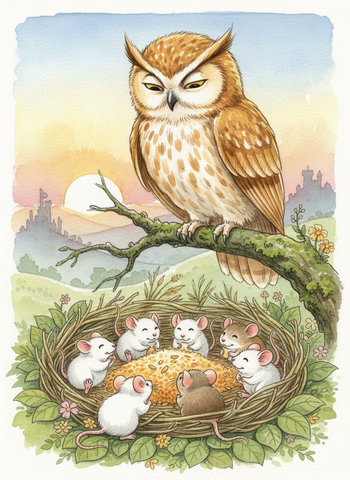
A clever owl keeps captive mice by removing their feet, feeding them grain while keeping them imprisoned — demonstrating that cunning strategy rivals human reasoning.
It is not always wise to say to your company, "Just listen to this joke" or "What do you think of this for a marvel?" for one can never be sure that the listeners will regard the matter in the same way that the teller does. Yet here is a case that makes an exception to this good rule, and I maintain that it is in truth wonderful, and, although it has the appearance of being a fable, it is in reality absolute fact.
对朋友说“听听这个笑话吧”,或者“你觉得这件奇事怎么样”,这样做并不总是明智的,因为你永远无法确定,听众看待这件事的方式会不会和讲述者一样。不过,这里有一个例外,我坚持认为这确实令人称奇,而且,虽然它看起来像一则寓言,实际上却是千真万确的事实。
There was once an extremely old pine-tree which an owl, that grim bird which Atropus takes for her interpreter, had made to serve as his palace. But there were other tenants lodging in its cavernous and time-rotted trunk. These were mice, well fed, positive balls of fat, but not one of them had a foot. They had all been mutilated. The owl had nipped their feet off with his beak, whilst feeding and fostering them with wheat from neighbouring stacks.
从前有一棵极其古老的松树,一只猫头鹰——那种阿特洛波斯用来做她代言人的阴森之鸟——把它当作自己的宫殿。可是这棵树那个空洞、腐朽已久的树干里,还住着别的房客。那是一群老鼠,个个吃得肥肥胖胖,圆滚滚的,可它们没有一只有脚。它们全都被截去了脚。猫头鹰在用附近粮堆里的麦子喂养它们、悉心照料它们的同时,用嘴把它们的脚都咬掉了。
It must be confessed that this bird had reasoned.
必须承认,这只鸟是经过一番推理的。
Doubtless, in his time, when hunting mice, he had found that after bringing them home they escaped again from the trunk, and to prevent the recurrence of such a loss the artful rascal had thenceforth nipped off the feet of all he caught, keeping them prisoners and eating them one to-day and one to-morrow. To eat them all at once would have been impossible. He had his health to think of. His forethought, which went quite as far as ours, extended to bringing them grain for their subsistence.
毫无疑问,它在捕鼠的过程中曾经发现,把老鼠带回家后,它们又会从树干里逃走,为了防止再次遭受这样的损失,这只狡猾的家伙从此便咬掉所有捕获的老鼠的脚,把它们囚禁起来,今天吃一只,明天再吃一只。要把它们一次吃个精光是不可能的。它得为自己的健康着想。它的深谋远虑,几乎和我们人类不相上下,甚至还包括给它们带来粮食维持生计。
If this is not reasoning, then I do not understand what reasoning is. See what arguments he used:—
如果这不算推理,那我真不知道推理是什么了。看看它用的是什么论证:——
"When these mice are caught they run away, therefore I must eat them as I catch them. What all? Impossible! But would it not be well to keep some for a needy future? If so, I must keep them and feed them too, without their escaping. But how's that to be done? Happy thought! Nip off their feet!"
“这些老鼠一被抓住就会逃跑,所以我必须一抓到手就把它们吃掉。什么,全都吃掉?不可能!可是留一些以备将来之需,岂不是更好?如果这样的话,我就得把它们养起来、喂起来,同时还不能让它们逃跑。可是这该怎么办呢?有了!把它们的脚咬掉!”
Now find me among human beings anything better carried out. Did Aristotle and his followers do any better thinking, by my faith?
现在,你倒找找看,人类当中有谁把这件事办得更漂亮的。凭我的信仰,亚里士多德和他的门徒们,思考得也未必比这更高明吧?
NOTE.—This is not a fable. The thing actually occurred, although marvellous enough and almost incredible. I have perhaps carried the forethought of this owl too far, for I do not pretend to establish in animals a line of reasoning; but in this style of literature a little exaggeration is pardonable.
附注:这不是一则寓言。这件事是真实发生的,尽管听起来奇妙得几乎令人难以置信。也许我把这只猫头鹰的深谋远虑说得有些过头了,因为我并不打算就此断言动物也具备推理能力;不过在这种文体里,稍作夸张也是可以原谅的。
