Sunday at Home
A free C1-level English story for language learners, readable online in 7 languages, with an option to listen via the free Storyteller app.
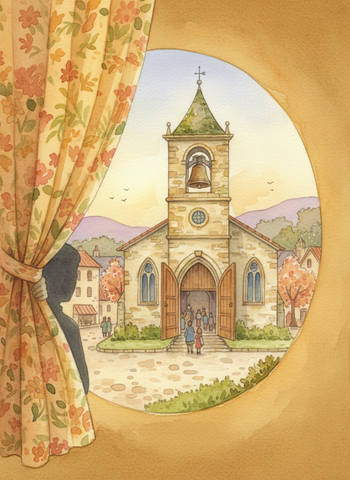
From behind his curtain, a solitary narrator spends an entire Sabbath watching his town's church — its bell, its worshippers, its silences — without ever stepping outside.
By Nathaniel Hawthorne
By Nathaniel Hawthorne
Every Sabbath morning in the summer time I thrust back the curtain, to watch the sunrise stealing down a steeple, which stands opposite my chamber-window. First, the weathercock begins to flash; then, a fainter lustre gives the spire an airy aspect; next it encroaches on the tower, and causes the index of the dial to glisten like gold, as it points to the gilded figure of the hour. Now, the loftiest window gleams, and now the lower. The carved framework of the portal is marked strongly out.
Cada mañana de sábado, en verano, aparto la cortina para contemplar cómo el amanecer se desliza por un campanario que se alza frente a la ventana de mi alcoba. Primero, la veleta empieza a destellar; luego, un resplandor más tenue da a la aguja un aspecto etéreo; a continuación avanza sobre la torre, y hace que el índice del reloj brille como el oro, mientras señala la cifra dorada de la hora. Ahora resplandece la ventana más alta, y ahora la más baja. El marco tallado del portal se recorta con fuerza.
At length, the morning glory, in its descent from heaven, comes down the stone steps, one by one; and there stands the steeple, glowing with fresh radiance, while the shades of twilight still hide themselves among the nooks of the adjacent buildings. Methinks, though the same sun brightens it every fair morning, yet the steeple has a peculiar robe of brightness for the Sabbath.
Al fin, la gloria de la mañana, en su descenso desde el cielo, baja los escalones de piedra uno a uno; y allí queda el campanario, resplandeciente de luz fresca, mientras las sombras del crepúsculo aún se ocultan entre los rincones de los edificios vecinos. Me parece que, aunque el mismo sol lo ilumina cada hermosa mañana, el campanario tiene un ropaje de brillo peculiar para el sábado.
By dwelling near a church, a person soon contracts an attachment for the edifice. We naturally personify it, and conceive its massive walls and its dim emptiness to be instinct with a calm, and meditative, and somewhat melancholy spirit. But the steeple stands foremost, in our thoughts, as well as locally. It impresses us as a giant, with a mind comprehensive and discriminating enough to care for the great and small concerns of all the town. Hourly, while it speaks a moral to the few that think, it reminds thousands of busy individuals of their separate and most secret affairs.
Al vivir cerca de una iglesia, uno pronto contrae un apego por el edificio. Naturalmente lo personificamos, y concebimos sus muros macizos y su penumbra vacía como animados por un espíritu sereno, meditativo y algo melancólico. Pero el campanario ocupa el primer lugar en nuestros pensamientos, tanto como en el espacio. Nos impresiona como un gigante, con una mente lo bastante amplia y perspicaz para ocuparse de los grandes y pequeños asuntos de todo el pueblo. Cada hora, mientras dirige una moraleja a los pocos que reflexionan, recuerda a miles de personas atareadas sus propios y más secretos asuntos.
It is the steeple, too, that flings abroad the hurried and irregular accents of general alarm; neither have gladness and festivity found a better utterance, than by its tongue; and when the dead are slowly passing to their home, the steeple has a melancholy voice to bid them welcome. Yet, in spite of this connection with human interests, what a moral loneliness, on week-days, broods round about its stately height! It has no kindred with the houses above which it towers; it looks down into the narrow thoroughfare, the lonelier, because the crowd are elbowing their passage at its base. A glance at the body of the church deepens this impression.
Es también el campanario el que lanza al aire los acentos apresurados e irregulares de la alarma general; y tampoco la alegría y la fiesta han hallado mejor voz que la suya; y cuando los muertos pasan lentamente hacia su morada, el campanario tiene una voz melancólica para darles la bienvenida. Y sin embargo, pese a esta conexión con los intereses humanos, ¡qué soledad moral, en los días laborables, envuelve su majestuosa altura! No tiene parentesco con las casas sobre las que se eleva; mira hacia la angosta calzada, más solitaria aún porque la multitud se abre paso a codazos en su base. Una mirada al cuerpo de la iglesia ahonda esta impresión.
Within, by the light of distant windows, amid refracted shadows, we discern the vacant pews and empty galleries, the silent organ, the voiceless pulpit, and the clock, which tells to solitude how time is passing. Time,—where man lives not,—what is it but eternity? And in the church, we might suppose, are garnered up, throughout the week, all thoughts and feelings that have reference to eternity, until the holy day comes round again, to let them forth. Might not, then, its more appropriate site be in the outskirts of the town, with space for old trees to wave around it, and throw their solemn shadows over a quiet green? We will say more of this, hereafter.
En su interior, a la luz de las ventanas distantes, entre sombras refractadas, distinguimos los bancos vacíos y las galerías desiertas, el órgano silencioso, el púlpito mudo, y el reloj, que le cuenta a la soledad cómo transcurre el tiempo. El tiempo —donde el hombre no habita— ¿qué es sino la eternidad? Y en la iglesia, podríamos suponer, se guardan, a lo largo de la semana, todos los pensamientos y sentimientos referidos a la eternidad, hasta que vuelve a llegar el día santo para dejarlos salir. ¿No sería, entonces, más apropiado su emplazamiento en las afueras del pueblo, con espacio para que viejos árboles se mecieran a su alrededor y proyectaran sus sombras solemnes sobre un prado tranquilo? Diremos más de esto más adelante.
But, on the Sabbath, I watch the earliest sunshine, and fancy that a holier brightness marks the day, when there shall be no buzz of voices on the exchange, nor traffic in the shops, nor crowd, nor business, anywhere but at church. Many have fancied so. For my own part, whether I see it scattered down among tangled woods, or beaming broad across the fields, or hemmed in between brick buildings, or tracing out the figure of the casement on my chamber-floor, still I recognize the Sabbath sunshine.
Pero, en el sábado, observo el sol de la mañana temprana, e imagino que un resplandor más sagrado marca el día, cuando no habrá bullicio de voces en la lonja, ni comercio en las tiendas, ni multitud, ni negocios, en ninguna parte salvo en la iglesia. Muchos lo han imaginado así. Por mi parte, ya lo vea disperso entre bosques enmarañados, o brillando ancho sobre los campos, o encerrado entre edificios de ladrillo, o trazando la figura de la ventana en el suelo de mi alcoba, reconozco siempre el sol del sábado.
And ever let me recognize it! Some illusions, and this among them, are the shadows of great truths. Doubts may flit around me, or seem to close their evil wings, and settle down; but so long as I imagine that the earth is hallowed, and the light of heaven retains its sanctity, on the Sabbath,—while that blessed sunshine lives within me,—never can my soul have lost the instinct of its faith. If it have gone astray, it will return again.
¡Y que siempre lo reconozca! Algunas ilusiones, y esta entre ellas, son la sombra de grandes verdades. Las dudas pueden revolotear a mi alrededor, o parecer cerrar sus alas malignas y posarse; pero mientras yo imagine que la tierra está consagrada, y que la luz del cielo conserva su santidad en el sábado —mientras ese bendito resplandor viva dentro de mí—, mi alma nunca podrá haber perdido el instinto de su fe. Si se ha extraviado, volverá.
I love to spend such pleasant Sabbaths, from morning till night, behind the curtain of my open window. Are they spent amiss? Every spot, so near the church as to be visited by the circling shadow of the steeple, should be deemed consecrated ground, to-day. With stronger truth be it said, that a devout heart may consecrate a den of thieves, as an evil one may convert a temple to the same. My heart, perhaps, has not such holy, nor, I would fain trust, such impious potency. It must suffice, that, though my form be absent, my inner man goes constantly to church, while many, whose bodily presence fills the accustomed seats, have left their souls at home.
Me encanta pasar estos placenteros sábados, de la mañana a la noche, tras la cortina de mi ventana abierta. ¿Se pasan mal? Todo lugar tan cercano a la iglesia como para ser visitado por la sombra circular del campanario debería considerarse, hoy, terreno consagrado. Con mayor verdad podría decirse que un corazón devoto puede consagrar una guarida de ladrones, del mismo modo que uno impío puede convertir un templo en lo mismo. Mi corazón, quizá, no posee tal potencia santa, ni, quiero creer, tal potencia impía. Baste con que, aunque mi cuerpo esté ausente, mi hombre interior va constantemente a la iglesia, mientras muchos, cuya presencia corporal llena los asientos acostumbrados, han dejado sus almas en casa.
But I am there, even before my friend, the sexton. At length, he comes,—a man of kindly, but sombre aspect, in dark gray clothes, and hair of the same mixture,—he comes and applies his key to the wide portal. Now my thoughts may go in among the dusty pews, or ascend the pulpit without sacrilege, but soon come forth again to enjoy the music of the bell. How glad, yet solemn too! All the steeples in town are talking together, aloft in the sunny air, and rejoicing among themselves, while their spires point heavenward.
Pero yo estoy allí, incluso antes que mi amigo el sacristán. Al fin llega él —un hombre de aspecto bondadoso pero sombrío, vestido de gris oscuro, con el cabello de la misma mezcla de color— llega y aplica su llave al ancho portal. Ahora mis pensamientos pueden entrar entre los polvorientos bancos, o subir al púlpito sin sacrilegio, pero pronto vuelven a salir para gozar de la música de la campana. ¡Qué alegre, y a la vez qué solemne! Todos los campanarios del pueblo conversan entre sí, en lo alto del aire soleado, y se regocijan entre ellos, mientras sus agujas apuntan al cielo.
Meantime, here are the children assembling to the Sabbath school, which is kept somewhere within the church. Often, while looking at the arched portal, I have been gladdened by the sight of a score of these little girls and boys, in pink, blue, yellow, and crimson frocks, bursting suddenly forth into the sunshine, like a swarm of gay butterflies that had been shut up in the solemn gloom. Or I might compare them to cherubs, haunting that holy place.
Mientras tanto, aquí están los niños reuniéndose para la escuela dominical, que se celebra en algún rincón dentro de la iglesia. A menudo, mirando el portal abovedado, me he alegrado al ver a una veintena de estas niñas y niños, con vestidos rosados, azules, amarillos y carmesí, brotando de pronto hacia la luz del sol, como un enjambre de alegres mariposas que hubieran estado encerradas en la solemne penumbra. O podría compararlos con querubines que frecuentan ese lugar sagrado.
About a quarter of an hour before the second ringing of the bell, individuals of the congregation begin to appear. The earliest is invariably an old woman in black, whose bent frame and rounded shoulders are evidently laden with some heavy affliction, which she is eager to rest upon the altar. Would that the Sabbath came twice as often, for the sake of that sorrowful old soul! There is an elderly man, also, who arrives in good season, and leans against the corner of the tower, just within the line of its shadow, looking downward with a darksome brow. I sometimes fancy that the old woman is the happier of the two.
Cosa de un cuarto de hora antes del segundo repique de la campana, comienzan a aparecer los individuos de la congregación. La primera es invariablemente una anciana vestida de negro, cuyo cuerpo encorvado y hombros redondeados están evidentemente cargados de alguna pesada aflicción, que ansía depositar sobre el altar. ¡Ojalá el sábado llegara el doble de veces, por el bien de esa alma anciana y afligida! Hay también un hombre de edad que llega con buena antelación, y se apoya en la esquina de la torre, justo dentro de la línea de su sombra, mirando hacia abajo con el ceño ensombrecido. A veces imagino que la anciana es la más feliz de los dos.
After these, others drop in singly, and by twos and threes, either disappearing through the doorway or taking their stand in its vicinity. At last, and always with an unexpected sensation, the bell turns in the steeple overhead, and throws out an irregular clangor, jarring the tower to its foundation. As if there were magic in the sound, the sidewalks of the street, both up and down along, are immediately thronged with two long lines of people, all converging hitherward, and streaming into the church. Perhaps the far-off roar of a coach draws nearer,—a deeper thunder by its contrast with the surrounding stillness,—until it sets down the wealthy worshippers at the portal, among their humblest brethren.
Después de estos, otros van llegando de uno en uno, y de dos en dos y de tres en tres, ya sea desapareciendo por la puerta o quedándose de pie en sus cercanías. Al fin, y siempre con una sensación inesperada, la campana gira en el campanario, en lo alto, y lanza un clamor irregular, que sacude la torre hasta sus cimientos. Como si hubiera magia en el sonido, las aceras de la calle, tanto arriba como abajo, se llenan de inmediato de dos largas filas de gente, todas convergiendo hacia aquí, y fluyendo hacia la iglesia. Quizá el rugido lejano de un coche se acerca —un trueno más profundo por contraste con la quietud circundante— hasta que deposita a los adinerados fieles en el portal, entre sus hermanos más humildes.
Beyond that entrance, in theory at least, there are no distinctions of earthly rank; nor indeed, by the goodly apparel which is flaunting in the sun, would there seem to be such, on the hither side. Those pretty girls! Why will they disturb my pious meditations! Of all days in the week, they should strive to look least fascinating on the Sabbath, instead of heightening their mortal loveliness, as if to rival the blessed angels, and keep our thoughts from heaven. Were I the minister himself, I must needs look.
Más allá de esa entrada, en teoría al menos, no hay distinciones de rango terrenal; ni tampoco, a juzgar por el vistoso atavío que ondea al sol, parecería haberlas de este lado. ¡Esas muchachas bonitas! ¡Por qué habrán de perturbar mis piadosas meditaciones! De todos los días de la semana, deberían esforzarse por parecer menos fascinantes en el sábado, en lugar de realzar su belleza mortal, como si quisieran rivalizar con los benditos ángeles, y apartar nuestros pensamientos del cielo. Si yo fuera el propio ministro, tendría que mirar de todos modos.
One girl is white muslin from the waist upwards, and black silk downwards to her slippers; a second blushes from topknot to shoe-tie, one universal scarlet; another shines of a pervading yellow, as if she had made a garment of the sunshine. The greater part, however, have adopted a milder cheerfulness of hue. Their veils, especially when the wind raises them, give a lightness to the general effect, and make them appear like airy phantoms, as they flit up the steps, and vanish into the sombre doorway.
Una muchacha va de muselina blanca de la cintura hacia arriba, y de seda negra hacia abajo hasta sus zapatillas; otra se sonroja de la coronilla al lazo del zapato, un escarlata uniforme; otra brilla de un amarillo omnipresente, como si se hubiera hecho un vestido de la luz del sol. La mayoría, sin embargo, ha adoptado un colorido de alegría más suave. Sus velos, especialmente cuando el viento los levanta, dan ligereza al efecto general, y las hacen parecer fantasmas aéreos mientras suben revoloteando los escalones y se desvanecen en el sombrío portal.
Nearly all—though it is very strange that I should know it—wear white stockings, white as snow, and neat slippers, laced crosswise with black ribbon, pretty high above the ankles. A white stocking is infinitely more effective than a black one.
Casi todas —aunque es muy extraño que yo lo sepa— llevan medias blancas, blancas como la nieve, y pulcras zapatillas, atadas en cruz con cinta negra, bastante por encima de los tobillos. Una media blanca es infinitamente más vistosa que una negra.
Here comes the clergyman, slow and solemn, in severe simplicity, needing no black silk gown to denote his office. His aspect claims my reverence, but cannot win my love. Were I to picture Saint Peter, keeping fast the gate of heaven, and frowning, more stern than pitiful, on the wretched applicants, that face should be my study. By middle age, or sooner, the creed has generally wrought upon the heart, or been attempered by it. As the minister passes into the church, the bell holds its iron tongue, and all the low murmur of the congregation dies away.
Aquí viene el clérigo, lento y solemne, de severa sencillez, sin necesitar sotana de seda negra para señalar su cargo. Su aspecto reclama mi reverencia, pero no puede ganar mi cariño. Si tuviera que retratar a San Pedro guardando la puerta del cielo, frunciendo el ceño, más severo que compasivo, ante los desdichados solicitantes, ese rostro sería mi modelo. Hacia la mediana edad, o antes, el credo generalmente ha obrado sobre el corazón, o ha sido templado por él. Cuando el ministro entra en la iglesia, la campana calla su lengua de hierro, y todo el bajo murmullo de la congregación se apaga.
The gray sexton looks up and down the street, and then at my window-curtain, where, through the small peephole, I half fancy that he has caught my eye. Now, every loiterer has gone in, and the street lies asleep in the quiet sun, while a feeling of loneliness comes over me, and brings also an uneasy sense of neglected privileges and duties. O, I ought to have gone to church! The hustle of the rising congregation reaches my ears.
El sacristán gris mira arriba y abajo por la calle, y luego hacia la cortina de mi ventana, donde, a través de la pequeña mirilla, casi imagino que ha atrapado mi mirada. Ahora, todos los rezagados han entrado, y la calle yace dormida bajo el sol tranquilo, mientras me invade una sensación de soledad, que trae también un incómodo sentimiento de privilegios y deberes descuidados. ¡Oh, debería haber ido a la iglesia! El bullicio de la congregación al ponerse de pie llega a mis oídos.
They are standing up to pray. Could I bring my heart into unison with those who are praying in yonder church, and lift it heavenward, with a fervor of supplication, but no distinct request, would not that be the safest kind of prayer? "Lord, look down upon me in mercy!" With that sentiment gushing from my soul, might I not leave all the rest to Him?
Están de pie para orar. Si pudiera poner mi corazón en armonía con los que oran en aquella iglesia, y elevarlo hacia el cielo, con un fervor de súplica, pero sin petición concreta, ¿no sería esa la forma más segura de oración? «¡Señor, mira hacia mí con misericordia!» Con ese sentimiento brotando de mi alma, ¿no podría dejar todo lo demás en Sus manos?
Hark! the hymn. This, at least, is a portion of the service which I can enjoy better than if I sat within the walls, where the full choir and the massive melody of the organ, would fall with a weight upon me. At this distance, it thrills through my frame, and plays upon my heartstrings, with a pleasure both of the sense and spirit. Heaven be praised, I know nothing of music, as a science; and the most elaborate harmonies, if they please me, please as simply as a nurse's lullaby. The strain has ceased, but prolongs itself in my mind, with fanciful echoes, till I start from my revery, and find that the sermon has commenced.
¡Escuchad! El himno. Esta, al menos, es una parte del servicio que puedo disfrutar mejor que si estuviera sentado dentro de los muros, donde el coro completo y la maciza melodía del órgano caerían sobre mí con un peso. A esta distancia, me atraviesa el cuerpo y toca las fibras de mi corazón, con un placer tanto de los sentidos como del espíritu. Loado sea el cielo, no sé nada de música como ciencia; y las armonías más elaboradas, si me agradan, me agradan tan simplemente como la nana de una niñera. La melodía ha cesado, pero se prolonga en mi mente con ecos imaginarios, hasta que salgo de mi ensueño y descubro que el sermón ha comenzado.
It is my misfortune seldom to fructify, in a regular way, by any but printed sermons. The first strong idea, which the preacher utters, gives birth to a train of thought, and leads me onward, step by step, quite out of hearing of the good man's voice, unless he be indeed a son of thunder. At my open window, catching now and then a sentence of the "parson's saw," I am as well situated as at the foot of the pulpit stairs.
Es mi desgracia rara vez fructificar, de manera ordenada, salvo con sermones impresos. La primera idea sólida que pronuncia el predicador da origen a una cadena de pensamientos, y me lleva adelante, paso a paso, bien lejos del alcance de la voz del buen hombre, a menos que sea de veras un hijo del trueno. En mi ventana abierta, captando de cuando en cuando una frase del «dicho del párroco», estoy tan bien situado como al pie de las escaleras del púlpito.
The broken and scattered fragments of this one discourse will be the texts of many sermons, preached by those colleague pastors,—colleagues, but often disputants,—my Mind and Heart. The former pretends to be a scholar, and perplexes me with doctrinal points; the latter takes me on the score of feeling; and both, like several other preachers, spend their strength to very little purpose. I, their sole auditor, cannot always understand them.
Los fragmentos rotos y dispersos de este único discurso serán los textos de muchos sermones, predicados por esos pastores colegas —colegas, pero a menudo contendientes— mi Mente y mi Corazón. La primera pretende ser erudita, y me confunde con puntos doctrinales; el segundo me toma por el lado del sentimiento; y ambos, como otros varios predicadores, gastan sus fuerzas para muy poco propósito. Yo, su único oyente, no siempre logro entenderlos.
Suppose that a few hours have passed, and behold me still behind my curtain, just before the close of the afternoon service. The hour-hand on the dial has passed beyond four o'clock. The declining sun is hidden behind the steeple, and throws its shadow straight across the street, so that my chamber is darkened, as with a cloud. Around the church-door all is solitude, and an impenetrable obscurity beyond the threshold. A commotion is heard. The seats are slammed down, and the pew-doors thrown back,—a multitude of feet are trampling along the unseen aisles,—and the congregation bursts suddenly through the portal.
Supongamos que han pasado unas horas, y helo aquí, todavía tras mi cortina, poco antes del cierre del servicio vespertino. La manecilla de la hora en el reloj ha pasado las cuatro. El sol declinante se oculta tras el campanario, y proyecta su sombra recta a través de la calle, de modo que mi alcoba queda oscurecida, como por una nube. Alrededor de la puerta de la iglesia todo es soledad, y una oscuridad impenetrable más allá del umbral. Se oye un alboroto. Los asientos se cierran de golpe, y las puertas de los bancos se abren de par en par —una multitud de pies pisotea por los pasillos invisibles— y la congregación irrumpe de pronto por el portal.
Foremost, scampers a rabble of boys, behind whom moves a dense and dark phalanx of grown men, and lastly, a crowd of females, with young children, and a few scattered husbands. This instantaneous outbreak of life into loneliness is one of the pleasantest scenes of the day. Some of the good people are rubbing their eyes, thereby intimating that they have been wrapped, as it were, in a sort of holy trance, by the fervor of their devotion.
Al frente corre en tropel una turba de muchachos, tras los cuales avanza una densa y oscura falange de hombres adultos, y por último, una multitud de mujeres, con niños pequeños, y unos pocos maridos dispersos. Este estallido instantáneo de vida en la soledad es una de las escenas más placenteras del día. Algunas de las buenas gentes se frotan los ojos, dando a entender con ello que han estado envueltas, por así decirlo, en una suerte de trance sagrado, por el fervor de su devoción.
There is a young man, a third-rate coxcomb, whose first care is always to flourish a white handkerchief, and brush the seat of a tight pair of black silk pantaloons, which shine as if varnished. They must have been made of the stuff called "everlasting," or perhaps of the same piece as Christian's garments in the Pilgrim's Progress, for he put them on two summers ago, and has not yet worn the gloss off. I have taken a great liking to those black silk pantaloons. But, now, with nods and greetings among friends, each matron takes her husband's arm, and paces gravely homeward, while the girls also flutter away, after arranging sunset walks with their favored bachelors.
Hay un joven, un petimetre de tercera categoría, cuyo primer cuidado es siempre agitar un pañuelo blanco y sacudirse el asiento de un ajustado par de pantalones de seda negra, que brillan como barnizados. Deben de estar hechos de esa tela llamada «eterna», o quizá de la misma pieza que las vestiduras de Cristiano en El progreso del peregrino, pues se los puso hace dos veranos y todavía no ha perdido el brillo. Le he tomado gran cariño a esos pantalones de seda negra. Pero ahora, con saludos e inclinaciones entre amigos, cada matrona toma del brazo a su marido y camina gravemente hacia casa, mientras las muchachas también revolotean, después de concertar paseos al atardecer con sus solteros favoritos.
The Sabbath eve is the eve of love. At length, the whole congregation is dispersed. No; here, with faces as glossy as black satin, come two sable ladies and a sable gentleman, and close in their rear the minister, who softens his severe visage, and bestows a kind word on each. Poor souls! To them the most captivating picture of bliss in heaven is—"There we shall be white!"
La víspera del sábado es la víspera del amor. Al fin, toda la congregación se ha dispersado. No; aquí, con rostros tan lustrosos como el raso negro, vienen dos damas de color y un caballero de color, y les sigue de cerca el ministro, quien suaviza su severo semblante y dedica una palabra amable a cada uno. ¡Pobres almas! Para ellos la imagen más cautivadora de la dicha en el cielo es: «¡Allí seremos blancos!»
All is solitude again. But, hark!—a broken warbling of voices, and now, attuning its grandeur to their sweetness, a stately peal of the organ. Who are the choristers? Let me dream that the angels, who came down from heaven, this blessed morn, to blend themselves with the worship of the truly good, are playing and singing their farewell to the earth. On the wings of that rich melody they were borne upward.
Todo vuelve a ser soledad. Pero, ¡escuchad! —un trino quebrado de voces, y ahora, ajustando su grandeza a su dulzura, un solemne repique del órgano. ¿Quiénes son los coristas? Dejadme soñar que los ángeles, que descendieron del cielo esta bendita mañana para fundirse con el culto de los verdaderamente buenos, están tocando y cantando su despedida a la tierra. Sobre las alas de esa rica melodía fueron llevados hacia arriba.
This, gentle reader, is merely a flight of poetry. A few of the singing men and singing women had lingered behind their fellows, and raised their voices fitfully, and blew a careless note upon the organ. Yet, it lifted my soul higher than all their former strains. They are gone, the sons and daughters of music,—and the gray sexton is just closing the portal.
Esto, amable lector, no es más que un vuelo de poesía. Unos pocos de los cantores y cantoras se habían rezagado tras sus compañeros, y alzaron sus voces a ratos, y sopraron una nota descuidada en el órgano. Y sin embargo, elevó mi alma más alto que todas sus melodías anteriores. Se han ido, los hijos e hijas de la música, y el sacristán gris está justo cerrando el portal.
For six days more, there will be no face of man in the pews, and aisles, and galleries, nor a voice in the pulpit, nor music in the choir. Was it worth while to rear this massive edifice, to be a desert in the heart of the town, and populous only for a few hours of each seventh day?
Durante seis días más no habrá rostro de hombre en los bancos, ni en los pasillos, ni en las galerías, ni voz alguna en el púlpito, ni música en el coro. ¿Valía la pena erigir este macizo edificio para que fuera un desierto en el corazón del pueblo, y poblado solo unas pocas horas de cada séptimo día?
O, but the church is a symbol of religion! May its site, which was consecrated on the day when the first tree was felled, be kept holy forever, a spot of solitude and peace, amid the trouble and vanity of our week-day world! There is a moral, and a religion too, even in the silent walls. And may the steeple still point heavenward, and be decked with the hallowed sunshine of the Sabbath morn!
¡Oh, pero la iglesia es un símbolo de la religión! ¡Que su emplazamiento, consagrado el día en que se taló el primer árbol, se mantenga santo para siempre, un lugar de soledad y paz, en medio del ajetreo y la vanidad de nuestro mundo cotidiano! Hay una moraleja, y también una religión, incluso en los muros silenciosos. ¡Y que el campanario siga apuntando hacia el cielo, y se engalane con el sagrado resplandor de la mañana del sábado!
