The Lad Who Went to the North Wind
A free B1-level English story for language learners, readable online in 7 languages, with an option to listen via the free Storyteller app.
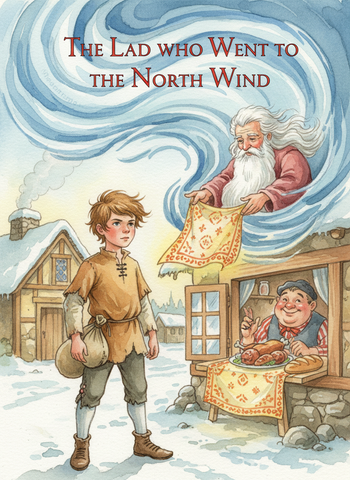
After the North Wind blows away his family's flour, a boy demands it back and is given a magic cloth instead — if only an innkeeper would leave it alone.
Once on a time there was an old widow who had one son; and as she was poorly and weak, her son had to go up into the safe to fetch meal for cooking; but when he got outside the safe, and was just going down the steps, there came the North Wind, puffing and blowing, caught up the meal, and so away with it through the air.
Había una vez una vieja viuda que tenía un solo hijo; y como ella estaba enferma y débil, su hijo tenía que subir a la despensa a buscar harina para cocinar; pero cuando salió de la despensa, y justo bajaba los escalones, llegó el Viento del Norte, resoplando y soplando, agarró la harina, y se la llevó por los aires.
Then the lad went back into the safe for more; but when he came out again on the steps, if the North Wind didn’t come again and carry off the meal with a puff; and, more than that, he did so the third time. At this the lad got very angry; and as he thought it hard that the North Wind should behave so, he thought he’d just look him up, and ask him to give up his meal.
Entonces el muchacho volvió a la despensa por más; pero cuando salió de nuevo a los escalones, no faltó que el Viento del Norte volviera otra vez y se llevara la harina de un soplido; y, más aún, hizo lo mismo la tercera vez. Ante esto el muchacho se enfadó mucho; y como le pareció injusto que el Viento del Norte se comportara así, pensó que iría a buscarlo, y le pediría que le devolviera su harina.
So off he went, but the way was long, and he walked and walked; but at last he came to the North Wind’s house.
Así que se marchó, pero el camino era largo, y caminó y caminó; pero al fin llegó a la casa del Viento del Norte.
“Good day!” said the lad, “and thank you for coming to see us yesterday.”
—¡Buenos días! —dijo el muchacho—, y gracias por venir a visitarnos ayer.
“GOOD DAY!” answered the North Wind, for his voice was loud and gruff, “AND THANKS FOR COMING TO SEE ME. WHAT DO YOU WANT?”
—¡BUENOS DÍAS! —respondió el Viento del Norte, pues su voz era fuerte y áspera—, Y GRACIAS POR VENIR A VERME. ¿QUÉ QUIERES?
“Oh!” answered the lad, “I only wished to ask you to be so good as to let me have back that meal you took from me on the safe steps, for we haven’t much to live on; and if you’re to go on snapping up the morsel we have, there’ll be nothing for it but to starve.”
—¡Ay! —respondió el muchacho—, solo quería pedirte que tuvieras la bondad de devolverme la harina que me quitaste en los escalones de la despensa, pues no tenemos mucho de qué vivir; y si sigues llevándote lo poco que tenemos, no habrá más remedio que pasar hambre.
“I haven’t got your meal”, said the North Wind; “but if you are in such need, I’ll give you a cloth which will get you everything you want, if you only say, “Cloth, spread yourself, and serve up all kind of good dishes!”
—No tengo tu harina —dijo el Viento del Norte—; pero si tanto la necesitas, te daré un mantel que te conseguirá todo lo que quieras, con solo decir: "¡Mantel, extiéndete, y sirve toda clase de buenos platos!".
With this the lad was well content. But, as the way was so long he couldn’t get home in one day, so he turned into an inn on the way; and when they were going to sit down to supper he laid the cloth on a table which stood in the corner, and said,
Con esto el muchacho quedó bien contento. Pero, como el camino era tan largo, no pudo llegar a casa en un solo día, así que se detuvo en una posada por el camino; y cuando se disponían a sentarse a cenar, puso el mantel sobre una mesa que había en el rincón, y dijo:
“Cloth, spread yourself, and serve up all kinds of good dishes.”
—«Mantel, extiéndete, y sirve toda clase de buenos platos».
He had scarce said so before the cloth did as it was bid; and all who stood by thought it a fine thing, but most of all the landlady. So, when all were fast asleep at dead of night, she took the lad’s cloth, and put another in its stead, just like the one he had got from the North Wind, but which couldn’t so much as serve up a bit of dry bread.
Apenas lo había dicho cuando el mantel hizo lo que se le pedía; y todos los presentes pensaron que era algo maravilloso, pero sobre todo la posadera. Así que, cuando todos estaban profundamente dormidos en plena noche, ella tomó el mantel del muchacho, y puso otro en su lugar, igual que el que había recibido del Viento del Norte, pero que no podía servir ni siquiera un pedazo de pan seco.
So, when the lad woke, he took his cloth and went off with it, and that day he got home to his mother.
Así que, cuando el muchacho se despertó, tomó su mantel y se marchó con él, y ese día llegó a casa junto a su madre.
“Now”, said he, “I’ve been to the North Wind’s house, and a good fellow he is, for he gave me this cloth, and when I only say to it, ‘Cloth, spread yourself, and serve up all kind of good dishes’, I get any sort of food I please.”
—Ahora bien —dijo él—, he estado en la casa del Viento del Norte, y es un buen tipo, pues me dio este mantel, y cuando solo le digo, "Mantel, extiéndete, y sirve toda clase de buenos platos", consigo la comida que quiera.
“All very true, I daresay,” said his mother; “but seeing is believing, and I shan’t believe it till I see it.”
—Muy cierto, sin duda —dijo su madre—; pero ver para creer, y no lo creeré hasta que lo vea.
So the lad made haste, drew out a table, laid the cloth on it, and said:
Así que el muchacho se apresuró, sacó una mesa, puso el mantel encima, y dijo:
“Cloth, spread yourself, and serve up all kind of good dishes.”
—«Mantel, extiéndete, y sirve toda clase de buenos platos».
But never a bit of dry bread did the cloth serve up.
Pero ni un pedazo de pan seco sirvió el mantel.
“Well”, said the lad, “there’s no help for it but to go to the North Wind again”; and away he went.
—Bueno —dijo el muchacho—, no hay más remedio que volver a ver al Viento del Norte otra vez—; y se marchó.
So he came to where the North Wind lived late in the afternoon.
Así que llegó a donde vivía el Viento del Norte ya bien entrada la tarde.
“Good evening!” said the lad.
—¡Buenas noches! —dijo el muchacho.
“Good evening!” said the North Wind.
—¡Buenas noches! —dijo el Viento del Norte.
“I want my rights for that meal of ours which you took”, said the lad; “for, as for that cloth I got, it isn’t worth a penny.”
—Quiero lo que me corresponde por aquella harina nuestra que te llevaste —dijo el muchacho—; pues, en cuanto a ese mantel que recibí, no vale ni un penique.
“I’ve got no meal”, said the North Wind; “but yonder you have a ram which coins nothing but golden ducats as soon as you say to it:
—No tengo tu harina —dijo el Viento del Norte—; pero allá tienes un carnero que no hace más que acuñar ducados de oro en cuanto le dices:
‘Rain, ram! make money!’
«¡Carnero, carnero, haz dinero!»
So the lad thought this a fine thing; but as it was too far to get home that day, he turned in for the night to the same inn where he had slept before.
Así que el muchacho pensó que esto era algo estupendo; pero como quedaba demasiado lejos para llegar a casa ese día, se detuvo a pasar la noche en la misma posada donde había dormido antes.
Before he called for anything, he tried the truth of what the North Wind had said of the ram, and found it all right; but, when the landlord saw that, he thought it was a famous ram, and, when the lad had fallen asleep, he took another which couldn’t coin gold ducats, and changed the two.
Antes de pedir nada, puso a prueba la verdad de lo que el Viento del Norte le había dicho sobre el carnero, y comprobó que todo era cierto; pero, cuando el posadero vio aquello, pensó que era un carnero famoso, y, cuando el muchacho se quedó dormido, tomó otro que no podía acuñar ducados de oro, y cambió los dos.
Next morning off went the lad; and when he got home to his mother, he said:
A la mañana siguiente el muchacho se marchó; y cuando llegó a casa junto a su madre, dijo:
“After all, the North Wind is a jolly fellow; for now he has given me a ram which can coin golden ducats if I only say ‘Ram, ram! make money.’”
—Después de todo, el Viento del Norte es un tipo estupendo; pues ahora me ha dado un carnero que puede acuñar ducados de oro con solo decir "Carnero, carnero, haz dinero".
“All very true, I daresay”, said his mother; “but I shan’t believe any such stuff until I see the ducats made.”
—Muy cierto, sin duda —dijo su madre—; pero no creeré semejante cosa hasta que vea los ducados hechos.
“Ram, ram! make money!” said the lad; but if the Ram made anything, it wasn’t money.
—«¡Carnero, carnero, haz dinero!»—, dijo el muchacho; pero si el carnero hizo algo, desde luego no fue dinero.
So the lad went back again to the North Wind, and blew him up, and said the ram was worth nothing, and he must have his rights for the meal.
Así que el muchacho volvió otra vez con el Viento del Norte, y le reclamó enfadado, y le dijo que el carnero no valía nada, y que debía recibir lo que le correspondía por la harina.
“Well!” said the North Wind; “I’ve nothing else to give you but that old stick in the corner yonder; but it’s a stick of that kind that if you say:
—¡Bueno! —dijo el Viento del Norte—; no tengo otra cosa que darte más que ese viejo palo de allá en el rincón; pero es un palo de tal clase que si dices:
“‘Stick, stick! lay on!’ it lays on till you say: ‘Stick, stick! now stop!’”
—«"¡Palo, palo, dale con fuerza!", da golpes hasta que dices: "¡Palo, palo, ahora para!"».
So, as the way was long, the lad turned in this night too to the landlord; but as he could pretty well guess how things stood as to the cloth and the ram, he lay down at once on the bench and began to snore, as if he were asleep.
Así que, como el camino era largo, el muchacho se detuvo esa noche también en la posada; pero como podía imaginarse bastante bien cómo estaban las cosas en cuanto al mantel y al carnero, se echó de inmediato en el banco y se puso a roncar, como si estuviera dormido.
Now the landlord, who easily saw that the stick must be worth something, hunted up one which was like it, and when he heard the lad snore, was going to change the two; but, just as the landlord was about to take it, the lad bawled out: “Stick, stick! lay on!”
Ahora bien, el posadero, que fácilmente adivinó que el palo debía de valer algo, buscó uno parecido, y cuando oyó roncar al muchacho, se disponía a cambiar los dos; pero, justo cuando el posadero estaba a punto de tomarlo, el muchacho gritó: «¡Palo, palo, dale con fuerza!».
So the stick began to beat the landlord, till he jumped over chairs, and tables, and benches, and yelled and roared:
Entonces el palo empezó a golpear al posadero, hasta que este saltó por encima de sillas, mesas y bancos, y aulló y bramó:
“Oh my! oh my! bid the stick be still, else it will beat me to death, and you shall have back both your cloth and our ram.”
—¡Ay, ay! ¡Ordénale al palo que se detenga, o me golpeará hasta la muerte, y recuperarás tanto tu mantel como nuestro carnero!
When the lad thought the landlord had got enough, he said:
Cuando el muchacho pensó que el posadero ya había tenido suficiente, dijo:
“Stick, stick! now stop!”
—«¡Palo, palo, ahora para!»
Then he took the cloth and put it into his pocket, and went home with his stick in his hand, leading the ram by a cord round its horns; and so he got his rights for the meal he had lost.
Entonces tomó el mantel y se lo guardó en el bolsillo, y se fue a casa con su palo en la mano, llevando al carnero de una cuerda atada a los cuernos; y así consiguió lo que le correspondía por la harina que había perdido.
