The Lad Who Went to the North Wind
A free B1-level English story for language learners, readable online in 7 languages, with an option to listen via the free Storyteller app.
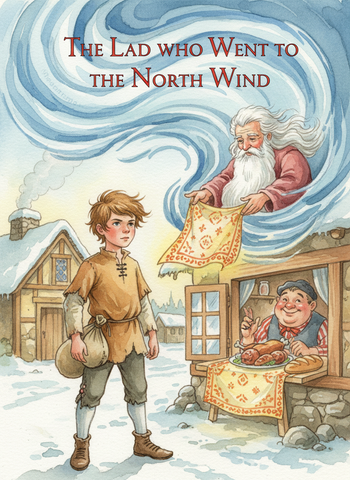
After the North Wind blows away his family's flour, a boy demands it back and is given a magic cloth instead — if only an innkeeper would leave it alone.
Once on a time there was an old widow who had one son; and as she was poorly and weak, her son had to go up into the safe to fetch meal for cooking; but when he got outside the safe, and was just going down the steps, there came the North Wind, puffing and blowing, caught up the meal, and so away with it through the air.
Era uma vez uma velha viúva que tinha um único filho; e como ela estava fraca e adoentada, seu filho tinha de subir até a despensa para buscar farinha para cozinhar; mas quando ele saiu da despensa, e estava descendo os degraus, veio o Vento Norte, bufando e soprando, agarrou a farinha, e foi embora com ela pelo ar.
Then the lad went back into the safe for more; but when he came out again on the steps, if the North Wind didn’t come again and carry off the meal with a puff; and, more than that, he did so the third time. At this the lad got very angry; and as he thought it hard that the North Wind should behave so, he thought he’d just look him up, and ask him to give up his meal.
Então o rapaz voltou à despensa para buscar mais; mas quando saiu de novo nos degraus, o Vento Norte apareceu outra vez e levou a farinha com um sopro; e, mais do que isso, fez o mesmo pela terceira vez. Diante disso, o rapaz ficou muito zangado; e como achava injusto que o Vento Norte se comportasse assim, pensou em ir procurá-lo, e pedir que devolvesse sua farinha.
So off he went, but the way was long, and he walked and walked; but at last he came to the North Wind’s house.
Então ele partiu, mas o caminho era longo, e caminhou e caminhou; mas por fim chegou à casa do Vento Norte.
“Good day!” said the lad, “and thank you for coming to see us yesterday.”
— Bom dia! — disse o rapaz —, e obrigado por ter vindo nos visitar ontem.
“GOOD DAY!” answered the North Wind, for his voice was loud and gruff, “AND THANKS FOR COMING TO SEE ME. WHAT DO YOU WANT?”
— BOM DIA! — respondeu o Vento Norte, pois sua voz era alta e áspera —, E OBRIGADO POR TER VINDO ME VISITAR. O QUE VOCÊ QUER?
“Oh!” answered the lad, “I only wished to ask you to be so good as to let me have back that meal you took from me on the safe steps, for we haven’t much to live on; and if you’re to go on snapping up the morsel we have, there’ll be nothing for it but to starve.”
— Ah! — respondeu o rapaz —, eu só queria pedir que o senhor fosse tão bondoso a ponto de me devolver aquela farinha que levou de mim nos degraus da despensa, pois não temos muito com que viver; e se o senhor continuar levando o pouco que temos, não vai restar nada além de passar fome.
“I haven’t got your meal”, said the North Wind; “but if you are in such need, I’ll give you a cloth which will get you everything you want, if you only say, “Cloth, spread yourself, and serve up all kind of good dishes!”
— Não tenho sua farinha — disse o Vento Norte —; mas se você está com tanta necessidade, vou lhe dar uma toalha que vai conseguir tudo o que você quiser, se você apenas disser: "Toalha, se estenda, e sirva todo tipo de pratos gostosos!"
With this the lad was well content. But, as the way was so long he couldn’t get home in one day, so he turned into an inn on the way; and when they were going to sit down to supper he laid the cloth on a table which stood in the corner, and said,
Com isso, o rapaz ficou bem satisfeito. Mas, como o caminho era tão longo, ele não conseguiu chegar em casa no mesmo dia, então parou numa pousada pelo caminho; e quando estavam prestes a se sentar para jantar, ele colocou a toalha sobre uma mesa que ficava num canto, e disse:
“Cloth, spread yourself, and serve up all kinds of good dishes.”
— Toalha, se estenda, e sirva todo tipo de pratos gostosos.
He had scarce said so before the cloth did as it was bid; and all who stood by thought it a fine thing, but most of all the landlady. So, when all were fast asleep at dead of night, she took the lad’s cloth, and put another in its stead, just like the one he had got from the North Wind, but which couldn’t so much as serve up a bit of dry bread.
Ele mal tinha dito isso quando a toalha fez o que lhe foi pedido; e todos que estavam por perto acharam aquilo maravilhoso, mas ninguém mais do que a dona da pousada. Então, quando todos estavam bem adormecidos na calada da noite, ela pegou a toalha do rapaz, e pôs outra em seu lugar, exatamente igual à que ele tinha ganhado do Vento Norte, mas que não conseguia nem servir um pedacinho de pão seco.
So, when the lad woke, he took his cloth and went off with it, and that day he got home to his mother.
Então, quando o rapaz acordou, pegou sua toalha e partiu com ela, e naquele dia chegou em casa, à casa de sua mãe.
“Now”, said he, “I’ve been to the North Wind’s house, and a good fellow he is, for he gave me this cloth, and when I only say to it, ‘Cloth, spread yourself, and serve up all kind of good dishes’, I get any sort of food I please.”
— Agora — disse ele —, eu fui à casa do Vento Norte, e ele é um bom sujeito, pois me deu esta toalha, e quando eu só digo a ela "Toalha, se estenda, e sirva todo tipo de pratos gostosos", eu consigo qualquer tipo de comida que eu quiser.
“All very true, I daresay,” said his mother; “but seeing is believing, and I shan’t believe it till I see it.”
— Tudo isso é bem verdade, imagino — disse sua mãe —, mas ver para crer, e não vou acreditar até ver com meus próprios olhos.
So the lad made haste, drew out a table, laid the cloth on it, and said:
Então o rapaz se apressou, puxou uma mesa, colocou a toalha sobre ela, e disse:
“Cloth, spread yourself, and serve up all kind of good dishes.”
— Toalha, se estenda, e sirva todo tipo de pratos gostosos.
But never a bit of dry bread did the cloth serve up.
Mas nem um pedacinho de pão seco a toalha serviu.
“Well”, said the lad, “there’s no help for it but to go to the North Wind again”; and away he went.
— Bem — disse o rapaz —, não há nada a fazer senão ir de novo até o Vento Norte — e lá se foi ele.
So he came to where the North Wind lived late in the afternoon.
Então chegou à casa do Vento Norte tarde da tarde.
“Good evening!” said the lad.
— Boa tarde! — disse o rapaz.
“Good evening!” said the North Wind.
— Boa tarde! — disse o Vento Norte.
“I want my rights for that meal of ours which you took”, said the lad; “for, as for that cloth I got, it isn’t worth a penny.”
— Quero o que é meu por direito, por aquela nossa farinha que o senhor levou — disse o rapaz —; pois, quanto àquela toalha que ganhei, ela não vale nem um centavo.
“I’ve got no meal”, said the North Wind; “but yonder you have a ram which coins nothing but golden ducats as soon as you say to it:
— Não tenho sua farinha — disse o Vento Norte —; mas ali você tem um carneiro que só faz cunhar moedas de ouro, assim que você disser a ele:
‘Rain, ram! make money!’
"Chove, carneiro! Faça dinheiro!"
So the lad thought this a fine thing; but as it was too far to get home that day, he turned in for the night to the same inn where he had slept before.
Então o rapaz achou aquilo uma coisa maravilhosa; mas como estava longe demais para chegar em casa naquele dia, ele parou para passar a noite na mesma pousada onde tinha dormido antes.
Before he called for anything, he tried the truth of what the North Wind had said of the ram, and found it all right; but, when the landlord saw that, he thought it was a famous ram, and, when the lad had fallen asleep, he took another which couldn’t coin gold ducats, and changed the two.
Antes de pedir qualquer coisa, ele testou a verdade do que o Vento Norte tinha dito sobre o carneiro, e viu que estava tudo certo; mas, quando o dono da pousada viu aquilo, achou que era um carneiro famoso, e, quando o rapaz adormeceu, pegou outro carneiro, que não conseguia cunhar moedas de ouro, e trocou os dois.
Next morning off went the lad; and when he got home to his mother, he said:
Na manhã seguinte, o rapaz partiu; e quando chegou em casa, à casa de sua mãe, disse:
“After all, the North Wind is a jolly fellow; for now he has given me a ram which can coin golden ducats if I only say ‘Ram, ram! make money.’”
— Afinal de contas, o Vento Norte é um sujeito muito simpático; pois agora ele me deu um carneiro que pode cunhar moedas de ouro, se eu só disser "Carneiro, carneiro! Faça dinheiro."
“All very true, I daresay”, said his mother; “but I shan’t believe any such stuff until I see the ducats made.”
— Tudo isso é bem verdade, imagino — disse sua mãe —, mas não vou acreditar nessas bobagens até ver as moedas sendo feitas.
“Ram, ram! make money!” said the lad; but if the Ram made anything, it wasn’t money.
— Carneiro, carneiro! Faça dinheiro! — disse o rapaz; mas se o Carneiro fez alguma coisa, não foi dinheiro.
So the lad went back again to the North Wind, and blew him up, and said the ram was worth nothing, and he must have his rights for the meal.
Então o rapaz voltou de novo até o Vento Norte, e o repreendeu, e disse que o carneiro não valia nada, e que ele precisava do que era seu por direito, por causa da farinha.
“Well!” said the North Wind; “I’ve nothing else to give you but that old stick in the corner yonder; but it’s a stick of that kind that if you say:
— Bem! — disse o Vento Norte —; não tenho mais nada para lhe dar, além daquele bastão velho ali no canto; mas é um bastão do tipo que, se você disser:
“‘Stick, stick! lay on!’ it lays on till you say: ‘Stick, stick! now stop!’”
"Bastão, bastão! Bata!" ele bate até você dizer: "Bastão, bastão! Agora pare!"
So, as the way was long, the lad turned in this night too to the landlord; but as he could pretty well guess how things stood as to the cloth and the ram, he lay down at once on the bench and began to snore, as if he were asleep.
Então, como o caminho era longo, o rapaz parou naquela noite também na casa do dono da pousada; mas como já conseguia bem adivinhar como tinham sido as coisas com a toalha e o carneiro, ele se deitou logo no banco e começou a roncar, como se estivesse dormindo.
Now the landlord, who easily saw that the stick must be worth something, hunted up one which was like it, and when he heard the lad snore, was going to change the two; but, just as the landlord was about to take it, the lad bawled out: “Stick, stick! lay on!”
Ora, o dono da pousada, que facilmente percebeu que o bastão devia valer alguma coisa, foi buscar um parecido, e quando ouviu o rapaz roncando, estava prestes a trocar os dois; mas, bem quando o dono da pousada ia pegá-lo, o rapaz gritou: — Bastão, bastão! Bata!
So the stick began to beat the landlord, till he jumped over chairs, and tables, and benches, and yelled and roared:
Então o bastão começou a bater no dono da pousada, até que ele pulou por cima de cadeiras, mesas e bancos, e gritou e berrou:
“Oh my! oh my! bid the stick be still, else it will beat me to death, and you shall have back both your cloth and our ram.”
— Ai! Ai! Mande o bastão parar, senão ele vai me matar de tanto bater, e o senhor vai receber de volta tanto sua toalha quanto nosso carneiro.
When the lad thought the landlord had got enough, he said:
Quando o rapaz achou que o dono da pousada já tinha levado o suficiente, disse:
“Stick, stick! now stop!”
— Bastão, bastão! Agora pare!
Then he took the cloth and put it into his pocket, and went home with his stick in his hand, leading the ram by a cord round its horns; and so he got his rights for the meal he had lost.
Então ele pegou a toalha e a colocou no bolso, e foi para casa com o bastão na mão, conduzindo o carneiro por uma corda ao redor dos chifres; e assim conseguiu o que era seu por direito, pela farinha que tinha perdido.
